Why I Built My Entire YouTube Strategy Around Ontario Buyers | Homes with Tristan

Why I Built My Entire YouTube Strategy Around Ontario Buyers (And What the Numbers Actually Show)
I launched my YouTube channel in January 2025 with no following, no brand, and no track record as a realtor. About 16 months in, one video has 64,737 views and drives a disproportionate amount of everything: traffic, watch time, and inbound buyer conversations. That video is about Ontario people considering Edmonton. Almost every video that's performed for me is about Ontario people considering Edmonton.
This isn't accidental. It's a strategic decision I made early, and I want to explain exactly why I made it, what the data shows, and what I think agents in other markets can learn from the pattern. Not a framework. Just what I actually did, and what happened.
- The top video on my channel has 64,737 views as of March 2026, about 8 times more than the second-best video. It's relocation content targeting Ontario buyers.
- Interprovincial relocation buyers are high-intent searchers on YouTube. They're solving a real, specific problem, not passively browsing. That changes the entire content dynamic.
- YouTube is a search engine, not a social feed. Content built around real questions with specific answers compounds over time in a way that social platform content doesn't.
- The gap for Edmonton-specific YouTube content is still wide open. Most Edmonton agents aren't producing consistently. This creates an early-mover advantage that's available right now and won't be in two years.
Why Ontario Buyers, Not Local Edmonton Buyers
Nearly 40,000 people moved from Ontario to Alberta in 2023, a national record for interprovincial migration (ZenMove Migration Data, 2025). That migration was being driven by buyers who were actively searching YouTube, Reddit, and Google before they ever called a realtor. The research phase for an interprovincial move is long, months, sometimes years. YouTube is where that research lives.
When I started the channel, I had two options for content targeting. The first was to try to reach local Edmonton buyers and sellers, people who were already here and might be ready to list or buy. The second was to reach people in Ontario and BC who were actively researching a move to Edmonton. The local market is crowded with agents who've been here for years. The relocation research space on YouTube in Edmonton was essentially empty. No consistent voice, no quality content, no one showing up week after week specifically for Ontario buyers making this decision. So that's where I went.
The thing that makes relocation content work differently from local market content: the viewer is solving a life decision, not shopping. Someone in Mississauga watching a video about Edmonton neighbourhoods is in a completely different mental state than someone in Edmonton browsing for a new home. They have more questions, they're willing to watch longer, and their trust threshold for "is this person actually knowledgeable" is higher because the stakes are higher. That's why my average view duration on relocation content runs 4 to 5 minutes on long-form, versus under 4 minutes on market update content.
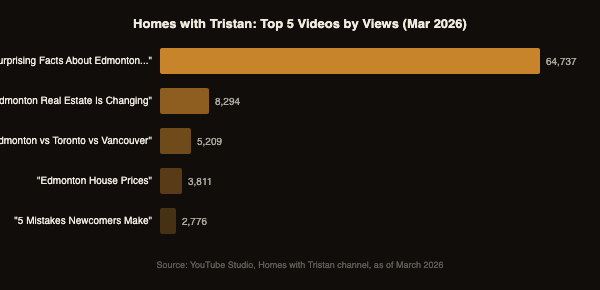 Homes with Tristan channel: top 5 videos by views as of March 2026. Source: YouTube Studio analytics.
What the Numbers Actually Show
Here's the raw data from my top five videos as of March 2026:
| Video | Views | Avg View Duration | Content Type |
|---|---|---|---|
| "5 Surprising Facts About Living in Edmonton..." | 64,737 | 4:45 | Relocation: counter-intuitive facts |
| "Edmonton Real Estate Is Changing - July 2025 Market Update" | 8,294 | 3:27 | Local market update |
| "I Compared Edmonton vs Toronto vs Vancouver | $500K Reality Check" | 5,209 | 5:43 | Relocation: comparison |
| "Edmonton House Prices: What You Can Actually Afford?" | 3,811 | 4:43 | Relocation: affordability |
| "Edmonton: 5 Mistakes Newcomers Make When Moving Here" | 2,776 | 7:36 | Relocation: mistakes/guidance |
A few things stand out here. The top video isn't just leading by a little. It has 8 times the views of the second-best video. The comparison content ("Edmonton vs Toronto vs Vancouver") has the highest average view duration at 5:43, which means people are watching almost the entire thing. The mistake/guidance content has the longest AVD at 7:36, confirming that people who want detailed, practical information will stay if you give it to them. The market update content, which is what most agents default to, has the lowest average view duration.
The Content Formula That Drives Relocation Views
Three patterns consistently produce higher views and longer watch time on my channel. I didn't invent these. They're structural properties of what makes relocation content work on YouTube.
Counter-intuitive or surprising framing
"5 Surprising Facts About Living in Edmonton" pulled 879,000 impressions and a 4.9% click-through rate. The word "surprising" does real work in a thumbnail. Ontario buyers who've already decided Edmonton might be affordable aren't clicking "Edmonton Home Prices" again. They click because they want to know what they're missing, what they haven't thought of yet. Counter-intuitive framing signals new information, and new information is the whole reason people are watching in the first place.
Direct comparison to where the viewer is coming from
The "$500K Reality Check" comparison video at 5,209 views has the highest average view duration of anything that isn't strictly a "mistakes/guidance" format. Comparisons work because the viewer already lives in one of the compared cities. The content is personally relevant in a way that generic market data isn't. "What can I get in Edmonton for my Toronto budget" is one of the most searched queries for Ontario buyers researching this move. A video that answers that exactly will rank.
Mistake and guidance formats with real specificity
The newcomer mistakes video has 7:36 average view duration on 2,776 views. That ratio matters as much as raw views. YouTube uses watch time as a quality signal, and 7:36 on a video with a modest view count still means the algorithm knows this content holds attention. The key is specificity: I'm not talking about generic moving tips, I'm talking about things that specifically trip up people making this specific move, from specific provinces. Vague advice doesn't hold watch time.

Why YouTube Works for This Audience When Social Doesn't
YouTube is a search engine. Someone in Hamilton, Ontario, is not scrolling Instagram and randomly discovering Edmonton real estate content. They're opening YouTube or Google and typing "moving to Edmonton from Ontario" because they're actually considering it. That intent signals a completely different kind of viewer. Social platform algorithms can surface you to people who weren't looking. YouTube mostly surfaces you to people who were. For relocation research, that's the right platform.
Real estate agents who use YouTube for market updates and listing promotions are mostly wasting the platform. Those videos have narrow audiences. The people who want to watch your market update are people who already know you, and they could just text you. YouTube's leverage comes from reaching people you've never met, in cities you'll never visit, who are in the exact research phase where a good video builds disproportionate trust. That's the relocation buyer. That's where the ROI is.
How to Apply This if You're Building a Channel
If you're an agent starting or building a YouTube channel, here's the question that matters: who is actively researching your market from somewhere else? Every mid-size Canadian city with affordability relative to Vancouver or Toronto has a relocation audience. Edmonton has a large one. Calgary has a massive one. Regina, Saskatoon, Halifax, Moncton: they all have versions of this audience because Ontario and BC buyers are priced out and looking.
Once you identify that audience, the content structure is the same everywhere. Answer the real questions they're actually searching. Use comparison framing where you can. Be specific about the things that are different from where they're coming from. Don't make market update content the core of your channel. And post consistently, because YouTube compounds on time in publishing much more than it compounds on production quality.
I put out a video today that'll still be getting views two years from now if it answers a question people keep searching. I can't say the same about a TikTok or an Instagram reel from the same day. That compounding is why I'm on YouTube, not primarily on short-form social.
Want to follow along as the channel grows?
I post every Friday. If you're an agent thinking about YouTube, subscribe. I'll be sharing what's working and what isn't as the numbers develop.
Subscribe on YouTubeFrequently Asked Questions
Do real estate YouTube channels actually generate leads?
Yes, when the content is built around real search intent. Generic content like market updates and listing tours generates minimal organic reach. Content that answers specific questions people are actively searching, especially relocation and comparison content, ranks on YouTube's search engine and keeps working after it's published. Listings with video receive 403% more inquiries than those without, according to RESimpli's 2025 video statistics report.
How long does it take for a real estate YouTube channel to start working?
Most agents see meaningful traction at 6 to 12 months of consistent publishing, provided the content targets real search queries rather than just social sharing. The compounding happens slowly at first: a well-structured video might get 200 views in its first month and 2,000 by month 12 as it accumulates search rank. Publishing volume and topic selection matter more than production quality in the early phase.
Why focus on relocation buyers instead of local buyers and sellers?
Relocation buyers actively search YouTube for months before making contact with an agent. That extended research phase means they're more likely to discover your content organically, more likely to watch deeply, and more likely to reach out already trusting you when they do. Local buyers and sellers rarely search YouTube for general real estate content. They call agents they already know or get a referral.
What content format works best for a real estate YouTube channel?
Mistake and guidance formats produce the highest average view duration. Comparison formats produce the highest discovery through search. Counter-intuitive or "surprising facts" framing produces the highest click-through rates from impressions. Market updates and listing tours produce the lowest organic reach. The best performing channels combine all three, with relocation and comparison content as the volume driver.
Is it too late to start a real estate YouTube channel in 2026?
No. Most markets in Canada are still early in terms of agent YouTube adoption. Edmonton is a good example: despite being a major city, there are very few agents publishing consistently on YouTube. The window for early-mover advantage is narrowing but still open in most mid-size Canadian markets. Starting now with a clear audience strategy is still more than viable.
Categories
Recent Posts