Moving to Edmonton from BC in 2026: Cost, Housing, and What to Expect | Homes with Tristan
Moving to Edmonton from BC in 2026: What You Actually Need to Know
I’ve worked with a lot of buyers relocating from BC, and the question I hear most is some version of: “Is Edmonton actually worth it, or is this just a price thing?” The honest answer is that it’s both — but the financial case is stronger than most people realize before they run the numbers. This post is for people who are seriously considering the move and want facts, not a sales pitch.
I’m going to walk you through what your money actually buys here, what the tax savings look like in real dollar terms, the neighbourhoods BC buyers tend to land in, and what the winters are honestly like. I’ll also cover the practical first-90-days checklist so you’re not scrambling after the moving truck leaves.
- Alberta has no property transfer tax. On a $600K purchase you save roughly $10,000+ compared to BC.
- $500K–$600K buys a fully detached home in Edmonton. In Greater Vancouver, that’s a condo with strata fees.
- No PST in Alberta — only 5% GST. BC charges 7% PST on top.
- Edmonton winters are genuinely cold. January averages -14C. Going in with eyes open makes it much easier.
- You have 90 days to get your Alberta driver’s licence and register your vehicle. BC health coverage carries you while AHCIP kicks in.
What Does $500,000 Buy in Edmonton vs BC?
In Greater Vancouver at the $500,000–$600,000 price point, you’re looking at a 1-bedroom or small 2-bedroom condo, and likely not in the city itself — more likely Langley, Surrey, or Abbotsford. On top of the mortgage, you’re paying strata fees anywhere from $400 to $700 a month, which is money out the door every month with no equity return. That’s $4,800 to $8,400 per year before you factor in special assessments.
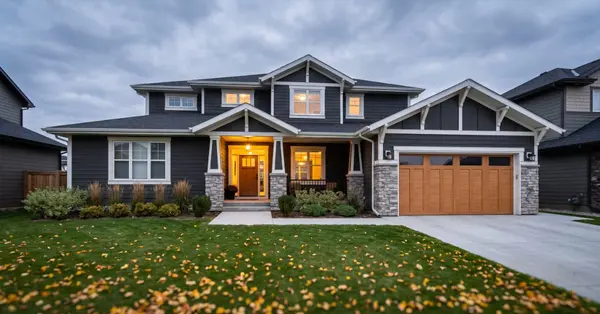
In Edmonton at $500,000–$600,000, you’re buying a fully detached home. We’re talking 1,400 to 1,700 square feet above grade, double attached garage as standard, typically a developed basement, and a 40 to 50-foot wide lot. No strata fees. No strata council. No one telling you what colour you can paint your door.
In my opinion, this is the most convincing single data point for BC buyers. It’s not just cheaper — it’s a fundamentally different type of asset. You’re getting a house, not a unit in a building.
The Tax Math: What Moving from BC to Alberta Actually Saves You
This is where the numbers get real.
Property Transfer Tax
Alberta has no provincial property transfer tax. When you buy a $600,000 home here, you pay a land title registration fee that works out to roughly $290. In BC, the property transfer tax on that same purchase is 1% on the first $200,000 ($2,000) plus 2% on the remaining $400,000 ($8,000) — a total of $10,000. That $10,000 difference is cash you keep on day one. On a $1,000,000 purchase the BC tax climbs to $18,000. On anything over $2,000,000 the rate jumps to 3%.
No Provincial Sales Tax
Alberta has no PST. Only 5% GST applies on applicable purchases. BC charges 7% PST on top of GST. On a $40,000 vehicle purchase, that’s $2,800 in PST that you simply don’t pay in Alberta. Over time, across furniture, appliances, vehicles, and major purchases, this adds up to a meaningful amount every year. (Note: Alberta does have provincial income tax — this isn’t a zero-tax province, but the consumption tax difference is real.)
Annual Property Tax
If you buy in Sherwood Park (Strathcona County), the 2025 mill rate was 7.4093, compared to Edmonton city’s 9.5914. On a $500,000 assessed home, that’s roughly $1,091 per year cheaper in Strathcona County than in Edmonton city. Both are still far below what you’d pay on a comparable property in Metro Vancouver.
Edmonton Neighbourhoods BC Buyers Are Choosing
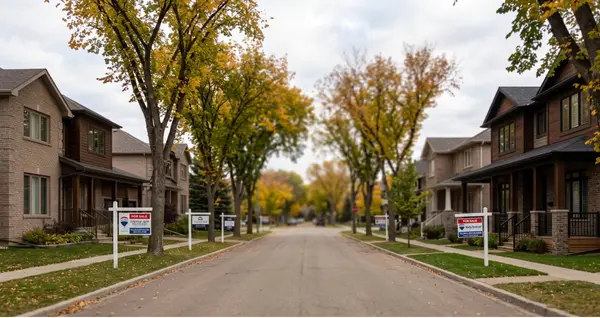
Not all of Edmonton is the same, and honestly, neighbourhood selection matters a lot. Here are the areas I see BC buyers gravitating toward most often.
Sherwood Park (Strathcona County)
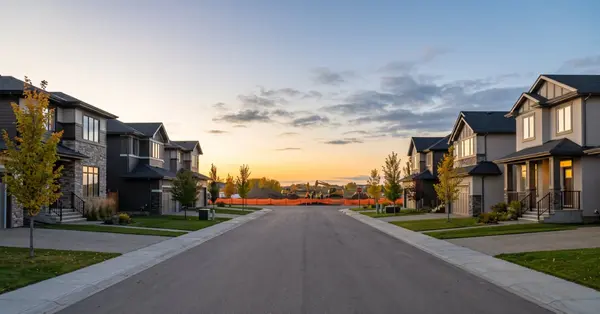
Sherwood Park is technically its own urban service area within Strathcona County, sitting just east of Edmonton city limits. Detached homes start in the $480K–$550K range with the full package: garage, basement, yard. The commute to downtown Edmonton is 20–25 minutes, the schools are well-regarded, and the lower Strathcona County property tax rate is a genuine annual savings. If you’re moving from a suburb of Vancouver, the lifestyle transition here is probably the smoothest.
Terwillegar (Southwest Edmonton)
Terwillegar is one of the best-established family neighbourhoods in southwest Edmonton. Detached homes run $550K–$750K depending on size and finish. You get direct access to the Terwillegar Park and the North Saskatchewan River ravine trail system — hundreds of kilometres of maintained trails for running, cycling, and cross-country skiing in winter. The Anthony Henday ring road makes getting across the city straightforward. Strong amenities, solid schools, and a neighbourhood that feels complete rather than still-being-built.
Glenridding Heights & Glenridding Ravine
These are newer builds (mostly 2010–2020) in the southwest, sitting right at the Henday for easy city access. Glenridding Heights sits in the $550K–$600K range for detached; Glenridding Ravine edges slightly higher at $625K–$675K. Some of the lots back directly onto ravine paths, which is rare at this price point anywhere. If you’re coming from somewhere like South Surrey or the Fraser Valley and want a newer home with a finished, polished feel, this area is worth a close look.
Windermere
Windermere is the premium option in southwest Edmonton — a master-planned community with newer builds, higher-end finishes, and easy access to the Henday and the airport. Entry-level detached starts around the low $600Ks, with the neighbourhood average for active listings around $1.6M. If you’re coming from West Vancouver or North Vancouver and the lifestyle there is what you’re used to, Windermere is the closest equivalent Edmonton has at the upper end. Strong commercial development nearby means groceries, restaurants, and services are all on your doorstep.
What the Weather Is Actually Like
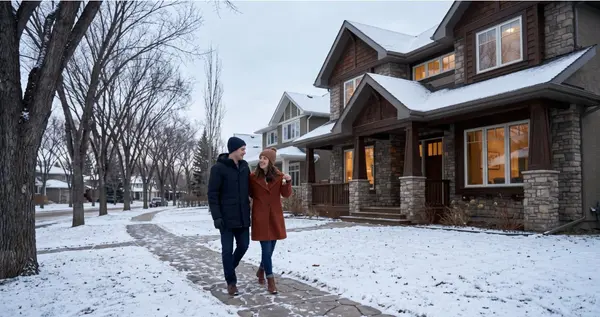
Honestly, I’m not going to sugarcoat this one. Edmonton winters are cold. January averages around -14C, and -20C to -30C days are regular throughout winter, not rare events. Snow typically runs from November through March, and some years you get a dumping in April. Edmonton is colder than Vancouver in winter, full stop.
That said, here’s what I’ve heard from almost every BC buyer I’ve worked with after their first winter: dry cold is genuinely different from wet cold. Vancouver’s 2C with rain and wind cuts through you. Edmonton’s -15C in bright sunshine, properly dressed, is actually manageable. The city is also extremely well-set-up for it — underground LRT stations, heated parkades, a downtown pedway system, and a culture where people just get on with it.
The summer is legitimately great. Edmonton averages 25–30C through July and August, with up to 17 hours of daylight in June. It’s warm, dry, and sunny. Edmonton actually gets more sunshine hours per year than Vancouver — by a significant margin.
And the Rocky Mountains are three hours away. Banff, Jasper, Canmore — all an easy weekend trip. If you’re coming from BC because you love the outdoors, you’re not giving that up. You’re trading a longer commute to the mountains for a much more affordable home base.
The Practical Stuff: AHCIP, Driver’s Licence, and Your First 90 Days
The admin side of a cross-province move has a learning curve. Here’s the sequence that works.
- 1
Register for AHCIP immediately on arrival
Head to an Alberta registry office and register for the Alberta Health Care Insurance Plan. Coverage typically begins the first day of the third month after you establish residency. Your BC MSP coverage generally continues for up to 90 days during the transition, so there’s usually no gap — but register early so there’s no risk.
- 2
Get your Alberta driver’s licence within 90 days
You have 90 days from establishing Alberta residency to exchange your BC licence for an Alberta one. Your BC driving history transfers directly. Bring your BC licence, proof of residency, and ID to a registry office. This is also where you register your vehicle.
- 3
Get an out-of-province vehicle inspection before registering
Before your BC-registered vehicle can be plated in Alberta, it needs an out-of-province vehicle inspection at an approved facility. Book this early in your first week. Most inspection shops can turn it around same-day or next-day. Once it passes, you can register and plate the vehicle at a registry office.
- 4
Understand the buying process before you start searching
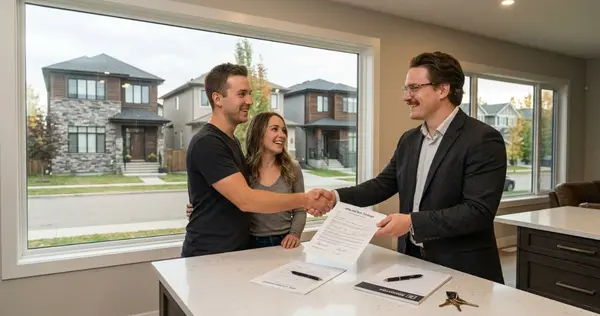
Alberta’s real estate process moves quickly once you find a home you want. After your offer is accepted, you’ll have a condition period of typically 7 to 10 business days to complete a home inspection ($500–$650) and confirm financing. Your deposit — usually $5,000 to $10,000 depending on purchase price — is due within the first 5 business days. All signing is done digitally via DocuSign. There’s no in-person signing requirement at any point.
- 5
Update your address and federal accounts
CRA, Service Canada, your bank, and your insurance provider all need your new Alberta address. CRA in particular — your province of residence on December 31 determines which provincial tax return you file for that year. If you move in July, you’ll be filing as an Alberta resident for that full year on your next return.
Thinking About Making the Move?
I work with BC buyers regularly — virtually at first, then in person once you’re ready to walk homes. Happy to answer questions, run neighbourhood comparisons, or just talk through whether the numbers make sense for your situation. No pressure, no pitch.
Book a Free Call →Common Questions from BC Buyers
Is there really no property transfer tax in Alberta?
Correct. Alberta has no provincial property transfer tax. You pay a land title registration fee based on the property value, which works out to roughly $290 on a $600,000 home. In BC on that same purchase you’d be paying over $10,000 in PTT. That’s money you keep in Alberta on day one.
Can I buy a home in Edmonton before I move?
Yes, and a lot of BC buyers do exactly that. I do live video walkthroughs with out-of-province clients so you can see the property in real time before committing to a trip. All offer and condition waiver signing is done digitally via DocuSign — there’s no requirement to be here in person at any stage of the transaction. Many clients finalize their purchase before they’ve ever set foot in Edmonton.
Does Alberta have provincial income tax?
Yes, Alberta has provincial income tax. What it does NOT have is a provincial sales tax (PST). You’ll often see Alberta described as a “low-tax province” and that’s accurate overall — but it’s the PST and property transfer tax that generate the biggest day-to-day savings for people moving here from BC.
What happens to my BC health coverage when I move?
Register for AHCIP (Alberta Health Care Insurance Plan) as soon as you arrive — go to any Alberta registry office. Alberta health coverage typically begins on the first day of the third month after you establish residency. BC MSP coverage generally continues for up to 90 days, which covers you during the waiting period. Register early to avoid any chance of a gap.
What are the best Edmonton neighbourhoods for someone coming from the Lower Mainland?
It depends on budget and lifestyle. If you want a newer community with strong amenities and easy ring-road access, southwest Edmonton (Glenridding, Terwillegar, Windermere) is where most BC buyers land. If you want slightly lower property taxes and a suburb feel, Sherwood Park is worth a serious look. St. Albert is a strong option if you have school-age kids and want a tight-knit community feel with good green space.
Categories
Recent Posts