How to Buy a Home in Edmonton: Step-by-Step Guide for 2026
How to Buy a Home in Edmonton: A Step-by-Step Guide for 2026
The buying process in Edmonton is more straightforward than most people expect. As of February 2026, the average detached home sits at $571,372 (WOWA, 2026). There is no provincial land transfer tax. The condition period gives you real time to inspect and confirm financing. And the market still has inventory. Coming from Ontario or BC, the difference in both price and process is significant.
This guide covers the actual Alberta process, step by step — not generic Canadian real estate content, but how it works here specifically.
- Edmonton’s average detached home price was $571,372 in February 2026 (WOWA, 2026).
- Alberta has no provincial land transfer tax. Ontario buyers pay $7,475 on a $550,000 purchase.
- The condition period in Alberta is typically 7–10 business days from accepted offer.
- Total closing costs in Edmonton typically run 1–3% of purchase price, excluding your down payment (CMHC, 2025).
Get Pre-Approved Before You Start Searching
Most buyers in Edmonton start looking at listings before they’ve talked to a mortgage broker. That’s the wrong order. A pre-approval locks in a rate for 90–120 days, tells you exactly what you can afford, and puts you in a position to write a confident offer when you find the right property (CMHC, 2026).
In 2026, you need to pass the federal mortgage stress test at either 5.25% or your contract rate plus 2%, whichever is higher. That number determines your ceiling — not your listed rate — so knowing it before you fall in love with a house at $100K over your ceiling saves a lot of frustration.
First-time buyers have two significant tools available. The First Home Savings Account (FHSA) lets you contribute $8,000 per year up to $40,000 lifetime. Contributions are tax-deductible and withdrawals for a qualifying home purchase are completely tax-free (Canada Revenue Agency, 2026). The RRSP Home Buyers’ Plan lets each person withdraw up to $60,000 — $120,000 per couple. Combined, these can move a serious amount of capital toward your down payment while lowering your tax bill at the same time.
In my experience, most buyers don’t realize how much the FHSA changes their first-year tax return until they see the actual number. Set it up before you start shopping. Even if you open it six months before you buy, that’s $8,000 in deductible contributions.
How the Offer Process Works in Alberta
When you find a property, your agent prepares a written offer. The offer includes the purchase price, your proposed possession date, and any conditions you’re placing on the sale. The condition period in Alberta typically runs 7–10 business days from the time the offer is accepted (RECA, 2025).
During the condition period, you’ll complete three things:
Budget $500–$650 for a qualified inspector. This is not optional on any property. An inspection isn’t just about finding problems — it’s about understanding exactly what you’re buying so there are no surprises after possession.
Your mortgage broker submits your file for final approval. Have all your documents ready before you write an offer so they’re not scrambling during your condition window.
If you’re buying in a condo corporation, this covers the financial health of the corporation, any pending special assessments, and the bylaws. Have a professional review these — not just a quick skim.
Your deposit is due within the first 5 business days of the accepted offer. Alberta accepts e-transfer, bank draft, wire transfer, Payload, or direct deposit — which method is accepted depends on the seller’s brokerage. Your agent confirms this before you write the offer. Know which account you’re pulling from before you write.
Everything is signed digitally via DocuSign. No in-person appointments, no notary visits, no office trips required at any stage. For out-of-province buyers, the whole process can run entirely remotely.
When conditions are satisfied, your agent sends a Condition Waiver. The sale goes firm. You’re buying the house.

What Does It Actually Cost to Close in Edmonton?
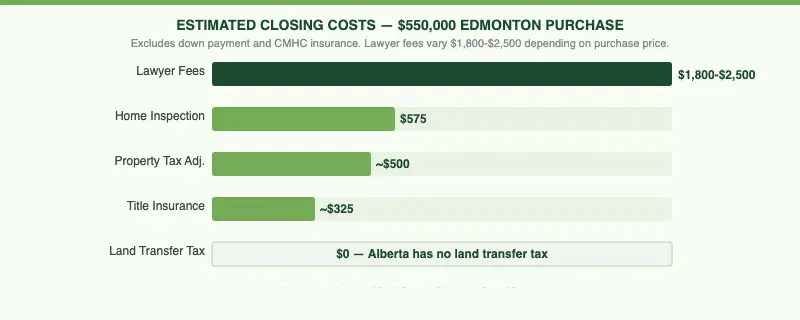
Total closing costs in Edmonton typically land in the 1–3% range of the purchase price, excluding your down payment (CMHC, 2025). Here is the honest breakdown for a $550,000 purchase:
| Closing Cost Item | Estimated Range | Notes |
|---|---|---|
| Home inspection | $500 – $650 | Not optional. Worth every cent. |
| Lawyer / notary fees | $1,800 – $2,500 | Varies with purchase price and complexity. |
| Title insurance | $250 – $400 | Often offered by the seller. |
| Property tax adjustment | ~$200 – $600 | Prorated to your possession date. |
| Alberta land transfer tax | $0 | No provincial land transfer tax in Alberta. |
| Estimated total | ~$2,750 – $4,150 | Roughly 0.5–0.75% for a $550K purchase. |
Source: CMHC (2025). Estimates only — confirm with your lawyer before closing.
The land transfer tax line is where Edmonton buyers get the clearest advantage over comparable Ontario markets. Alberta doesn’t have one. On a $550,000 purchase, Ontario’s tiered provincial formula produces $7,475 in land transfer tax before you’ve moved in a single piece of furniture. Toronto adds a second municipal tax on top of that.
Alberta vs Ontario — The Cost Difference That Surprises Most Buyers
This comes up in almost every conversation I have with buyers relocating from Ontario. Beyond land transfer tax, Alberta has no provincial sales tax. Only 5% GST applies, and only on new construction. Coming from Ontario’s 13% HST environment, this affects the cost of nearly every service and item you’ll buy after you move.
| Purchase Price | Alberta Land Transfer Tax | Ontario Provincial LTT | Savings in Alberta |
|---|---|---|---|
| $400,000 | $0 | $4,475 | $4,475 |
| $550,000 | $0 | $7,475 | $7,475 |
| $700,000 | $0 | $10,475 | $10,475 |
Provincial LTT only. Toronto buyers add municipal LTT on top at equivalent rates. Source: Ontario Ministry of Finance, 2026.
On a $550,000 purchase, buying in Edmonton instead of a comparable Ontario market saves $7,475 in provincial land transfer tax alone. On top of a purchase price difference that’s often $300,000–$600,000, the total financial advantage of Edmonton over Toronto or Vancouver is genuinely significant.
The process itself is similar to Ontario in structure: offer, condition period, firm sale, possession day. The differences are in the details. Alberta’s condition period tends to run 7–10 business days, the deposit is due within 5 business days, and digital signing is standard throughout. If you’ve bought in Ontario before, the Alberta process will feel familiar but faster.
After Your Offer Goes Firm — What Happens Next?
Once you’ve waived conditions, the sale is firm and your lawyer takes over the administrative work. Your lawyer handles the title transfer, reviews the Real Property Report (if included) to confirm lot boundaries, and works with your lender to fund the mortgage on possession day.
A final walkthrough is typically scheduled 1–2 days before possession day — not on possession day itself. This is your opportunity to confirm the property is in the same condition as when you wrote the offer, that any agreed-upon items are still included, and that no new damage has appeared.
On possession day, your lawyer registers the title transfer and your mortgage funds. Your agent picks up the keys and hands them to you. That’s it. The house is yours.
Thinking About Buying in Edmonton?
Whether you’re relocating from Ontario or BC, or buying locally, I can walk you through the process and help you find the right neighbourhood for your situation. Book a 15-minute call to start.
Book a Call with TristanFrequently Asked Questions
How long does buying a home in Edmonton typically take?
Most buyers are in their home within 7–12 weeks from starting the search. The condition period is 7–10 business days after offer acceptance. Possession typically follows 30–60 days after that. For out-of-province buyers doing virtual showings, the search phase can compress significantly.
What is the minimum down payment for a home in Edmonton?
The federal minimum is 5% on the first $500,000 of the purchase price, and 10% on any portion above that. For a $571,000 home, that’s $25,000 on the first $500K and $7,100 on the remaining $71K — a minimum of $32,100 plus CMHC insurance added to your mortgage. With 20% or more down, no CMHC premium applies.
Do I need a real estate agent to buy a home in Edmonton?
You don’t legally need one. In practice, buyer agent commissions in Alberta are paid by the seller, so working with an agent costs you nothing and you get someone reviewing contracts, negotiating, managing timelines, and coordinating inspections on your behalf. For out-of-province buyers especially, having an agent who knows specific Edmonton neighbourhoods is worth more than most people expect.
Can I buy a home in Edmonton without visiting in person?
Yes. FaceTime walkthroughs, DocuSign offers, inspection reports reviewed online. For buyers relocating from Ontario or BC, it’s entirely workable to handle the process before your physical move. The final walkthrough is scheduled near possession day. I’ve had clients from other provinces close without visiting until they picked up the keys.
What happens if my home inspection finds problems?
If the inspection reveals something significant, you have options: negotiate a price reduction, request the seller repair the issue before possession, or exercise your inspection condition and cancel the deal. The condition period exists specifically to protect you. A good inspection on a $550,000 home costs around $575. Don’t waive it to compete on an offer.
Categories
Recent Posts