Alberta vs BC Taxes: The Real Cost to Buy a Home in 2026 | Homes with Tristan
Alberta vs. British Columbia: The Real Financial Case for Buying in Edmonton Over Vancouver
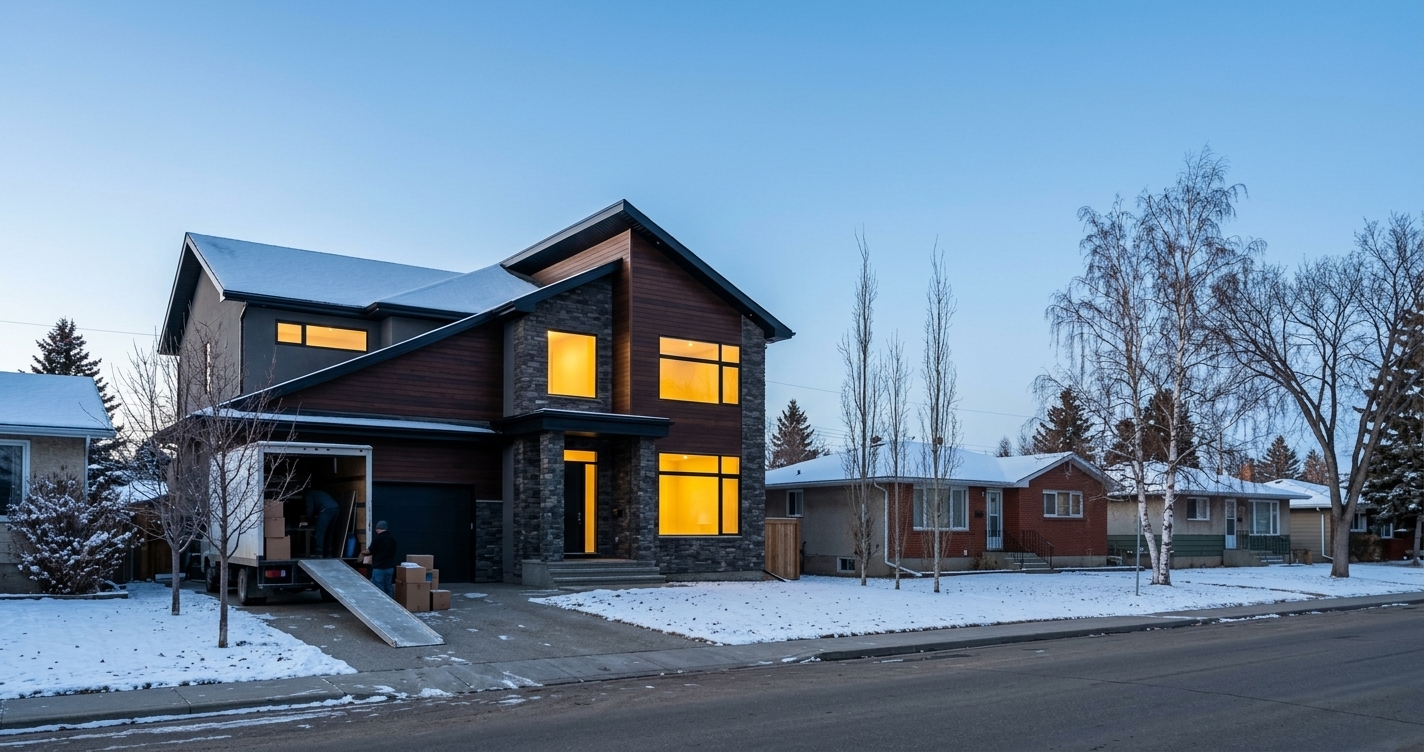
Every quarter, thousands of British Columbians pack a moving truck for Alberta. In the second quarter of 2025 alone, 8,931 people moved from BC to Alberta while 7,906 went the other way, a net gain of 1,025 in three months, and BC sent Alberta roughly 3,000 more people than it received back across all of 2025 (ICBA Economics, 2025). Ask most of them why, and you'll hear the same two lines: no provincial sales tax, and cheaper homes.
Here's what that answer usually gets wrong. I ran the actual 2026 tax brackets for both provinces, and at a typical household income, Alberta's famous income tax advantage barely shows up. It's real. It just kicks in a lot higher up the income scale than most people assume. In my opinion, the honest version of this comparison is more useful than "Alberta has no PST," so here's the full math: income tax, sales tax, the bill you get at your lawyer's office on closing day, and what the mortgage stress test actually does to your buying power in each province.
- Alberta's income tax advantage doesn't kick in until roughly $187,000 in income under 2026 brackets. Below that, BC's lower bottom-bracket rate can mean less provincial tax owed, not more (alberta.ca; gov.bc.ca, 2026).
- BC charges a combined 12% sales tax (7% PST plus 5% GST) on most goods and services. Alberta charges 5% GST only, with no PST at all (Province of British Columbia, 2026).
- BC's Property Transfer Tax runs roughly $8,000 to $22,000 or more depending on home price. Alberta has no land transfer tax of any kind.
- For a $95,000 household buying a $600,000 home, the combined tax and closing-cost gap favors Alberta by about $10,400 over five years, before counting the difference in home prices themselves.
Does Alberta Actually Have Lower Income Tax Than BC?
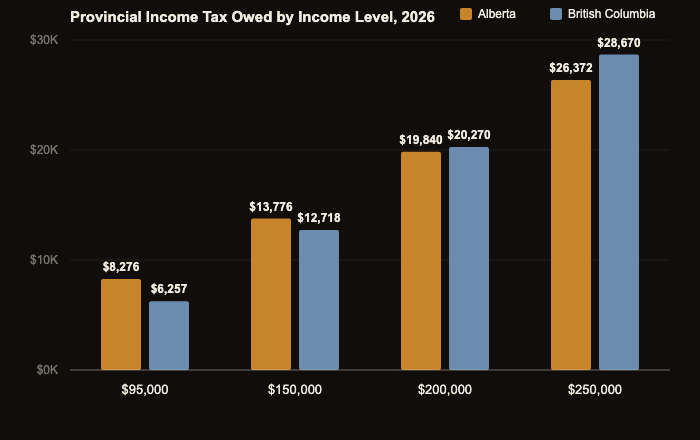
Not at every income level, no. Under the official 2026 brackets, a $95,000 earner pays about $8,276 in Alberta provincial income tax versus roughly $6,257 in BC, meaning Alberta actually costs about $2,019 more a year in provincial tax alone at that income (Government of Alberta; Government of British Columbia, 2026). That's the opposite of what most relocation content tells you.
The reason is bracket structure, not headline rates. BC's 2026 budget raised its lowest personal tax rate from 5.06% to 5.60%, still applying only to the first $50,363 of income. Alberta's lowest bracket starts at 8% on the first $61,200. A lower starting rate on a similar-sized first bracket means BC stays cheaper through most of the middle-income range, even after the 2026 increase.
I ran both bracket tables side by side across four income levels to find where that flips. The crossover sits at roughly $187,000 to $190,000 in taxable income. Below that line, BC residents generally owe less provincial income tax than an Alberta resident earning the same amount. Above it, Alberta's capped 15% top rate pulls ahead of BC's climb to 20.5%.
So if the income tax story is more complicated than the internet says, where does Alberta actually win? Three places: sales tax on everyday spending, the bill at your lawyer's office on closing day, and the price tag on the home itself.

How Much Do You Save With Alberta's Zero PST?
BC charges 7% Provincial Sales Tax on top of the 5% federal GST, a combined 12%, while Alberta charges GST only, at 5%, with no PST at all (Province of British Columbia, 2026). On $30,000 a year in PST-taxable spending, a reasonable estimate for furniture, vehicles, electronics, and non-grocery retail for a typical household, that's a real $2,100 saved annually just on the sales tax line, not counting anything related to the home itself.
PST doesn't apply to real estate transactions directly in BC. That's the Property Transfer Tax's job, covered next. But BC's 2026 budget widened where PST applies going forward: starting October 1, 2026, PST extends to certain professional services, including accounting, architectural, engineering, and non-residential real estate services (EY Canada, 2026). Alberta residents never see that line item, on any service, at any rate.
Isn't 7% a small difference? Not once you add it up across a year of ordinary purchases. On a new $35,000 vehicle alone, that's $2,450 in PST a BC buyer pays and an Alberta buyer doesn't, on top of whatever GST both provinces already charge.

What Does BC's Property Transfer Tax Cost That Alberta Doesn't Charge?
BC's Property Transfer Tax is calculated on a tiered scale: 1% on the first $200,000 of a home's fair market value, 2% on the portion from $200,000 to $2,000,000, 3% up to $3,000,000, and 5% above that (WOWA.ca, citing BC provincial rates, 2026). Alberta doesn't have a cheaper version of this tax. It has zero of this tax, full stop, at any price point.
On a $600,000 home, that's $10,000 owed to the BC government just to register the sale. On BC's average home price of roughly $950,000, it's about $17,000. Neither number shows up anywhere on an Alberta closing statement, whether the home costs $400,000 or $4 million.
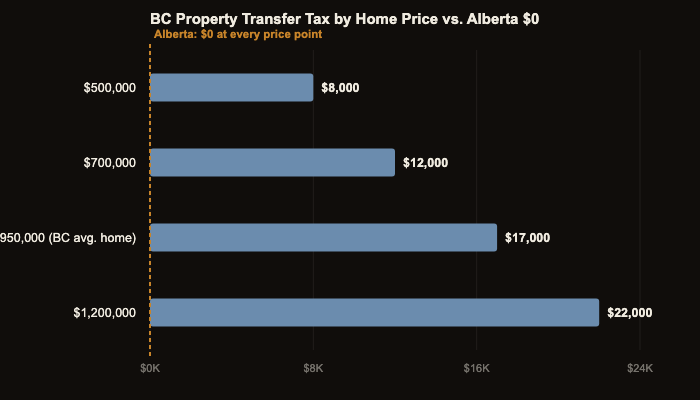
BC does offer a partial first-time buyer exemption up to a fair market value of $835,000, tapering out completely at $860,000, worth up to $8,000 in reduced tax (WOWA.ca, 2026). It helps, but it only applies once, to first-time buyers, under a specific price ceiling. Alberta's zero land transfer tax applies to every buyer, every time, at every price.
Home prices matter here too, and they compound this gap rather than offset it. A detached home that runs $950,000 or more around greater Vancouver often lists well under that around Edmonton and Sherwood Park. I've broken down exactly what specific price tiers buy across Edmonton, Toronto, and Vancouver in what $800,000 actually buys you in each city, so I won't repeat those numbers here. The short version: a lower purchase price shrinks BC's percentage-based PTT bill too, which is one more reason the gap between the two provinces rarely closes.
Does the Mortgage Stress Test Work Differently in Alberta Than BC?
No, it doesn't. The federal mortgage stress test is identical in every province: you have to qualify at the higher of your contract rate plus 2 percentage points, or 5.25% (OSFI B-20 guideline, confirmed unchanged as of January 2026). What's different isn't the math. It's what that qualifying number is able to buy once you cross the Alberta border.
I walk clients through this calculation on almost every pre-approval call, and the confusion is always the same: people assume the stress test is somehow easier in Alberta. It isn't. The lender runs the identical formula whether the property is in Kelowna or Sherwood Park.
Here's what that looks like with real numbers. Take a household earning $95,000 a year, roughly the midpoint of the range most BC-to-Alberta relocators are working with. As of August 2026, the best insured five-year fixed rates were running around 4.19% (Ratehub.ca, 2026), which puts the qualifying rate at 6.19% under the stress test.
- Gross monthly income: $7,917
- Maximum GDS payment (39%): $3,088, covering principal, interest, property tax, and heat
- Minus estimated property tax and heat: roughly $350 a month
- Available for principal and interest: about $2,738 a month
- Maximum qualifying mortgage at 6.19%, 25-year amortization: approximately $417,000
- Supported purchase price with a minimum 5% down payment: roughly $439,000
That qualifying power buys a real starter home in parts of Sherwood Park or Edmonton's outer neighbourhoods. In greater Vancouver, that same $417,000 mortgage barely covers a down payment on an average home. The test didn't change. The market it's being applied to did. For what that same buying power actually gets you room by room, the buyer's guide walks through the full offer and condition process once you've got a pre-approval in hand.
What's the Real Five-Year Savings From Moving to Alberta?
For a $95,000 household buying a $600,000 home, the honest five-year number is about $10,400 in Alberta's favor, and almost all of it lands in year one. That's the answer to a question most "Alberta has no taxes" content never actually runs the math on.
Here's how it breaks down. Alberta costs roughly $2,019 more a year in provincial income tax at this income, as shown above. Alberta saves roughly $2,100 a year in sales tax, using the $30,000 taxable-spending estimate from earlier. Those two nearly cancel out, netting Alberta only about $81 a year on an ongoing basis. The real money is the one-time $10,000 Property Transfer Tax a BC buyer would owe on that same $600,000 home and an Alberta buyer simply doesn't pay.
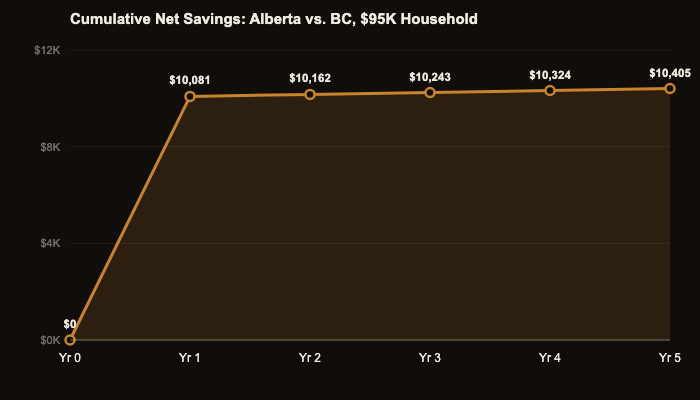
So is Alberta actually cheaper? Yes, just not for the reason most people repeat. The annual difference in income tax and sales tax is close to a wash at a $95,000 income. Where Alberta wins big is the closing table, and even more, the size of the mortgage you're not taking out in the first place because the home itself costs less.
Working through the numbers on a move from BC?
Every household's math looks a little different depending on income, down payment, and price range. Let's run your actual numbers before you list or start touring homes.
Talk Through Your NumbersFrequently Asked Questions
Does Alberta really have lower income tax than BC?
Only above roughly $187,000 in income. Below that, BC's lower bottom-bracket rate of 5.60% often means less provincial tax owed than Alberta's 8% starting rate, based on official 2026 brackets from both provinces.
How much is BC's property transfer tax compared to Alberta's land transfer tax?
BC charges 1% to 5% depending on price tier, roughly $10,000 on a $600,000 home. Alberta charges no land transfer tax at all, at any price, for any buyer.
What is BC's combined sales tax rate versus Alberta's?
BC charges a combined 12% (7% PST plus 5% GST) on most goods and services. Alberta charges 5% GST only, with no provincial sales tax.
Is the mortgage stress test different in Alberta than in BC?
No. The federal stress test formula, contract rate plus 2 percentage points or 5.25%, whichever is higher, is identical in every province. What differs is what your qualifying mortgage amount can actually purchase in each market.
How much can moving from BC to Alberta actually save a household over five years?
For a $95,000 household buying a $600,000 home, roughly $10,400 over five years, driven mostly by the one-time Property Transfer Tax savings rather than ongoing income or sales tax differences.
None of this needs an oversold pitch. The BC-to-Alberta case is real, it's just built on the closing table and the price tag, not a blanket "no taxes" claim that falls apart once you actually run someone's income through both bracket tables. If you're at the stage of comparing what your current home would fetch against what that budget buys here, a free home valuation is a reasonable next step before you run the rest of the numbers.
Categories
Recent Posts