Closing Costs in Edmonton: A Real $575K Example
Homes with Tristan: Buyer Finance Guide
Closing Costs in Edmonton: The Real Cash You Need for a $575K Home
By Tristan Boire, REALTOR | Park Realty, Sherwood Park AB
Closing costs in Edmonton catch more buyers off guard than almost anything else in the process. Everyone budgets for the down payment. Almost nobody budgets for the $4,500 to $7,500 in cash that shows up separately, from legal fees to land title registration to the property tax adjustment your lawyer hands you a few days before possession.
I want to walk you through exactly what that number looks like on a real Edmonton home, not a vague percentage. We'll use $575,000, which is close to the current average price of a detached home in Edmonton, and break down every line item so you know what to have in your account and when.
Key Takeaways
- • Budget $4,500–$7,500 cash for closing costs on a $575,000 Edmonton home, separate from your down payment (movefaster.ca; Alberta Land Titles Office, 2026).
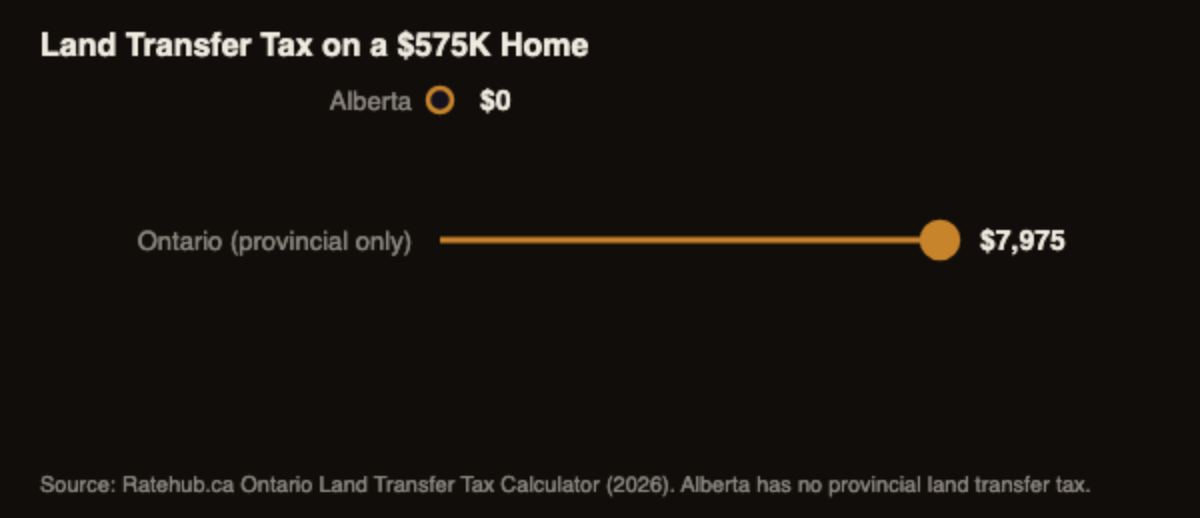
- • Alberta has no provincial land transfer tax. That alone saves $7,975 compared to an Ontario buyer on the same $575,000 purchase (Ratehub.ca, 2026).
- • If your down payment is under 20%, the CMHC insurance premium (up to 4.00% at 95% loan-to-value) gets added to your mortgage, not paid in cash at closing (CMHC, 2026).
- • Legal fees, inspections, and appraisals in Alberta carry 5% GST since there's no provincial sales tax here, a line item most buyers forget to add.
How Much Are Closing Costs in Edmonton?
Closing costs on an Edmonton home purchase typically run $4,500 to $7,500 in cash for a $575,000 resale property, separate from the down payment (movefaster.ca; Alberta Land Titles Office fee schedule, 2026). That range covers legal fees, registration fees, title insurance, inspection, and the property tax adjustment.
Most guides quote a general rule of "1.5% to 4% of the purchase price." That's fine as a gut check, but it's wide enough to be almost useless when you're actually wiring money before possession. I'd rather show you the real line items so you can build your own number instead of guessing.
If you're still working through what happens between an accepted offer and possession day, I covered that step by step in what actually happens after your offer gets accepted in Edmonton. Closing costs sit inside that timeline, not off to the side of it.
What's Actually in Your Closing Cost Bill?
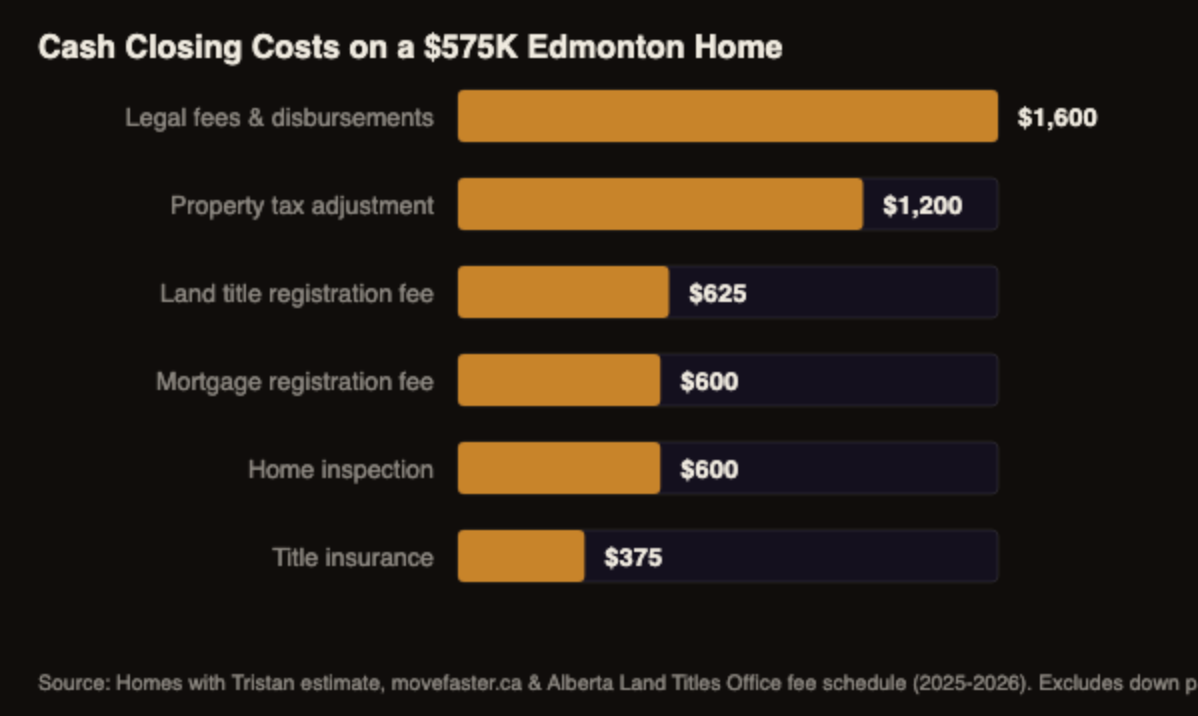
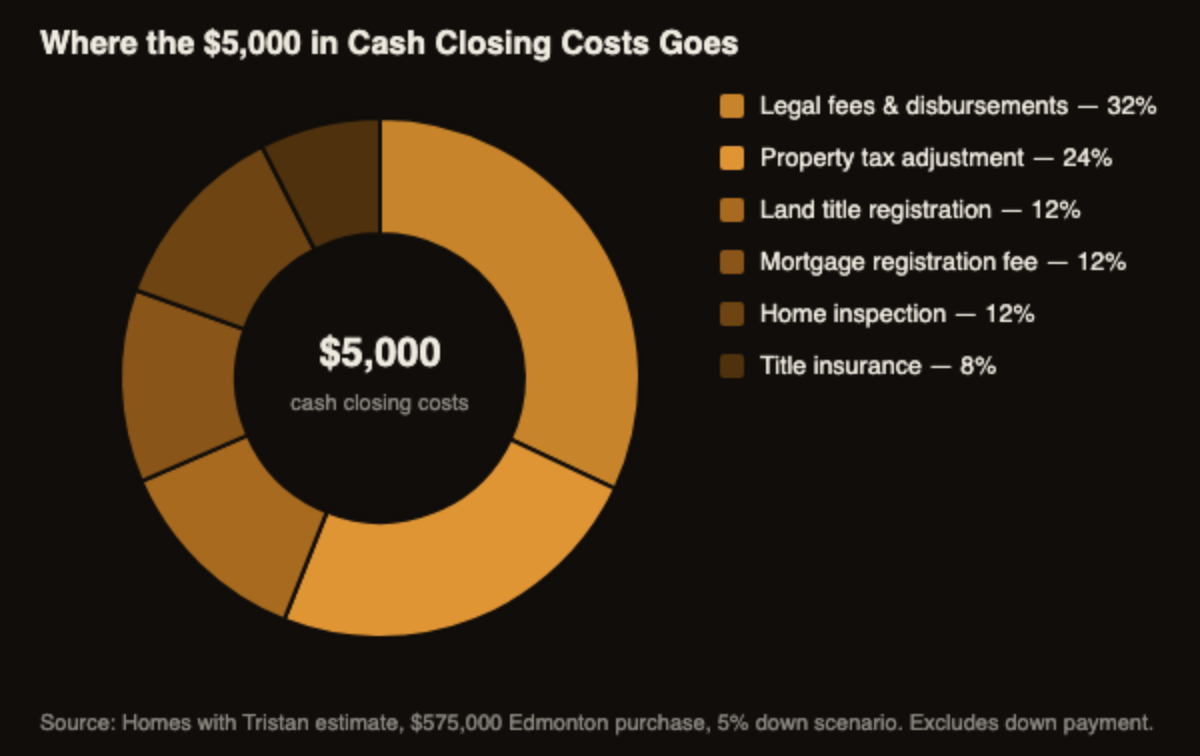
Six line items make up almost every dollar of your closing costs on a resale purchase. None of them are optional, and none of them are something your realtor pays for you, so it's worth knowing what each one is actually for before you see it on a statement of adjustments.

Legal fees and disbursements
Edmonton real estate lawyers typically charge $1,200 to $2,000 total for a standard purchase, combining their fee with disbursements like title searches, courier charges, and registration costs (movefaster.ca, 2025). Get a written quote early. It's the single biggest line item and the one with the most variation between firms.
Land title and mortgage registration fees
Alberta charges $50 plus $5 per $5,000 of value to register your land title, and the same formula applies to registering your mortgage (Alberta Land Titles and Surveys fee schedule, 2026). On a $575,000 purchase with a $546,250 mortgage, that's roughly $625 for the title and $600 for the mortgage registration.
Title insurance
A one-time premium, usually $250 to $500, that protects against title defects, survey issues, or fraud on the property (houseinaminute.com, 2026). Most Edmonton lawyers arrange this automatically and add it to your bill.
Home inspection
Budget $500 to $700 for a standard inspection during your condition period. This one gets paid before you're firm on the deal, not at the lawyer's office, so it's cash you need earlier than the rest of this list.
Property tax adjustment
If the seller already paid property tax for the year, you reimburse them for the portion covering your ownership. On a mid-year closing this often lands between $800 and $1,500, and it swings depending on the month you possess.
Buying a condo? Add an estoppel certificate fee, usually $200 to $400, on top of everything above. It's a small line, but it's an easy one to forget until it shows up.
Cash-to-Close on a $575K Edmonton Home: A Real Example
Add up every line item above and you land around $5,000 in cash closing costs on a $575,000 purchase. But that's not the full amount you need in your account before possession. Your down payment sits on top of it, and how much you put down changes the total more than anything else on this list.
A buyer putting 5% down on a $575,000 Edmonton home needs about $33,750 in total cash before possession: a $28,750 down payment plus roughly $5,000 in closing costs. The CMHC insurance premium is financed into the mortgage, not paid separately in cash.
That last point trips up more buyers than anything else in this article. If your down payment is under 20%, you're required to carry CMHC mortgage default insurance, and at 95% loan-to-value that premium runs 4.00% of the mortgage amount (CMHC, 2026). On a $546,250 insured mortgage that's roughly $21,850. It feels like it should be a cash cost. It isn't. CMHC adds it to your mortgage balance and you pay it off over the life of the loan, along with interest on it.
Here's how the two most common down payment scenarios actually compare in cash terms:
| Scenario | Down Payment | Cash Closing Costs | Total Cash Needed |
|---|---|---|---|
| 5% down | $28,750 | ~$5,000 | ~$33,750 |
| 20% down | $115,000 | ~$4,900 | ~$119,900 |
I built this table from a real $575,000 example rather than a generic percentage, because that's the question buyers actually ask me: not "what percent," but "what do I need in the account by Friday." The 20% down scenario avoids the CMHC premium entirely and comes with a slightly lower mortgage registration fee, which is why its cash closing costs land a touch below the 5% down scenario despite the much larger mortgage in the other direction.
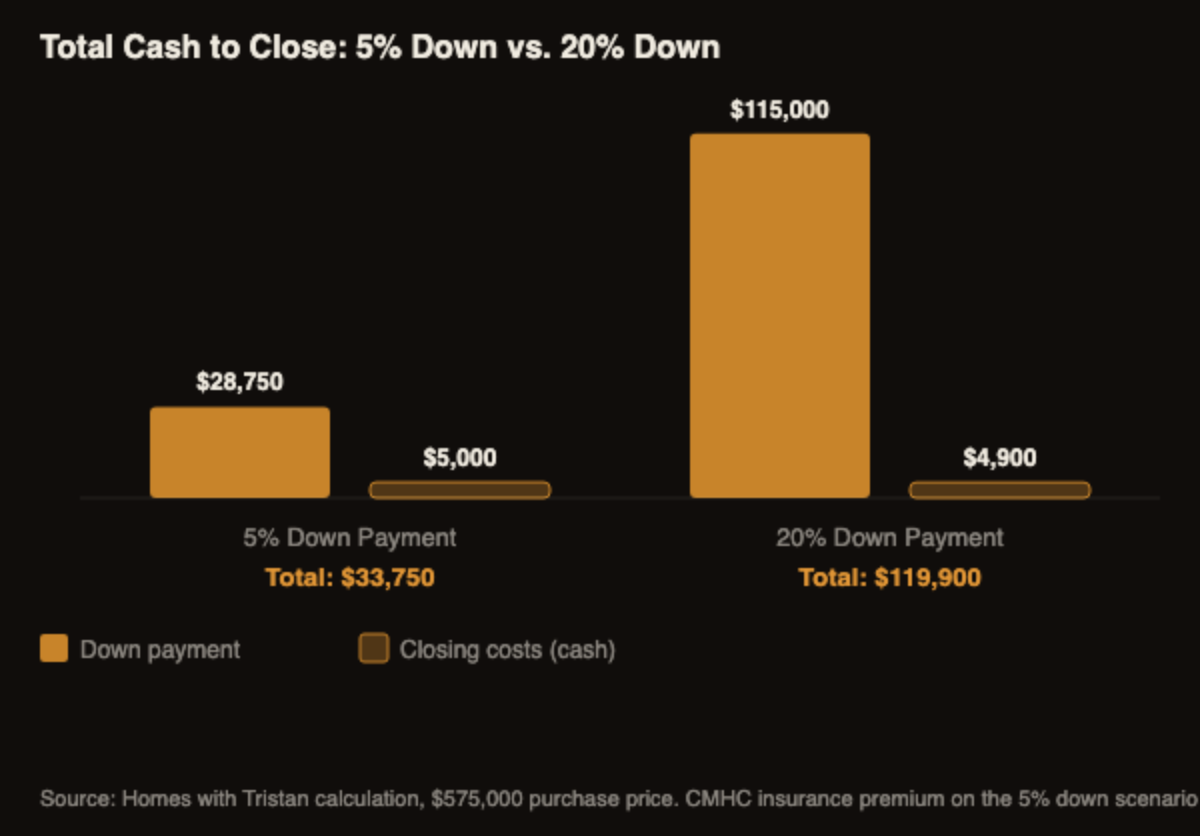
Notice the closing costs column barely moves between the two scenarios. It's the down payment that swings your total, which is exactly why so many buyers underestimate how much they need at 5% down and overestimate it at 20%.
If you're still building your down payment, the FHSA and RRSP Home Buyers' Plan combined strategy is worth reading before you set your target number, since it changes how much you actually need to save versus borrow.
Why Alberta Buyers Save Thousands Compared to Ontario
Alberta charges no provincial land transfer tax. On a $575,000 purchase, that's $7,975 an Ontario buyer would owe in provincial land transfer tax alone, a bill that never arrives here (Ratehub.ca, 2026). If that Ontario purchase happened to be in Toronto, add the municipal land transfer tax on top of it.

I hear this from almost every client relocating from Ontario or BC: they've already mentally budgeted for a land transfer tax bill in the thousands, and then it just isn't there. It's the single biggest structural reason Alberta's closing costs sit lower than most other provinces, well before you even get to the smaller line items.
That said, don't confuse "no land transfer tax" with "no tax at all." Alberta does have provincial income tax. What it doesn't have is a provincial sales tax, which matters for the next section.
The GST Line Nobody Mentions
Alberta charges 5% GST and no provincial sales tax on most purchases, including the professional service fees tied to closing. A $1,600 legal bill actually lands closer to $1,680 once GST is added, if it wasn't already built into the quote you received.

This is different from the GST conversation most buyers have already heard about, which is GST on the purchase price of a new-build home and the federal rebate that can offset it. That's a separate topic with its own math. If you're buying new construction, I broke that down fully in the first-time buyer GST rebate guide. What we're talking about here is the smaller, easy-to-miss GST that shows up on legal fees, inspections, and appraisals on any purchase, resale or new.
Ask your lawyer and inspector directly whether their quoted price includes GST. Most do, but I've had clients assume it was included when it wasn't, and that's an unpleasant $80 to $100 surprise on closing day.
When Do You Actually Pay These Costs?
Your deposit is due within the first 5 business days of an accepted offer, and the rest of your closing costs land with your lawyer just before possession day. These are two separate cash moments, not one, and I walk every client through both so nobody's caught short at either point.
In practice, here's the order I see it happen in: the deposit goes in first, usually by bank draft, wire, or e-transfer depending on what the seller's brokerage accepts. Then your home inspection gets paid during the 7 to 10 business day condition period. Once conditions are waived and the deal is firm, your lawyer takes over and the legal fees, registration fees, title insurance, and property tax adjustment all get finalized on one statement, due a few business days before possession.
- • Within 5 business days of accepted offer: deposit due, sent to the brokerage trust account
- • During the 7–10 day condition period: home inspection paid directly to the inspector
- • After conditions waived: lawyer engaged, legal fees and disbursements confirmed
- • A few business days before possession: remaining down payment and full closing cost statement due to your lawyer
Alberta deposits get placed into a licensed brokerage's interest-bearing trust account, not handed directly to the seller (Real Estate Council of Alberta, Real Estate Act Rules). That deposit isn't extra money on top of your down payment. It's the first installment of it, so don't double-count it when you're adding up your total cash needed.
For the full possession-day walkthrough, including what happens the morning keys change hands, I covered that separately in possession day in Alberta: what to expect.
Frequently Asked Questions
How much are closing costs in Edmonton?
Budget roughly $4,500 to $7,500 in cash for a resale home priced around $575,000, on top of your down payment. That covers legal fees, title insurance, land title and mortgage registration fees, home inspection, and the property tax adjustment (movefaster.ca; Alberta Land Titles Office, 2026).
Is the CMHC insurance premium part of my cash to close?
No. If your down payment is under 20%, CMHC charges a premium of up to 4.00% of the mortgage at 95% loan-to-value, but it's added to your mortgage balance, not paid in cash at closing (CMHC, 2026). Your lender finances it automatically.
Does Alberta have a land transfer tax like Ontario?
No. Alberta charges no provincial land transfer tax. A buyer purchasing a $575,000 home in Ontario pays $7,975 in provincial land transfer tax alone, a cost that simply doesn't exist here (Ratehub.ca, 2026).
Do I pay GST on closing costs in Edmonton?
Yes, on the service fees. Legal fees, home inspections, and appraisals in Alberta carry 5% GST since Alberta has no provincial sales tax. This is separate from GST on new-build purchase prices, which works differently and has its own rebate.
When do I actually need the cash in my account?
Your deposit is due within the first 5 business days of an accepted offer, and the rest of your closing costs land with your lawyer a few business days before possession. Budget for both moments, not just one lump sum at the end.
Know Your Number Before You Offer
Let's Build Your Real Cash-to-Close Number
Grab the Edmonton Budget Buyer's Guide for a full worksheet, or book a 15-minute call and I'll run your exact numbers with you.
Get the Buyer's GuideClosing costs aren't the scary part of buying in Edmonton once you can see them broken out line by line. What trips buyers up is guessing at a percentage and getting surprised. Build your number from the real items above, confirm it with your lawyer once you're under contract, and you'll walk into possession day knowing exactly what's leaving your account and when.
Categories
Recent Posts