30-Year Mortgages in Alberta: 2026 CMHC Rules
Homes with Tristan: Alberta Buyer Finance
30-Year Mortgages in Alberta: What the CMHC Rule Change Actually Means for First-Time Buyers
By Tristan Boire, REALTOR | Park Realty, Sherwood Park AB
First-time buyers in Alberta can get a 30-year amortization on an insured mortgage on any home purchase, and the insured-mortgage price cap now sits at $1.5 million, up from $1 million (Department of Finance Canada, effective Dec. 15, 2024). Those two changes are still in effect heading into 2026, and most of the buyers I talk to haven't run the actual math on what they mean for their own purchase.
I get some version of the same question almost every week: can I really put less than 20% down on a $1.2 million home, and does stretching my mortgage to 30 years actually save me money or just cost me more in the long run? Here's the real math, using Edmonton price points, not national averages. If you're earlier in the process, my full Edmonton buyer's guide covers the rest of the timeline from offer to possession.
- The insured-mortgage price cap rose to $1.5 million from $1 million on Dec. 15, 2024, and remains in effect through 2026 (Department of Finance Canada).
- Any first-time buyer, on any home purchase, can now access a 30-year insured amortization, not just on new construction.
- Minimum down payment is 5% on the first $500,000 and 10% on the portion above that, up to $1.5 million.
- Alberta buyers pay no provincial sales tax on their CMHC premium, unlike buyers in Ontario (8%), Quebec (9%), or Saskatchewan (6%).
What Actually Changed With CMHC's Mortgage Rules?
The federal government raised the insured-mortgage price cap to $1.5 million from $1 million, effective Dec. 15, 2024, and it's still the rule as of this writing (Department of Finance Canada). Before that, anyone buying above $1 million with less than 20% down couldn't get mortgage default insurance at all, meaning they needed a conventional 20% down payment no matter their income or credit.
The government's own release put a real number on it: on a $1.4 million home, the minimum required down payment dropped by up to $165,000 under the new rules. That's the difference between needing roughly $280,000 down under the old 20% rule and needing about $115,000 under the new tiered structure.
Who Actually Qualifies for a 30-Year Amortization?
Any first-time buyer qualifies for a 30-year insured amortization on any home purchase, and any buyer, first-time or not, qualifies if they're purchasing newly constructed property (Department of Finance Canada, 2024). Before this rule, 30-year amortizations on insured mortgages were only available on new builds, and only in limited cases.
That means a first-time buyer purchasing a 40-year-old resale bungalow in Westmount qualifies for the 30-year option just as easily as someone buying new construction in Glenridding. The "first-time buyer" and "new build" pathways are separate, and you only need to clear one of them.
What Counts as a First-Time Buyer Here
The federal definition is broader than people expect. You typically qualify if you haven't owned a home in the last four years, even if you owned one before that. I've had clients assume they're disqualified because they owned a condo a decade ago, and they're not. If it's been more than four years, it's worth checking your eligibility with your mortgage broker before you assume you don't qualify.
What's the Minimum Down Payment Now in Edmonton?
The minimum down payment is 5% on the first $500,000 of the purchase price and 10% on the portion above that, up to $1.5 million. Above $1.5 million, insured mortgages aren't available at all and you're back to a conventional 20% down payment.
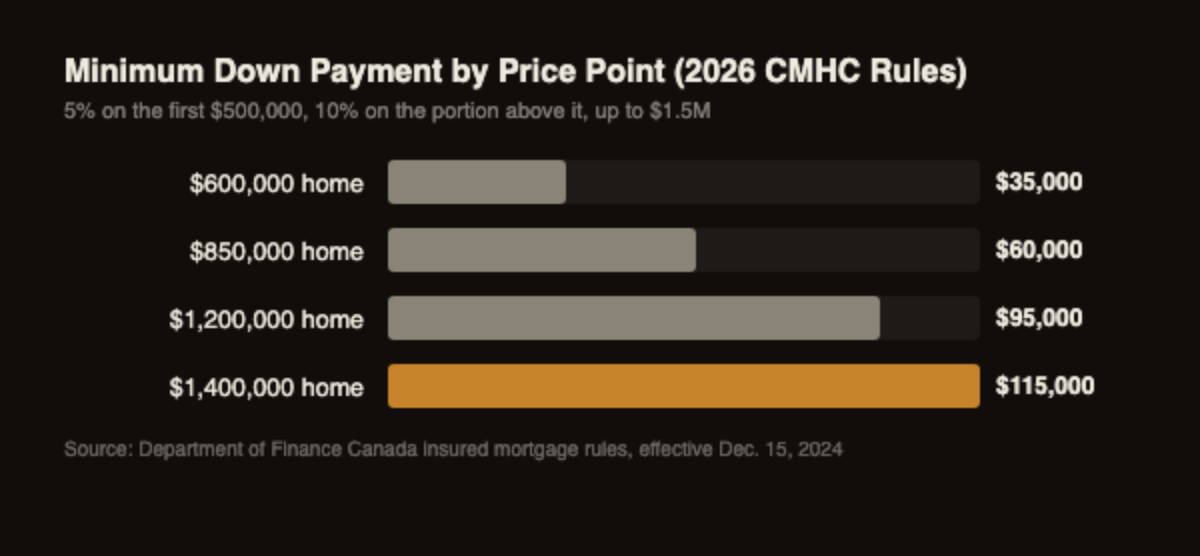
Run that against real Edmonton price points and it gets concrete fast. A $600,000 home, which covers a lot of what's available in Terwillegar or Keswick, needs $35,000 down. An $850,000 home needs $60,000. Push into the $1.2 million range, closer to a Donsdale or Quesnell Heights listing, and you need $95,000 down, still well short of the roughly $240,000 a conventional 20% down payment would require.
Windermere is where this rule change actually bites. The average active listing there runs around $1.6 million, just past the insured cap, but entry-level Windermere homes start in the low $600s, well inside it. If you're shopping Windermere specifically, whether you land above or below $1.5 million changes your entire down payment math, not just your monthly payment.
Does the 30-Year Option Actually Save You Money?
A 30-year amortization lowers your monthly payment but costs you more in total interest, and it carries roughly a 0.20% premium surcharge on top of your standard CMHC insurance rate. On a $500,000 mortgage at 4.04%, stretching to 30 years drops your payment from about $2,641 a month to about $2,389, a difference of roughly $252 a month.
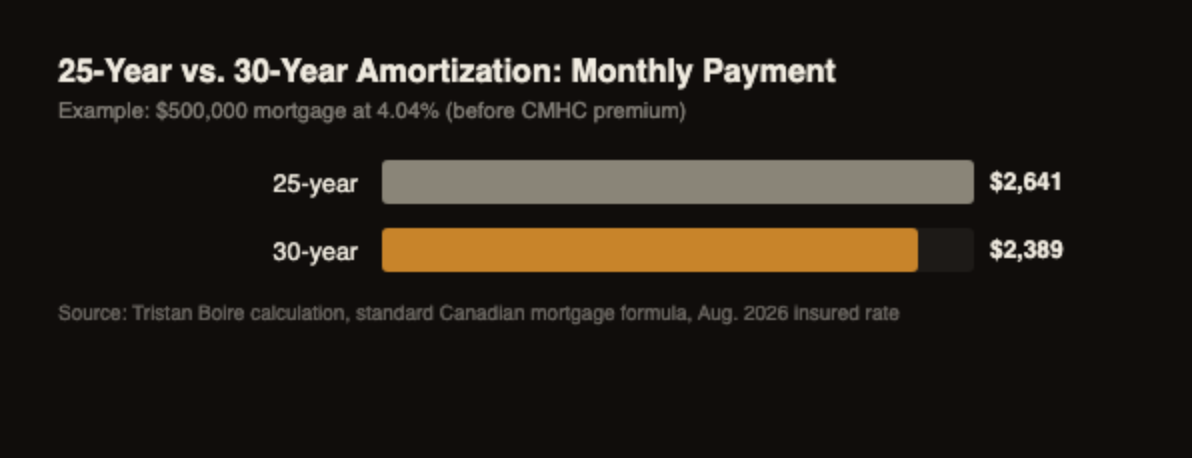
I've had first-time buyers take the 30-year option purely to get approved at all, since the lower payment can be the difference between passing and failing the stress test on a specific property. That's a legitimate reason to use it. What I push back on is using it just because it's available when the buyer could comfortably carry the 25-year payment. An extra five years of interest on a $500,000 mortgage adds up to real money, and it's worth running both numbers with your mortgage broker before you default to the longer term.
Your total insurance premium also depends on how much you put down, separate from the amortization surcharge. Insurers charge roughly 4.00% of the loan for a 5-9.99% down payment, dropping to about 2.80% once you're at 15-19.99% down. That premium gets added to your mortgage, so a smaller down payment doesn't just mean a bigger loan, it means a bigger loan at a higher premium rate too.
Do You Pay Extra Tax on Your CMHC Premium in Alberta?
No. Alberta charges no provincial sales tax on your mortgage default insurance premium, while Ontario charges 8%, Quebec charges 9%, and Saskatchewan charges 6% (nesto.ca). That tax has to be paid in cash at closing in the provinces that charge it, it can't be rolled into the mortgage.
This is one of the quieter cost differences for clients relocating from Ontario, and almost nobody mentions it. On a $600,000 home with 5% down, the CMHC premium runs roughly $22,000. An Ontario buyer pays an extra 8% of that in cash at closing, about $1,760, on top of everything else. An Alberta buyer pays zero. It's not a huge number next to land transfer tax savings, but it's one more line item that disappears the moment you move here.
How Does This Interact With the New GST Rebate?
The two federal programs share the same $1.5 million ceiling, but they're separate benefits that don't offset each other. The First-Time Home Buyers' GST rebate, which received Royal Assent on March 12, 2026, refunds up to $50,000 in GST on new-construction homes priced at $1 million or less, phasing out completely by $1.5 million.
If you're a first-time buyer purchasing new construction under $1.5 million, you could be eligible for the GST rebate, the 30-year amortization, and the higher insured cap all at once. I broke down exactly how the GST rebate math works, including who qualifies and how the phase-out actually calculates, in a separate guide to the first-time buyer GST rebate in Alberta, since it deserves its own full explanation.
Can You Actually Pass the Stress Test?
You need to qualify at the higher of your contract rate plus 2%, or 5.25%, and OSFI has confirmed that rate stays unchanged heading into 2026. Your lender also caps your gross debt service at 39% of income and total debt service at 44%, and CMHC insurance requires a minimum credit score of 600.
- Stress test rate: the greater of your contract rate plus 2%, or 5.25%, whichever is higher.
- GDS (gross debt service): housing costs capped at 39% of gross income.
- TDS (total debt service): all debt payments capped at 44% of gross income.
- Minimum credit score: 600 for a CMHC-insured mortgage.
Wondering why your pre-approval number feels lower than what you expected based on your take-home pay? The stress test is almost always the answer. It's calculated on the qualifying rate, not your actual contract rate, which is exactly why the 30-year option can move someone from failing to passing without changing anything else about the deal. I walked through the full income and stress test math, with real Edmonton examples, in my guide to how much income you need to buy in Edmonton.
Budgeting For Your Purchase
Not sure what you actually qualify for?
My Edmonton Buyer's Guide walks through down payment tiers, closing costs, and every step between an accepted offer and possession day.
Get the Buyer's GuideFrequently Asked Questions
Can first-time buyers in Alberta get a 30-year mortgage in 2026?
Yes. Any first-time buyer qualifies for a 30-year insured amortization on any home purchase, and any buyer qualifies on newly constructed homes (Department of Finance Canada). The rule has been in effect since Dec. 15, 2024, and remains active through 2026.
What's the minimum down payment on a $700,000 home in Edmonton?
$45,000: 5% on the first $500,000 ($25,000) plus 10% on the remaining $200,000 ($20,000). That's under the current insured mortgage rules, valid up to a $1.5 million purchase price.
Does choosing a 30-year amortization cost extra?
Yes, it carries roughly a 0.20% premium surcharge on top of your standard CMHC insurance rate. It lowers your monthly payment but increases the total interest paid over the life of the mortgage.
Do Alberta buyers pay tax on their CMHC insurance premium?
No. Alberta charges no provincial sales tax on the premium, while Ontario charges 8%, Quebec 9%, and Saskatchewan 6%, due in cash at closing in those provinces (nesto.ca).
Can I get an insured mortgage on a $1.6 million home in Windermere?
No. The insured mortgage cap is $1.5 million. Above that, you need a conventional mortgage with at least 20% down, regardless of whether you're a first-time buyer.
These rules move affordability more than most buyers realize, but they don't remove the need to run your own numbers. Talk to a mortgage broker before you fall in love with a listing, so you know your real down payment, your real payment at both amortization lengths, and whether the property even qualifies for insurance in the first place.
Categories
Recent Posts