Bridge Financing in Alberta: 2026 Costs
Homes with Tristan: Alberta Buyer Finance
Bridge Financing in Alberta: What It Is, When You Need It, What It Actually Costs
By Tristan Boire, REALTOR | Park Realty, Sherwood Park AB · Updated August 24, 2026
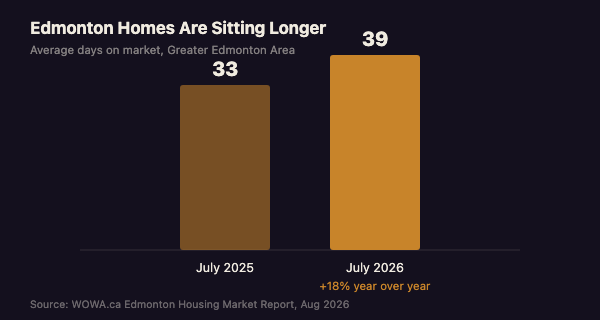
Greater Edmonton homes took an average of 39 days to sell in July 2026, six days longer than the same month a year earlier (WOWA.ca, 2026). That extra week matters more than it sounds like it should. It means more Edmonton buyers than usual are finding their next home before their current one has sold, and landing in exactly the spot bridge financing was built for.
This guide walks through what bridge financing actually is, when you genuinely need it, what it costs in real dollars at 2026 rates, and why Alberta lenders are asking harder questions about it this year. If you're weighing whether to buy before you sell your current home, this is the math you need first.
- • A $125,000, 60-day bridge loan in Alberta typically costs $1,700 to $2,500 in interest and fees at 2026 rates (WOWA.ca; HelloMortgage.ca, 2026).
- • You only qualify once your current home has a firm, unconditional sale, not just a listing.
- • Most Alberta bridge loans run 30 to 90 days; lenders rarely extend past 120 without it getting expensive.
- • Edmonton's slower market, 39 days on market in July 2026 versus 33 a year earlier, is pushing more move-up buyers into needing it (WOWA.ca, 2026).
What Is Bridge Financing, Exactly?
Bridge financing is a short-term loan that covers the gap when your new home's purchase closes before your current home's sale closes (WOWA.ca, 2026). It uses the equity sitting in your current home, equity you can prove exists but can't touch yet, to fund your new down payment or closing costs.
Think of it as a loan against money that's already yours. Your current home is sold. The buyer's financing is confirmed. You're just waiting on their possession date to actually receive the funds. A bridge loan closes that timing gap so you're not stuck choosing between losing your dream home or delaying your move.
It's not a second mortgage and it's not meant to last. Most lenders expect it repaid the moment your old home's sale funds land in your lawyer's trust account, typically within 30 to 90 days.

When Do You Actually Need Bridge Financing in Edmonton Right Now?
Greater Edmonton homes averaged 39 days on market in July 2026, up from 33 days in July 2025, as supply climbed and sales activity slowed (WOWA.ca, 2026). That shift matters directly here: the longer homes sit, the more likely your sale and your purchase won't line up on the calendar.
I've had more move-up clients ask me about bridge financing this summer than I did in all of 2025 combined. It's almost always the same story: they found the right house in Terwillegar or Windermere before their current place sold, and they didn't want to lose it waiting on a buyer.
Bridge financing isn't something every buyer needs. You genuinely need it when:
- • You found your next home before your current one sold. Common in a slower market where good listings still move fast.
- • Your home is firmly sold, but possession is later than your new purchase closes. A 60-day possession on your sale doesn't help if your purchase closes in 20.
- • You're relocating to Edmonton and buying before your old property closes. This comes up constantly with clients moving from Ontario or BC.
- • You don't have enough liquid cash to cover a new down payment while still carrying your current mortgage.
If your purchase closes on or after your sale, you don't need it. Same day or later, your sale proceeds are already there when you need them. It's only the overlap that costs you.
How Much Can You Actually Borrow?
Lenders typically advance up to 90% of your remaining home equity after subtracting your mortgage balance, real estate commission, and legal costs (True North Mortgage, 2026). On a typical Edmonton move-up, that number usually lands well above what you actually need.
Here's a real-numbers example using verified Edmonton price ranges, a seller moving from Terwillegar into an entry-level home in Windermere:
| Line Item | Amount |
|---|---|
| Terwillegar home, sale price | $650,000 |
| Less: outstanding mortgage | −$310,000 |
| Less: est. commission, legal, adjustments | −$34,000 |
| Available equity | $306,000 |
| Windermere entry-level home, purchase price | $625,000 |
| Down payment needed (20%) | $125,000 bridge loan |
This is an illustrative example, not a specific client's numbers, but the price ranges are real: Terwillegar detached homes run $550,000 to $750,000, and Windermere entry-level homes start in the low $600s. With $306,000 in available equity against a $125,000 need, this buyer has plenty of room. Most move-up buyers do. The bigger question is what that $125,000 actually costs to borrow.
What Does Bridge Financing Actually Cost in 2026?
On a $125,000, 60-day bridge loan in Alberta, expect $1,120 to $1,942 in interest alone, depending on your lender and rate tier, calculated against the Bank of Canada prime rate of 4.45% as of August 2026 (WOWA.ca, 2026).
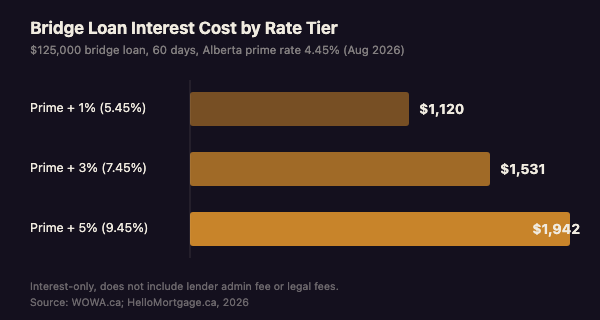
Bridge loan rates in Alberta run from prime plus 1% at the low end, usually your own bank or credit union if you're bringing them your new mortgage too, up to prime plus 5% with alternative lenders who care more about your equity than your credit score. On top of interest, budget for a lender admin fee (typically $100 to $500) and a legal fee for registering the second charge on your home (typically $200 to $300).
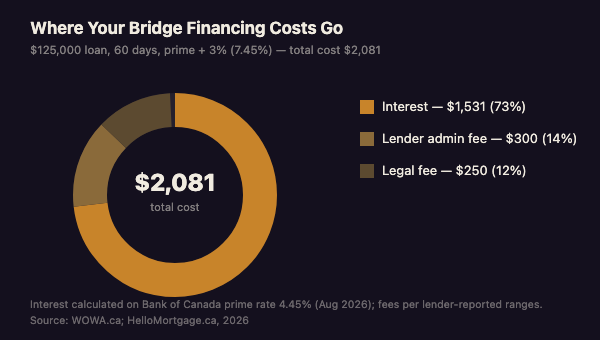
You'll see "$1,000 to $2,000" quoted as the typical total cost of bridge financing on a lot of mortgage sites. That figure is a little dated for 2026. With prime sitting at 4.45%, the middle-of-the-road scenario above lands closer to $2,081 all-in, and the higher-rate scenario pushes past $2,400. Run the actual math against today's prime rate before you budget for it, not an average from a few years back.
Why Alberta Lenders Are Asking Harder Questions This Year
Lenders across Alberta tightened approval criteria and increased scrutiny on debt-service coverage starting in early 2026, favouring low-risk, conventional borrowers over riskier files (BrightCap Financial, 2026). For an everyday move-up buyer, that translates into a simple reality: your lender wants proof you can carry both properties, even briefly, before they'll sign off.
What's changed in practice is how firm "firm sale" needs to be. A few years ago, some lenders would work with a strong offer that still had minor conditions outstanding. In this environment, I'm seeing underwriters push back on anything short of a fully unconditional, subject-free sale agreement. If your buyer still has financing or inspection conditions on the table, don't count on bridge financing being approved yet, even if the deal looks solid.
This is also why timing your condition removal matters more than it used to. The sooner your buyer waives conditions on your sale, the sooner you can actually apply.
How Do You Qualify for Bridge Financing in Alberta?
You qualify by showing your lender a firm, unconditional sale agreement on your current home and an accepted purchase agreement on your new one; without both, most lenders won't even start the file (WOWA.ca; Sunlite Mortgage, 2026).
- • A firm, unconditional sale on your current home. Listed doesn't count. Conditionally sold doesn't count either.
- • An unconditional purchase agreement on your new home.
- • Enough remaining equity. Most lenders want at least 20% left once selling costs are deducted.
- • Reasonable credit and proof you can carry both mortgages briefly if the sale is delayed. Alternative lenders are more flexible here, at a higher rate.

Buying Before You Sell?
Let's Figure Out Your Actual Numbers
Every equity, timeline, and lender situation is different. Grab the Edmonton Budget Buyer's Guide or book 15 minutes with me and we'll map out whether you actually need bridge financing, or a cheaper option gets you there.
Get the Buyer's GuideBridge Financing vs. Your Other Options
Bridge financing isn't the only way to cover the gap between closing dates. A HELOC on your current home, a rent-back arrangement with your buyer, or simply negotiating a longer possession date can sometimes cost less, but each comes with its own trade-offs.
- • HELOC: Usually cheaper interest, but you need it set up before your home sells, and not every lender allows it once you're firm on a sale.
- • Rent-back after closing: You sell, close, then rent your old home back from the new owner for a few weeks. No bridge loan needed, but not every buyer will agree to it.
- • Negotiating a later possession on your sale: The cleanest fix when it's possible, but it depends entirely on what your buyer needs.
In my experience, most Edmonton move-up buyers end up with bridge financing anyway, simply because it's the option that doesn't depend on someone else agreeing to anything. It costs more, but it puts the timeline in your hands.
There's also a timing piece people miss. A HELOC has to be arranged before your current home sells, sometimes before it's even listed, because most lenders won't set one up once you're firmly under contract to sell. If you think there's any chance you'll need extra flexibility, ask your mortgage broker about a HELOC early, well before you're negotiating possession dates on two properties at once.
Frequently Asked Questions
How long does bridge loan approval take in Alberta?
Once you have a firm, unconditional sale agreement and an accepted purchase agreement, approval can happen in a few days to about a week. Most lenders in Alberta cover terms from 30 to 90 days, occasionally up to 120 (WOWA.ca, 2026).
Can I get bridge financing before my home is sold?
No. Lenders require an unconditional sale agreement on your current home, not just an active listing. Without proof the sale is firm, most Alberta lenders will not approve a bridge loan file (Sunlite Mortgage, 2026).
Do I make monthly payments on a bridge loan?
Usually not. Interest is typically calculated for the full bridge period and paid as a closing cost through your lawyer once your old home's sale funds arrive, rather than as ongoing monthly payments (True North Mortgage, 2026).
What's the difference between bridge financing and a HELOC?
A HELOC is set up in advance against your home's existing equity and can carry lower interest, often near prime. Bridge financing is arranged after you have a firm sale, is short-term by design, and typically costs prime plus 1% to prime plus 5% (WOWA.ca, 2026).
Is bridge financing worth the cost?
For most move-up buyers, yes. Paying $1,700 to $2,500 to secure the right home without losing it to another buyer is usually cheaper than the alternative: settling for a different property or missing out entirely in a market where good listings still move quickly (WOWA.ca; HelloMortgage.ca, 2026).
Bridge financing isn't complicated once you've seen the real numbers. It's a short, expensive-feeling loan that solves a very specific problem: your timing, not your equity. If you're weighing a move in one of Edmonton's move-up neighbourhoods, run your own numbers before you assume you'll need it. A lot of buyers don't, and the ones who do usually come out ahead for having asked early.
Want a second set of eyes on your specific timeline? Download the Edmonton Budget Buyer's Guide or reach out and we'll walk through it together.
Categories
Recent Posts