What Does $700K Buy You in Edmonton Right Now? A Neighbourhood-by-Neighbourhood Breakdown | Homes with Tristan

Homes with Tristan: Edmonton vs Alberta
Edmonton vs Calgary: What $700K Gets You in Each City Right Now
By Tristan Boire, REALTOR | Park Realty, Sherwood Park AB | May 27, 2026
One of the questions I get constantly from people considering a move to Alberta is whether they should pick Edmonton or Calgary. Both cities have strong cases. Both are growing. Both have no provincial land transfer tax. But they're different markets, and $700K means something different in each one.
This isn't a "which city is better" post. That's too personal to answer for someone else. This is a direct comparison of what $700K actually buys you in each city right now, based on current MLS benchmark data from RAE and CREB. Make your own call from there.
Key Takeaways
- →Edmonton's composite HPI benchmark is $431,900 (RAE/CREA, April 2026). At $700K you're 62% above the typical Edmonton home.
- →Calgary's detached benchmark is $745,400 (CREB, April 2026). $700K buys below the average Calgary detached home.
- →Both Alberta cities have no provincial land transfer tax. A $700K purchase saves $9,975+ vs Ontario regardless of which city you choose.
- →Edmonton prices are up 1.8% YoY; Calgary's overall benchmark is down 3.5% YoY (April 2026). Edmonton is currently outperforming on both value and price momentum.
Where Does $700K Sit in Each Market?
The single most useful number in any city comparison is the HPI benchmark price. It measures the price of a typical, median-quality home as tracked monthly by each city's real estate board. It's far cleaner than average list price for apples-to-apples comparison.
Edmonton's composite HPI benchmark was $431,900 in April 2026 (RAE/CREA). Calgary's overall composite was $568,800, and Calgary's detached-only benchmark was $745,400 (CREB, April 2026). What that means in practice: $700K puts you 62% above Edmonton's composite benchmark. In Calgary, $700K is above the overall average but still below the typical detached home.
Edmonton's composite HPI benchmark was $431,900 versus Calgary's detached benchmark of $745,400 (RAE/CREA and CREB, April 2026). A buyer with a $700K budget sits 62% above Edmonton's composite average, while that same budget falls short of buying a typical Calgary detached home. Equal purchasing power produces very different market positions depending on which city you choose.
What Does $700K Actually Get You in Edmonton?
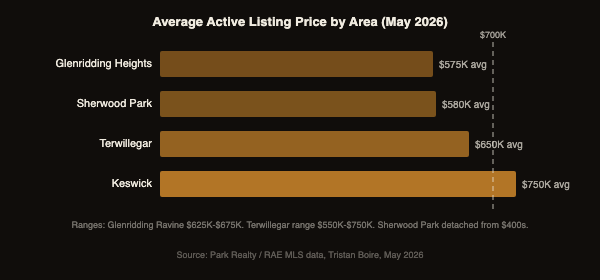
At $700K in Edmonton you're choosing from: Terwillegar (range $550K–$750K), Keswick (average $750K, so $700K is below average but active inventory exists), Glenridding Heights (~$575K average, so $700K is comfortably above), Glenridding Ravine ($625K–$675K range), and Sherwood Park (range $400K–$750K with plenty of options mid-range). Windermere entry-level starts from the low $600Ks, so $700K gets you in there as well.
In physical terms: two-storey detached home, 1,800 to 2,400 square feet is realistic, double attached garage, finished basement in many cases, and a lot size that would cost significantly more in comparable Toronto suburbs. These aren't compromise homes. They're good family houses in established or newer communities.
The buyers I work with who came from the GTA tell me the same thing consistently: they expected to make compromises and they didn't. $700K in Edmonton lets them stop sharing walls with neighbours and start having a proper yard. That shift matters to people who've been in condos or semis for years.

What Does $700K Actually Get You in Calgary?
Calgary's overall HPI benchmark was $568,800 in April 2026 (CREB), but the detached-specific benchmark was $745,400. That's the number that matters for buyers targeting a single-family home. $700K is $45,400 short of the typical Calgary detached. You're not buying above average in Calgary's detached market at $700K — you're buying below it.
Communities in Calgary's $650K–$750K range include established suburban areas in the southeast and northwest, and some newer developing communities further from the city centre. Inner-city Calgary (Killarney, Altadore, Bankview, Marda Loop) typically runs $900K and up for detached homes. At $700K you're in the outer ring, not the walkable inner-city neighbourhoods that draw many buyers to Calgary.
On appreciation: Calgary had a strong run in 2022 through 2024, driven by interprovincial migration and private sector growth. That narrative has shifted. Calgary's overall benchmark is down 3.5% year-over-year as of April 2026 (CREB). Edmonton's average residential price is up 1.8% over the same period. Right now, Edmonton is outperforming Calgary on both value and price momentum.
Taxes, Costs, and Other Practical Differences
Both cities share the Alberta land title transfer fee instead of a provincial land transfer tax. On a $700K purchase, that fee runs approximately $484 in both cities. The saving versus Ontario (outside Toronto at ~$9,975 LTT, or Toronto with both taxes at over $19,000) applies equally regardless of which Alberta city you choose.
Property taxes differ. Edmonton's 2026 residential mill rate is 0.76% (City of Edmonton approved a 6.9% increase for 2026). Calgary's rate is generally lower per dollar of assessed value. On a $700K home, the annual tax difference between the two cities could be in the $500–$1,000 range. Not a dealbreaker, but worth factoring into total monthly carrying costs when you're comparing cities side by side.
Both cities are cold in winter. Both have strong job markets. Calgary skews more oil-and-gas corporate; Edmonton skews more government, healthcare, and education. Which job market fits you depends entirely on what you do. Neither city wins on every dimension.
The honest summary: Edmonton wins on both measures right now. You get more home for $700K, and the market is currently appreciating faster. The story that Calgary always outperforms Edmonton on price growth was true in 2023 and 2024. It isn't in 2026. Buyers who choose Calgary over Edmonton for appreciation reasons should run the current numbers, not the old narrative.

Considering Edmonton?
Get the Edmonton Budget Buyer's Guide
Neighbourhoods, price ranges, the Alberta buying process, and what to expect. Free download from Tristan Boire at Park Realty.
Get the Free GuideFrequently Asked Questions
Is Edmonton or Calgary cheaper for real estate in 2026?
Edmonton is significantly cheaper. Edmonton's composite HPI benchmark was $431,900 in April 2026 (RAE/CREA) vs Calgary's overall benchmark of $568,800 and detached benchmark of $745,400 (CREB). For the same $700K budget, Edmonton delivers a well-above-average home; in Calgary, $700K buys below the average detached.
Does Calgary have better real estate appreciation than Edmonton in 2026?
Not right now. Calgary's overall benchmark was down 3.5% year-over-year in April 2026 (CREB). Edmonton's average residential price was up 1.8% over the same period. Calgary had strong appreciation in 2022–2024. In 2026, Edmonton is the stronger performer by both value and current price momentum.
Do I pay land transfer tax in Calgary?
No. Neither Calgary nor Edmonton has a provincial land transfer tax. Alberta charges a land title transfer fee instead, which runs approximately $484 on a $700K purchase. This applies in both cities. It's one of the clearest financial advantages of buying in Alberta over Ontario or BC.
Which city is better for families moving from Ontario: Edmonton or Calgary?
Both are strong choices with good schools, safe communities, and family-oriented suburban infrastructure. Edmonton offers more home for the dollar at $700K and is currently appreciating faster. Calgary offers slightly more inner-city walkability and private-sector job diversity. The right answer depends on where you work and your lifestyle.
Are property taxes higher in Edmonton or Calgary?
Edmonton runs higher. Edmonton's 2026 residential mill rate is 0.76% (City of Edmonton approved a 6.9% increase for 2026). On a $700K home that's approximately $5,320/year or $443/month. Calgary's residential mill rate is generally lower per dollar of assessed value. On equivalent homes, the annual difference is roughly $500–$1,000.
Categories
Recent Posts