Edmonton Fall Housing Market 2026: What September Changes
Edmonton Fall Housing Market 2026: What September Really Changes for Buyers and Sellers
Edmonton sales dropped 15.4% from July to August this year, the steepest single-month drop of the summer, while inventory sat 15.1% higher than the same month in 2025 (Realtors Association of Edmonton, September 2026). If you're trying to decide whether to make an offer or list your house this September, that combination changes the math more than most people assume.
Most "fall market update" content is generic filler that could apply to any city in Canada. This one is not. Every number below comes straight from RAE's own monthly releases, and it walks through exactly what shifts as summer turns to fall in Edmonton, what buyers can actually use as leverage right now, and what sellers need to know before they decide to wait for spring.
- Edmonton sales fell 15.4% month over month in August 2026, to 2,143, while inventory ran about 15% higher than a year earlier (RAE, September 2026).
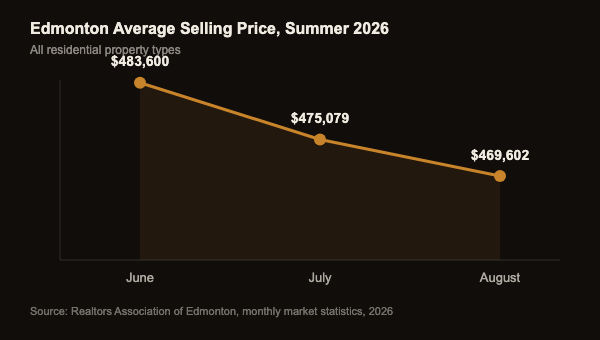
- Average price has slipped three straight months, from $483,600 in June to $469,602 in August, a $14,000 pullback (RAE, 2026).
- Buyers have real room to negotiate this fall: 3.8 months of supply and homes averaging 41 days on market across Edmonton in August.
- Fall hasn't reliably meant a rebound here. September and October 2025 sales kept falling month over month instead of bouncing back.
- Sellers pricing within a few percent of the $426,900 HPI benchmark are still moving homes on a normal timeline, even with inventory rising.
Is Fall Actually a Good Time to Buy or Sell in Edmonton?
Fall 2026 favors buyers more than it has in years. Edmonton's average sale price fell to $469,602 in August, down 1.1% from July and down roughly $14,000 since June, while sales dropped 15.4% that same month (Realtors Association of Edmonton, 2026). For sellers, that means pricing matters more than timing does. For buyers, it means real leverage that spring shoppers simply didn't have.
Board Chair Darlene Reid put it plainly in RAE's August release: "A slow-down in activity has continued as autumn approaches, reflecting normal seasonal trends... Supply is ample, but unless demand keeps up, we are likely to see downward pressure on prices beyond the usual seasonal patterns." That's not a sales pitch. That's the association that runs the MLS system for this city telling its own members what's happening.
So what does that mean if you're staring at a specific house, or a specific listing decision, right now? It means the calendar matters less this year than the actual data on the property in front of you. Let's look at how we got here.
How Much Has Edmonton's Market Already Slowed Since Summer?
Edmonton's average selling price has fallen for three consecutive months: $483,600 in June, $475,079 in July, and $469,602 in August, a drop of roughly 2.9% over the summer (RAE monthly statistics, 2026). Sales have fallen even faster, down from 2,746 in June to 2,143 in August, a 22% drop in two months.
New listings have slowed too, but not nearly as fast as sales have. In June, 4,475 new listings hit the market against 2,746 sales. By August, new listings had dropped to 3,769, but sales had fallen further still, to 2,143. The gap between what's coming onto the market and what's actually selling keeps widening.
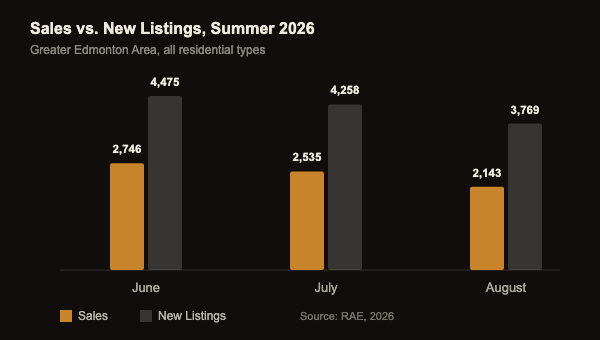
Why does that gap matter more than either number alone? Because it's what actually builds inventory. Every month new listings outpace sales, unsold homes pile up, and that pile is what gives buyers their negotiating room heading into fall. For a look at neighbourhood-specific pricing, my Sherwood Park guide breaks down where that inventory is concentrated in the $400s to $750s.

Does Edmonton Real Estate Actually Pick Up in September?
Not reliably, and that surprises a lot of people. Edmonton sales fell 7.8% from August to September in 2025, then dropped another 5.7% from September into October, down 17.0% from October 2024 (RAE monthly statistics, 2025). The "back to school bump" that gets talked about online just hasn't shown up as a real rebound the last two autumns in this city.
In my opinion, this is the single most useful thing to understand before you time an offer or a listing around Labour Day. September does bring a short wave of more serious buyers, people who spent the summer touring casually and are now ready to act before winter. But that wave has not been strong enough recently to reverse the broader summer slowdown. It's a ripple, not a rebound.
RAE's own July release backed this up before August's numbers even came in. Reid noted that activity "may modestly recover through fall but likely won't return to spring volumes for the remainder of 2026." That's a direct, current forecast from the board that tracks Edmonton's MLS data every month, not a guess dressed up as one.
Isn't it possible this year breaks the pattern? Sure, markets shift. But with inventory still up double digits year over year heading into September, the setup looks more like a continuation of the cooling trend than a reversal of it.
How Much Negotiating Room Do Buyers Have This Fall?
Edmonton buyers had 3.8 months of supply and an average of 41 days on market across all property types in August 2026 (RAE data, compiled by Mortgages for Less, 2026). Months of supply is a simple idea: it's how long it would take to sell every home currently listed at the current sales pace. Anything under roughly 4 months is still considered seller-friendly by convention, but 3.8 is close enough to balanced that buyers finally have some pull.
Break it down by property type and the picture sharpens. Detached homes moved fastest, averaging 38 days on market and 3.5 months of supply, with an August average price of $575,575. Semi-detached homes took 41 days at $424,322 average. Row and townhomes took 45 days at $298,238. Apartment condos took the longest at 48 days, sitting at 5.1 months of supply and a $215,422 average price, firmly a buyer's market on paper (RAE data via Mortgages for Less, August 2026).
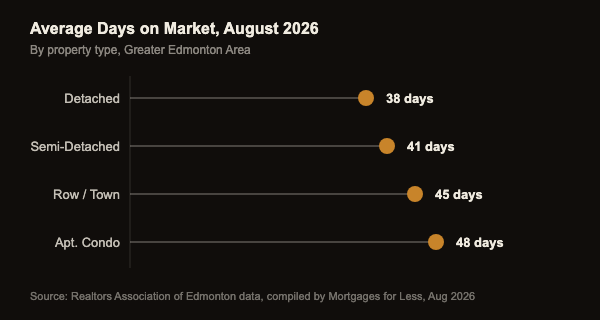
What does that actually mean if you're writing an offer this month? If a detached listing has already sat past that 38-day average, you likely have room to negotiate below list, especially on price or on who covers closing costs. Alberta's condition period typically runs 7 to 10 business days from an accepted offer, plenty of time to get a proper home inspection done before you're locked in. Terwillegar buyers watching the $550,000 to $750,000 detached range should be paying close attention to how long individual listings have actually been sitting, not just the neighbourhood average.
Should You List Your Home in September or Wait Until Spring?
List now if your home is priced correctly, because inventory is still climbing and waiting for spring means competing with an even bigger wave of new listings. Edmonton's active inventory was up 22.2% year over year in June, 17.9% in July, and 15.1% in August, still elevated even as the growth rate slows a little each month (RAE monthly statistics, 2026).
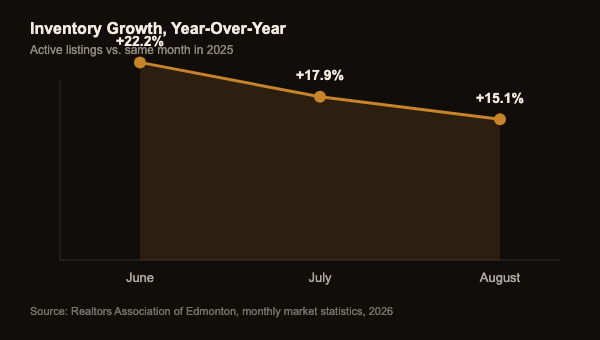
I've noticed the same pattern on my own showings every September for the last two years. The casual weekend lookie-loos disappear once school starts. The people who show up in September and October tend to have a real timeline, often a lease ending or a job relocation, and they move faster once they find the right property. Fewer showings, but higher quality ones, is the honest way to describe fall traffic in my experience.
The risk isn't listing in fall. It's listing above where the $426,900 HPI benchmark and your property's comparables actually support, and then watching your home sit well past 41 days while three more competing listings hit the same street. In a rising-inventory market, an overpriced listing gets punished faster than it would have in March. If your home has been sitting and you're not sure why, my post on why isn't my home selling in Edmonton walks through the most common pricing and presentation mistakes I see. My full sellers guide covers the listing, showing, and offer process step by step if you're getting ready to list.

What Should You Actually Do This Month?
If you're buying, use the data as your opening position. Ask your agent for the exact days-on-market figure on any home you're serious about, not just the citywide average. Anything above 41 days for that property type is a green light to negotiate on price, closing costs, or possession date. Get your pre-approval locked in now so you can move quickly once you find the right property, since Alberta's initial deposit is typically due within 5 business days of an accepted offer.
If you're selling, price at or just below the current HPI benchmark for your property type from day one instead of testing a higher number first. In a market where inventory keeps building, the homes that sit the longest are almost always the ones that started too high and had to chase the market down with price cuts. A correctly priced home listed in September competes against serious buyers, not summer traffic, and that's a real advantage even with sales volume down citywide.
- Buyers: Pull the specific days-on-market number for any listing you're considering, not the citywide average.
- Buyers: Get pre-approved before you tour, so you can move within the 5-business-day deposit window once an offer is accepted.
- Sellers: Price within a few percent of the current HPI benchmark for your home's property type and area.
- Sellers: Don't count on a big September rebound to bail out an overpriced listing. The data says that rebound hasn't shown up the last two years.
Not sure what this means for your specific budget or timeline?
The Edmonton Budget Buyer's Guide breaks down what different price points actually buy across the city right now, or we can just talk through your numbers directly.
Get the Budget Buyer's GuideFrequently Asked Questions
What is the average home price in Edmonton right now?
Edmonton's average residential selling price was $469,602 in August 2026, down 1.1% from July and about $14,000 lower than June's $483,600 (Realtors Association of Edmonton, 2026). The MLS Home Price Index benchmark, a steadier measure of typical home value, sat at $426,900 that same month.
Is Edmonton a buyer's market in fall 2026?
Edmonton is leaning toward buyers this fall, with 3.8 months of supply and homes averaging 41 days on market in August 2026 (RAE data, compiled by Mortgages for Less). It isn't a full buyer's market across every property type yet, but buyers have noticeably more room to negotiate than they did in spring.
Does Edmonton real estate typically pick up in September and October?
Not reliably. Edmonton sales fell 7.8% from August to September in 2025, then dropped another 5.7% into October (RAE, 2025 data). Fall usually brings a short wave of more serious back-to-school buyers, but it hasn't produced a sustained rebound in either of the last two years.
How long do homes take to sell in Edmonton right now?
Detached homes averaged 38 days on market in August 2026, semi-detached homes 41 days, row and townhomes 45 days, and apartment condos 48 days (RAE data via Mortgages for Less, 2026). All four property types are taking longer to sell than they were earlier in the year.
Should I wait until spring to sell my Edmonton home?
Not necessarily. Fall buyers tend to be more serious than summer traffic, and homes priced close to the $426,900 HPI benchmark are still selling on a normal timeline. Waiting for spring means competing with the seasonal jump in new listings that typically arrives in March and April.
None of this requires guessing. Edmonton's fall market has real, published numbers behind it every single month, and they tell a more useful story than "the market always heats up in September." This September, the data says buyers hold more cards than they have in a while, and sellers who price honestly still have a clear path to a sale. If you want to know exactly where your budget or your listing fits into these numbers, a free home valuation is a fast way to find out before you decide.
Categories
Recent Posts