Edmonton Winter vs Toronto Winter: What the Data Actually Shows
Homes with Tristan: Relocation Guide
Edmonton Winter vs Toronto Winter: What the Data Actually Shows
By Tristan Boire, REALTOR | Park Realty, Sherwood Park AB
Edmonton is colder than Toronto in January, but not by as much as most people assume, and it gets meaningfully more sunshine doing it. Edmonton's average January high is -6.5°C compared to Toronto's -2.3°C (Weather Atlas, 2026), roughly a 4-degree gap. Meanwhile Edmonton logs 2,345 hours of sunshine a year against Toronto's 2,066 (CurrentResults.com, 2025).
I have this conversation constantly with people moving here from Ontario or BC, plenty of them house-hunting in family neighbourhoods like Terwillegar. They picture Edmonton winter as something closer to the Arctic than it actually is. Here is the real breakdown: the numbers, what the cold actually feels like day to day, and what my clients tell me after they have lived through a full year of it.
Key Takeaways
- •Edmonton's January average high is -6.5°C versus Toronto's -2.3°C, about a 4-degree gap, not the extreme difference most people expect (Weather Atlas, 2026)
- •Edmonton gets 2,345 hours of sunshine annually, 279 more than Toronto and 407 more than Vancouver (CurrentResults.com, 2025)
- •Core winter runs November through March; by late June Edmonton gets close to 17 hours of daylight with highs in the low-to-mid 20s
- •Most relocating clients tell me they wish they had made the move sooner once they're through their first year
How Much Colder Is Edmonton Than Toronto in Winter?
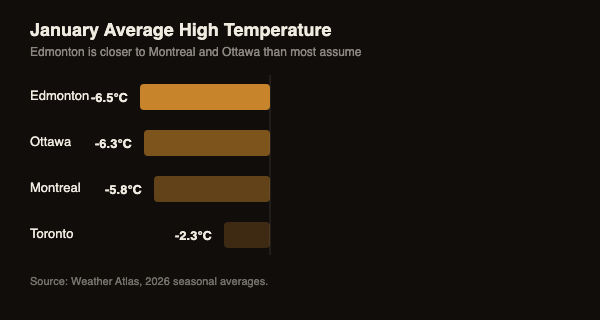
Edmonton's January average high sits at -6.5°C compared to Toronto's -2.3°C, a gap of roughly 4 degrees (Weather Atlas, 2026). That puts Edmonton in the same general range as Ottawa (-6.3°C) and Montreal (-5.8°C), not in some separate, harsher category.
What actually catches people off guard is the extreme cold snaps, not the daily average. Edmonton does get stretches at -25°C or colder most winters. Those days are real and they're not fun, but they're outliers lasting a few days at a time, not the baseline experience.
Edmonton's January average high of -6.5°C is closer to Montreal (-5.8°C) and Ottawa (-6.3°C) than to the extreme cold most Ontario or BC residents picture before they check the actual data (Weather Atlas, 2026).
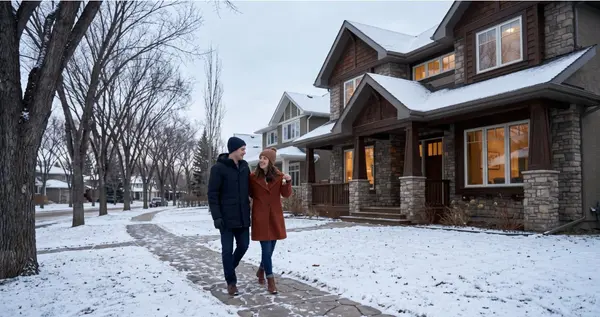
Cold prep here is standard, not exceptional. Remote starters, block heaters built into parking stalls, a properly rated coat. After a few weeks it stops being something you think about constantly. The infrastructure and the habits exist because the city has been dealing with this for a long time.
Does Edmonton Actually Get More Sunshine Than Toronto?
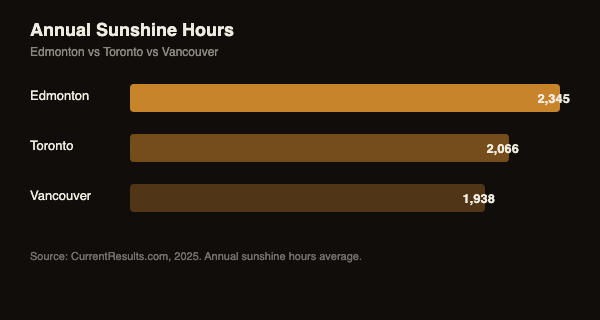
Yes, by a wide margin. Edmonton averages 2,345 hours of sunshine per year versus Toronto's 2,066 and Vancouver's 1,938 (CurrentResults.com, 2025). Edmonton is one of the sunniest major cities in Canada, and it isn't close.
There's a phrase people use here: the quality of the cold. A -10°C day under a full blue sky feels completely different from a grey -5°C day under overcast skies. Clients who move here from Vancouver, which is famously grey through winter, tell me the sunny Edmonton winters feel better psychologically than the milder, damper winters they left behind. You're cold, but the sky is clear.
Edmonton logs 2,345 hours of sunshine a year, 279 more than Toronto and 407 more than Vancouver (CurrentResults.com, 2025). For anyone weighing a move from a greyer, wetter climate, that difference shows up daily, not just in the yearly average.
This is the stat that changes how most people think about Edmonton winter once they actually look it up. It's genuinely counterintuitive, and it's the single biggest thing I wish more relocating buyers knew before they wrote off the city based on temperature alone.

What Edmonton Has Built Around Winter
Edmonton is built for winter in a way a lot of cities simply aren't. The North Saskatchewan River valley, 160 kilometres of connected urban parkland, becomes a working network of cross-country ski trails, fat biking paths, and outdoor skating rinks the moment it freezes. The city doesn't shut down when it gets cold. People go outside.
Hawrelak Park floods its loop for skating starting in December. The Deep Freeze festival turns the river valley into an outdoor winter gathering every January. Rogers Place brings NHL hockey downtown, and Marmot Basin, out in the Alberta Rockies, is two hours west for anyone who wants real ski terrain without the lift-line chaos of the bigger resorts.
The city's infrastructure backs this up. Snow removal is fast. There's an underground pedway network downtown, and heated parkades are common. People here don't talk about winter like it's something to survive. It's just the season they're in.
How Long Does Edmonton Winter Actually Last?
Core winter, meaning consistent cold and snow, runs from November through March. That's five months, and I'm not going to pretend otherwise. It's a real chunk of the calendar.
But here's what the other side looks like. By early April the snow is melting. By May you're outside without a jacket. July and August highs sit around 22 to 24°C, and because Edmonton sits further north, the daylight is extraordinary: close to 17 hours by late June (timeanddate.com), with the sun up before 5am and not setting until almost 10pm.
People who've lived here their whole lives will tell you there's no better summer in Canada. Having lived through both sides of the year here, I believe them.

What Clients Tell Me After Year One
I've had this conversation with somewhere around 30 to 40 clients who made the move from Ontario or BC. The pattern is almost identical every time. Year one: they manage, they adjust, there are hard weeks, especially in February when the cold snap hits and the novelty has fully worn off.
Year two looks completely different. The first cold week in November arrives and they're already in their routine, remote start running, coat on, not thinking about it in the same loaded way. What they usually tell me, if I ask directly, is that the financial breathing room, actually feeling like their income works for them here, made it worth it before winter was even a real question anymore.
Across roughly 30-40 client relocations from Ontario and BC, the same adjustment pattern shows up almost every time: a difficult first winter followed by full comfort by year two, once financial relief from the move outweighs any lingering climate adjustment.
Most of them tell me they wish they'd moved sooner.
Thinking About Moving to Edmonton?
Let's Talk Through Your Specific Situation
I work with buyers relocating from Ontario and BC every month. Neighbourhoods, budgets, timelines, and yes, what winter is actually like. Happy to have that conversation.
Book a Free ConsultationFrequently Asked Questions
Is Edmonton colder than Toronto in winter?
Yes. Edmonton's January average high is -6.5°C compared to Toronto's -2.3°C, roughly a 4-degree gap (Weather Atlas, 2026). Edmonton's cold is closer in range to Montreal (-5.8°C) and Ottawa (-6.3°C) than most people expect, and it comes with significantly more winter sunshine.
How many months of winter does Edmonton have?
Core winter, with consistent snow and cold, runs roughly November through March, about five months. By April the snow is melting, and by June the city is fully into lake and patio season, with summer highs around 22-24°C.
Is Edmonton sunnier than Toronto?
Yes, and by a meaningful margin. Edmonton averages 2,345 hours of sunshine a year compared to Toronto's 2,066 and Vancouver's 1,938 (CurrentResults.com, 2025). The extra sunshine noticeably changes how the cold feels day to day.
What do people in Edmonton do outside in winter?
Quite a lot. The North Saskatchewan River valley has 160km of trails for cross-country skiing, fat biking, and skating. Rogers Place hosts Oilers NHL games downtown, Marmot Basin is two hours west for downhill skiing, and the Deep Freeze festival runs every January in the river valley.
Do people who move to Edmonton regret it in winter?
In my experience with 30-40 relocating clients, the first winter is the hardest adjustment, particularly February. By year two almost everyone is fully adjusted, and most tell me directly that they wish they'd made the move sooner.
Categories
Recent Posts