Is Moving to Edmonton Still Worth It in 2026?
Homes with Tristan: Migration Data & Market Update
Is Moving to Edmonton Still Worth It in 2026? What the Immigration Numbers Actually Show
By Tristan Boire, REALTOR | Park Realty, Sherwood Park AB
For the last three years, I've told people the same story. Alberta's affordable, Ontario and BC are leaving in record numbers, come on out. I built a decent chunk of my business on that narrative. It's just not as true as it used to be anymore, and the reason has almost nothing to do with Alberta.
Canada cut its own immigration targets hard for 2026, and that single policy decision is doing more to slow interprovincial migration than anything happening inside this province. Here's what the actual numbers say, what I'm seeing with my own Ontario and BC clients right now, and why a slower migration story might still mean good news if you're buying in Edmonton this year. I walk through all of this on video too: watch "Is Moving to Edmonton Still Worth It in 2026?" on YouTube.
Key Takeaways
- Canada's 2026 to 2028 levels plan cuts temporary resident targets 43% (673,650 to 385,000), international student spots nearly in half, and the temporary foreign worker program by 27% this year alone (IRCC, Dec. 2025).
- Alberta's net interprovincial migration gain in Q1 2026 was down 8.4% year over year, a drop of roughly 19,344 arrivals against the prior year's pace (Statistics Canada).
- Edmonton's average detached home sold for $569,820 in September 2026, still less than half of Toronto's $1,292,016 and under a third of Vancouver's $1,784,700 benchmark price.
- Fewer total movers plus a cooling local market means less competition for buyers with flexibility right now, even though the underlying affordability gap hasn't closed.
Why Everyone Says Alberta Is Flooded With Movers, and Why That's Changing
Alberta set a national record for net interprovincial migration in 2024, pulling in more than 36,000 people on net, the largest gain of any province that year (Statistics Canada, via StrategyCorp analysis, 2025). For a stretch after that, Edmonton actually edged out Calgary for the largest net interprovincial surplus of any metro area in the country. That part of the story was real, and it's the reason the "everyone's moving to Alberta" narrative took hold in the first place.
But a number came out this year that explains why that story is changing, and it isn't really about Alberta at all. Canada's federal government cut its own immigration targets hard for 2026 through 2028, and not in just one category. When you shrink the total pool of people in the country, you shrink the pool of people available to eventually move between provinces too. Interprovincial migration doesn't happen in a vacuum. It happens on top of however many people are actually here to begin with.
Canada Just Cut Its Immigration Targets. Here's What That Actually Means.
Temporary resident targets are dropping 43%, from 673,650 down to 385,000 for 2026 (Immigration, Refugees and Citizenship Canada, 2026 to 2028 Immigration Levels Plan, Dec. 2025). International student spots are being cut nearly in half, landing at 155,000 for 2026 and settling near 150,000 for 2027 and 2028. The temporary foreign worker program drops from 82,000 to 60,000 this year, a 27% cut, and falls again to 50,000 by 2027 and 2028. The government's own stated goal is getting the temporary resident population under 5% of Canada's total population by the end of 2027, which tells you this isn't a minor adjustment. It's a structural shift.
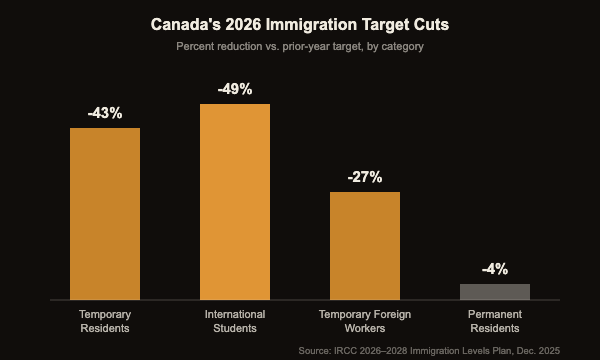
Permanent resident targets barely moved by comparison, holding at 380,000 a year through 2028, down less than 4% from 395,000. So this isn't really about fewer people choosing to immigrate to Canada for the long term. It's specifically about far fewer people being here on a temporary basis in the first place.
Canada's temporary resident target fell 43% for 2026, from 673,650 to 385,000, while permanent resident admissions were held nearly flat at 380,000 a year through 2028 (IRCC, Dec. 2025). The cuts are concentrated almost entirely in temporary categories, not long-term immigration.
The federal government and outside analysts have tied these cuts, at least in part, to housing and rental affordability pressure nationally. Fewer temporary residents means less demand competing for the same limited housing stock in every province, not just here. So in a strange loop, the exact policy response to a national housing affordability problem is quietly slowing down the migration trend that's driven a real share of my own business the last two years. Worth sitting with that for a second, because it changes who gets credit, or blame, for what happens to migration next.
What I'm Actually Seeing From Ontario and BC Buyers Right Now

I'm still getting calls and DMs from Ontario and BC. That hasn't stopped. But I can feel the pace slowing compared to a year or two ago, and the Q1 2026 numbers back up what I'm feeling, not just guessing at. Alberta's net interprovincial migration in the first quarter of this year was down 8.4% from the same period in 2025, with arrivals falling to 19,344 people against 13,338 who left, a net gain of 6,006 (Statistics Canada, Q1 2026 interprovincial migration estimates). That's a real drop from the 2024 peak, not a rounding error.
What hasn't changed is who's actually reaching out. It's almost always a younger couple in their late twenties to early thirties, white collar, shopping in the $500,000-plus range, and mostly people who want to put down roots for the long run rather than chase cheaper rent for a year or two. Most of it still comes out of the GTA and Ottawa specifically, with BC close behind. The geography hasn't shifted. Just the volume.
Alberta's provincial government has been publicly vocal that the federal cuts don't go far enough. The province has pushed for deeper reductions specifically in temporary foreign workers, international students, and asylum claimants, while leaving provincially selected economic immigration alone (CBC News, 2026). Whether or not you agree with that position, it tells you this isn't purely a federal story happening to Alberta. The province has been pushing in the same direction for its own reasons.
Toronto and Vancouver Still Haven't Gotten Cheaper

Ontario and BC haven't gotten more affordable just because fewer people are leaving them for here. Toronto's average detached sale price sat at $1,292,016 in September 2026, down 4.9% from a year earlier (WOWA / Toronto Regional Real Estate Board, Oct. 2026 report). That sounds like a real correction until you remember the starting point. Vancouver's detached benchmark price was $1,784,700 that same month, down 7.3% year over year (WOWA / Real Estate Board of Greater Vancouver, Oct. 2026 report). Both markets are correcting. Slowly. From a level that's still nowhere close to what Edmonton offers.
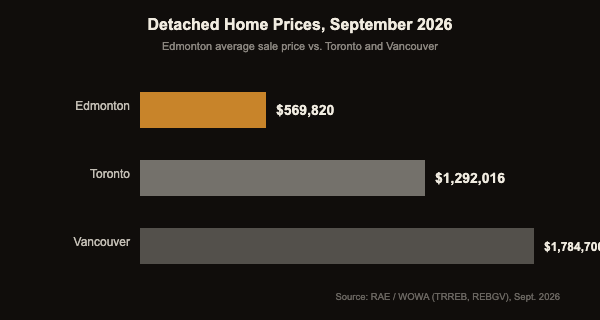
Run the actual math and it isn't close. Edmonton's average detached home sold for $569,820 in September 2026, up 2.9% from the year before (REALTORS® Association of Edmonton, Sept. 2026 report). Toronto's detached average is still 2.27 times that number even after its pullback. Vancouver's benchmark is 3.13 times Edmonton's price. A percentage correction on a much higher starting number still lands you somewhere completely different than what's actually achievable here. The gap that drove people out here in the first place hasn't closed. There are just fewer people total making any kind of move right now, for reasons that have nothing to do with Alberta.
So Is Moving to Edmonton Still Worth It in 2026?
Yes, if you're settling somewhere long term without stretching your budget to the edge, or you're planning retirement somewhere your money goes further. I still think Edmonton is one of the better answers in the country for that person. If you're being forced to move for work on a timeline you don't control, I think there are genuinely good buying opportunities coming as this slower period plays out, and that's worth knowing before you lock in a purchase.
Is the flood of movers story dead, then? Not quite. It's just smaller than it was, and for different reasons than most people assume. The affordability gap is still the real driver. The federal government just changed how many people are in the country to begin with, which changes the volume without changing the math that made Edmonton worth it in the first place.
What This Means If You're Buying or Selling in Edmonton Right Now

This ties directly into what I'm already watching in this month's local numbers. New listings have kept climbing while sales have slowed through the fall, average days on market in Edmonton reached 44 days in September 2026, up from 39 a year earlier, and months of supply has crept into buyer's market territory across the city (REALTORS® Association of Edmonton, Sept. 2026 report). A slower migration story and a cooling local market are happening at the same time, and for a buyer with flexibility, that combination is exactly when you get real negotiating room, not when everyone else is bidding on the same handful of listings.
If you're in the camp that has to move regardless of timing, I'd treat this slower period as useful information, not something to wait out. Sellers who listed expecting last year's level of competition are more open to real conversations right now than they were twelve months ago. For someone still weighing a move from Ontario or BC, that's good news hiding inside what sounds like bad news. Fewer total movers means less competition for you specifically, even while the affordability gap that made the move worth it in the first place hasn't gone anywhere.
Run Your Own Numbers
Thinking About the Move From Ontario or BC?
Grab the free worksheet I built comparing what you're paying now against what the same move actually looks like in Edmonton, then book a 15-minute call and we'll talk through your specific situation.
Get the Moving WorksheetFrequently Asked Questions
Why is interprovincial migration to Alberta slowing down in 2026?
Mainly because Canada cut its own temporary resident targets 43% for 2026, shrinking the national pool of people available to move between provinces (IRCC, Dec. 2025). Alberta's own Q1 2026 interprovincial arrivals fell 8.4% year over year as a result, not because the province lost its appeal.
How much did Canada cut its immigration targets for 2026?
Temporary resident targets dropped 43%, from 673,650 to 385,000. International student spots fell nearly in half to 155,000, and the temporary foreign worker program dropped 27%, from 82,000 to 60,000. Permanent resident admissions held nearly flat at 380,000 (IRCC, 2026 to 2028 Immigration Levels Plan).
Has the type of person moving to Edmonton from Ontario or BC changed?
Not really. The buyers reaching out are still mostly couples in their late twenties to early thirties, white collar, shopping at $500,000 and up, coming out of the GTA, Ottawa, and BC. The volume has slowed, but the profile and the geography have stayed consistent through 2026.
Is Edmonton still more affordable than Toronto and Vancouver in 2026?
Yes, by a wide margin. Edmonton's average detached home was $569,820 in September 2026, while Toronto's sat at $1,292,016 and Vancouver's benchmark price was $1,784,700 the same month (RAE; WOWA via TRREB and REBGV). Both bigger markets have corrected slightly but remain more than double Edmonton's price.
Is it still worth moving to Edmonton right now?
For most people planning to settle long term or stretch their money further in retirement, yes. For anyone forced to move on a timeline they don't control, the current slowdown in both migration and local sales activity may actually create better buying opportunities than the last two years offered.
The flood of movers story isn't dead. It's just smaller than it was, and for different reasons than most people assume. If you want to run your own numbers instead of taking my word for any of this, grab the worksheet above, or reach out directly. I'm happy to walk through your specific situation.
Categories
Recent Posts