
The Real Estate Opinions I Almost Didn't Say on Camera (And Why Bluntness Wins on YouTube)
The Real Estate Opinions I Almost Didn't Say on Camera (And Why Bluntness Wins on YouTube)
Every agent who films video hits the same moment. You write a line with an actual edge to it, something specific enough that someone could disagree with you, and your thumb hovers over the delete key. I hit that moment three times this year on three different scripts, and every time I left the line in instead of softening it, the video became one of my best performers.
That is not luck, and I do not think it is unique to me. Five years in the Canadian Armed Forces trained a version of directness into me that most people spend a sales career unlearning, and that training is the actual reason my most opinionated real estate videos are also my most watched. Here is what my own numbers say, and how to catch the hedge in your own script before it costs you a video.
- My highest click-through rate ever, 12.1%, belongs to my most opinionated video: a bold, specific take on how NATO's growing presence near Edmonton is putting pressure on the housing market (Homes with Tristan YouTube Studio analytics, March 2026).
- "5 Reasons Why Edmonton Is NOT For You," a video built around telling the wrong-fit buyers not to move here, still pulled an 8.0% CTR and a 4:58 average view duration.
- My newest video names exactly where I'd point a client's money right now and where I'd tell them to wait, including two acreage deals that went $65,000 and $40,000 over asking and still lost.
- The military trained me to say the unpopular thing directly because a hedge in the field gets someone hurt. That habit, not a content trick, is the real reason the blunt videos win.
Why I Almost Cut These Lines Before I Filmed Them
My best-performing video by click-through rate is also the one I almost softened before I hit record. "Why NATO Wants Edmonton (And What It Means for Real Estate)" pulled a 12.1% CTR, the best number my channel has ever posted, off a script that made a specific, arguable claim instead of a safe one (Homes with Tristan YouTube Studio analytics, March 2026). It landed 1,146 views in its first 8 days and held viewers for an average of 4:54.
The first draft of that script had a line close to this: NATO's footprint around Edmonton is going to put real upward pressure on this market, and I think it already has. My instinct was to hedge it, something like "some experts believe this could potentially influence pricing in certain segments." I caught myself mid-edit and thought about five years of training that punished exactly that kind of language.
In reconnaissance and sniper work, a hedge in a range card or a patrol report gets someone hurt. You call the distance, you call the wind, you call what you actually saw, and you own it if you're wrong. Nobody wants "possibly six hundred metres, give or take, depending on conditions." That habit does not turn off when you sit down at a desk with a teleprompter and a real estate script in front of you.
I am not saying every real estate agent needs to serve in the military to figure this out. I am saying that if you have any instinct in you that already resists hedging, whether it came from sports, a trade, or just being someone who says what they mean, that instinct is an asset on camera. Most agents train it out of themselves because the industry rewards being agreeable. On YouTube, it works against you.
What Happens When You Say the Blunt Thing Anyway?
Two videos built entirely around a direct, sometimes uncomfortable opinion have outperformed the rest of my channel on both ends of the funnel, the click and the watch (Homes with Tristan YouTube Studio analytics, 2026). Neither one hedges, and neither one tries to be liked by everyone who clicks on it.
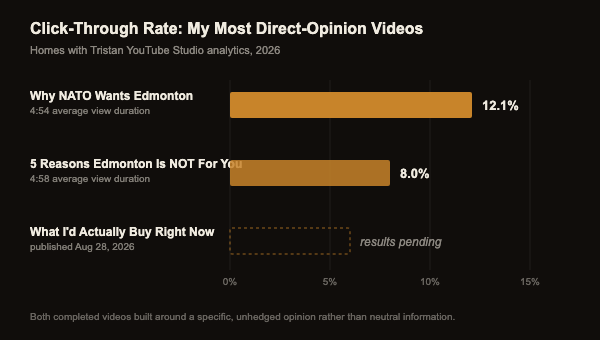
"Why NATO Wants Edmonton" takes a specific economic position and defends it. "5 Reasons Why Edmonton Is NOT For You" does something almost no relocation channel does on purpose: it spends the entire video talking a chunk of its own audience out of moving here. That video pulled 213 views on day one, an 8.0% CTR, and a 4:58 average view duration, all well inside what I'd call a strong result for my channel at that point in its life.
Here is the part I did not expect going in. A pattern-interrupt video that tells viewers they might not be a fit performed almost as well, on both CTR and retention, as a video making a bold macro prediction. The common thread is not the topic. It is that both titles promise a real, checkable stance, not a vague summary of information the viewer could get anywhere.
The Newest Test: Telling Buyers Exactly Where I'd Buy Right Now
My newest video, "What I'd Actually Buy in Edmonton Right Now (My Honest Take)," published today, is the bluntest one yet. I name where I'd point a client's money and where I'd tell them to hold off, with no version of the script that tries to please every viewer at once.

The clearest example in that video is the acreage market. Instead of the safe line, "the acreage market is competitive right now," I told viewers what actually happened: I've had clients go $65,000 over asking on one acreage and $40,000 over asking on another this year, and both times they still lost the property. That is not a general market comment. It is a specific number two of my own clients lived through, and it tells a viewer far more about what they're walking into than "competitive" ever could.
The video is up on the channel now, but it is too new to have final CTR or watch time numbers, so I am not going to pretend I know how it performed. What I can tell you is the deliberate choice behind it: this is normally the kind of thing I would only say to a client privately, in a phone call after they'd already committed to working with me. Putting it on camera instead of holding it back for a private conversation is the actual pattern this whole post is about.
How Do You Know When a Line in Your Script Is a Hedge?
A hedge in a real estate script almost always has the same shape: a qualifier stacked on another qualifier, a vague noun standing in for a specific one, and a sentence that ends on a disclaimer instead of a position. Once you know the shape, it is easy to find in your own writing.
- Qualifier stacking. Words like "might," "could," "in some cases," and "depending on your situation" doing the work an actual number or name should be doing.
- Vague nouns. "Certain areas," "some buyers," "a home like this" instead of naming the neighbourhood, the price range, or the buyer you actually mean.
- Disclaimer endings. A sentence that exists to protect you from being wrong rather than to answer the question the viewer actually clicked for.
Here is a version of the test I ran on my own script for the acreage section, illustrative of the exercise rather than a direct quote from the final cut:
Direct: "If you've got around $700K and you're serious about an acreage, move now. I've had clients go $65,000 and $40,000 over asking on two separate acreages this year and still lose. Wait another six months and you'll be bidding against more people, not fewer."
Run every debatable line through one question before you film: could a junior agent at any brokerage in the country have said this exact sentence? If yes, it is not an opinion yet. It is a placeholder, and it needs a number, a name, or a real stance before it earns a place in the script.
Why Does Direct Opinion Beat Neutral Information for Watch Time?
I do not have a controlled experiment, just three data points from my own channel, but the pattern has held up consistently enough that I now plan every script around it: when a title and thumbnail promise an actual position, viewers click to find out if you'll really take it, and they stay because you do (Homes with Tristan YouTube Studio analytics, 2026).
A neutral, purely informational video promises nothing to be surprised by. There is less reason to click past the thumbnail and less reason to stay past the first thirty seconds, because the viewer already assumes they know roughly what you'll say. Not every successful real estate YouTube channel is built this way, and that is worth saying plainly. Sarah Meslowski built a channel behind roughly $150 million in production over five years on practical, honest, highly searchable videos rather than opinion or personality, prioritizing high-intent viewers over raw view counts (Inman, 2026). That is a legitimate model. Mine leans opinionated because that is what my own numbers say earns the click and the watch time for my market and my audience.

The honest caveat: bluntness only works if the opinion is actually earned. I would not have a 12.1% CTR video if the NATO take was invented for shock value instead of something I'd actually researched and believed. The pattern is not "say anything controversial." It is "say the specific thing you actually think, instead of the vague thing that protects you from being wrong."
Watch the pattern in action
New Edmonton real estate videos every Friday
I post a new long-form video every week, direct opinions included. If you want to see how this plays out on camera before you try it on your own channel, subscribe and watch the next one land.
Subscribe on YouTubeFrequently Asked Questions
Does being this blunt on camera ever hurt lead quality?
I think of it as pre-qualifying rather than risking it. A viewer who disagrees with a specific take, like which neighbourhoods I'd buy in right now, was probably never going to book a call with me anyway. The people who do reach out already know how I work before we speak.
How do you decide which opinions are worth putting on camera?
If I would say it to a client's face in a private conversation, it goes in the script. If I would only give a client the softer version and save the truer version for another agent over coffee, that is the line I am hedging, and usually the one worth fixing before I film.
Isn't it risky for an agent to publicly say some buyers shouldn't move to their city?
"5 Reasons Why Edmonton Is NOT For You" is the proof it isn't. That video, built entirely around telling wrong-fit buyers to stay away, still pulled an 8.0% click-through rate and a 4:58 average view duration on my channel (Homes with Tristan YouTube Studio analytics, March 2026).
Does this pattern only apply to market takes, or buyer advice too?
It's the exact logic behind my newest video, where I tell viewers plainly where I'd point their money right now and where I'd tell them to wait, including specific acreage deals that went $65,000 and $40,000 over asking and still lost this year.
What's the fastest way to catch a hedge before you film it?
Read the line out loud and ask if a junior agent at any brokerage could have said the exact same sentence. If the answer is yes, it isn't a real opinion yet. It needs a number, a name, or a stance before it's ready to film.
None of this required a script formula or a growth hack. It required leaving the specific line in instead of trading it for a safer one, three separate times this year, and letting the numbers make the argument I couldn't have made in advance. If you're building a real estate channel of your own, the fastest audit you can run today is going back through your last five scripts and counting how many sentences a competitor could have said word for word. That number is your starting point.
Categories
Recent Posts