
Why Price-Point Videos Outperform Market Updates on YouTube: Real Data From My Real Estate Channel

Homes with Tristan: Behind the Brand
Why Price-Point Videos Outperform Everything Else on a Real Estate YouTube Channel
By Tristan Boire, REALTOR | Park Realty, Sherwood Park AB | May 29, 2026
I posted a video on May 22 called "What $700K Gets You in Edmonton Right Now." It's a price-point video: a specific budget applied to a specific city, walking through real neighbourhoods and real homes. I've made two of this format. One got 64,737 views. The other got 5,209.
Compare that to my best market update: 8,294 views. My best tips video: 3,811 views. The difference isn't luck or timing. It's format. Price-point videos consistently outperform everything else on my channel, and after running the numbers I can explain exactly why that happens and what to do about it.
Key Takeaways
- →Price-point videos on my channel average 34,973 views vs 8,294 for market updates and 3,294 for tips content (YouTube Studio, May 2026)
- →Price-point viewers arrive pre-qualified: they have a budget, they're interested in your city, and they've engaged long enough to self-select as serious buyers
- →The structure that works: answer in the hook, real dollar amount in the title, neighbourhood-by-neighbourhood breakdown, honest about trade-offs
- →Every price-point video should be paired with a companion blog post published within 24 hours to capture search traffic after YouTube momentum fades
The Numbers From My Channel
My channel has 5 long-form videos as of May 2026. Two are price-point or comparison format. One is a market update. Two are tips or how-to. Running the averages across content types (YouTube Studio data, May 2026):
- Price-point / comparison34,973 avg views (64,737 and 5,209)
- Market update8,294 views (one video)
- Tips / how-to3,294 avg views (3,811 and 2,776)
Price-point outperforms market updates by 4.2x and tips content by 10.6x on my channel. That's not marginal. It's a format that works, and it's repeatable.
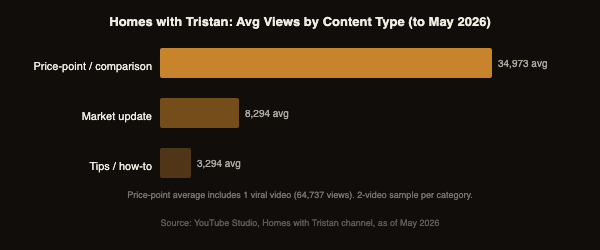
Price-point and comparison videos on the Homes with Tristan channel average 34,973 views per video, versus 8,294 for market updates and 3,294 for tips and how-to content (YouTube Studio, May 2026). The format difference produces a 4x gap in reach against the next-best content type, and a 10x gap against educational how-to content.
Why Price-Point Videos Find Different Viewers
Market update videos serve people already in your audience. Tips and how-to content serves people in the early stages of thinking about real estate. Price-point videos serve people who are actively searching to buy, with a budget in hand.
The search intent is fundamentally different. "What can I get for $700K in Edmonton" is a transactional query. The person searching it has already decided they're moving. They have a number. They want to see what that number buys. You're not convincing them real estate is worth considering. They're already convinced.
This changes how YouTube's algorithm distributes the video too. Price-point videos match specific keyword searches on YouTube (which is the second-largest search engine in the world). Market updates and tips content compete for browse and suggested feed placement. The former is pull. The latter is push. Pull converts better.
The leads I get from price-point videos show up pre-framed. They tell me their budget in the first message because the video set it up as the context. I don't spend the first call figuring out if they're serious or what they can afford. They've already shown me.

The Video That Proved It: 64,737 Views
My top-performing video is "5 Surprising Facts About Living in Edmonton" — 64,737 views, 4:45 average view duration, 879,000 impressions, 4.9% click-through rate. It's technically a price-point and relocation hybrid: it uses surprising counter-intuitive framing around what Edmonton's market actually looks like versus what people expect from experience in Toronto or Vancouver.
The 4.9% CTR on 879K impressions is the number that tells the story. People who saw the thumbnail clicked it at nearly 5%, which is well above average for real estate content. The hook worked. The title worked. The framing of "surprising facts" combined with an implied cost comparison drove curiosity from exactly the right audience: people who are evaluating Edmonton as a place to move.
What I've noticed: the price-point videos that overperform aren't just listing what homes cost. They're answering the question buyers are actually asking, which is "does my budget work there, and what am I actually getting for it?" The answer has to be honest about trade-offs. Buyers can tell when a video is promotional versus informational. Informational wins.
How to Structure a Price-Point Video
The structure that's worked consistently for me:
- 1.Answer in the hook. State the budget and the city in the first 5 seconds. "Here's what $700K actually gets you in Edmonton right now." Don't tease the answer, give it. Then deliver the detail.
- 2.Real number in the title. Not "Edmonton homes might surprise you." Put "$700K" in the title. People searching for this content use budget numbers as search terms. Match their language.
- 3.Neighbourhood by neighbourhood. Don't describe an average home. Take the viewer through specific communities with specific price ranges. This is the information they came for. Be specific.
- 4.Be honest about trade-offs. "$700K in Windermere gets you to the bottom of the market. In Glenridding Heights it gets you above average." Transparency builds trust faster than cheerleading.
- 5.Pair it with a blog post. The video drives views and subscribers. The blog captures search traffic after the video's initial momentum fades. One without the other leaves reach on the table.
The Blog Pairing Strategy
Every price-point video should have a companion blog post published within 24 hours. The video and blog serve different traffic sources.
The video captures people who found you through YouTube's search or recommendation engine. The blog captures people who Google "what does $700K buy in Edmonton" — a search that runs on Google's algorithm, not YouTube's. They're different audiences arriving through different channels, but they're looking for the same information.
The Saturday post that accompanied the May 22 video ("What Does $700K Buy You in Edmonton Right Now?") is the written version of that content. Same data, formatted for search. They reinforce each other: a YouTube viewer might read the blog for reference. A Google searcher might watch the video. Together they cover more surface area than either one alone.
This is also why posting a market update blog when you post a market update video makes sense, but matters less. Market update viewers are mostly existing followers. They already know you. Price-point viewers are strangers who found you through a search. The blog is what converts a stranger who found the video into someone who can find you again when they're ready to contact an agent.
See the Strategy in Action
Subscribe on YouTube
Every video is a real case study in what works. Follow along as the channel and the lead flow build in real time.
Subscribe on YouTubeFrequently Asked Questions
What type of YouTube videos work best for real estate agents?
Based on my channel data (YouTube Studio, May 2026), price-point and city comparison videos average 34,973 views versus 8,294 for market updates and 3,294 for tips content. Price-point videos attract buyers who are actively searching, which produces better lead quality in addition to higher view counts.
How do I find price-point video ideas for my market?
Start with common buyer budgets in your city: $500K, $700K, $1M. Each becomes a video. Then layer in comparisons: "$700K in Edmonton vs Calgary." Then drill into specific communities: "What $700K buys in Terwillegar." Each one targets a different search query while building on the same format.
How do I turn price-point video views into leads?
Three things work: a clear call to action at the end of the video (link to a buyer's guide or book-a-call page), a companion blog post that captures Google search traffic and links back to your site, and consistent posting so viewers who find you once see you again. The conversion happens over time, not from one video.
Should I post market update videos or price-point videos?
Both, but prioritize price-point. Market updates serve your existing audience and build retention. Price-point videos find new buyers who are actively searching. If you're early in building a channel, price-point content grows the audience faster. Market updates become more valuable once you have subscribers worth retaining.
Categories
Recent Posts