Real Estate YouTube Script Structure That Retains

Homes with Tristan: Behind the Brand
The Real Estate YouTube Script Structure Behind My Highest-Retention Videos
By Tristan Boire, REALTOR | Park Realty, Sherwood Park AB

On August 7th I deleted two paragraphs from a script I'd already been happy with, then put them back in a different order. Same six paragraphs, same facts, same footage plan. I just moved what used to be paragraph five up to where paragraph four sat, and slid the old paragraph four down one spot. It's the smallest edit I've made to a script all year, and it's the one I think about the most.
This post is about that edit specifically: what was wrong with the original order, what the research on memory and persuasion says about where evidence belongs relative to opinion, and the two-part test I now run on every script before I film it. I'm using the video that edit happened on, "Alberta Builders Are Sitting on a Housing Glut Right Now," which drops August 21st, as the worked example. This is a real estate YouTube script structure question, but honestly it applies to any script built around proof and opinion.
Key Takeaways
- • On August 7, 2026, I reordered two paragraphs in a real estate script. Nothing else changed.
- • The fix: put the real example immediately before the opinion it supports. Never two paragraphs apart.
- • Middle-position content gets displaced from memory before it's rehearsed into long-term recall, a pattern known as the serial position effect (Glanzer & Cunitz, 1966).
- • A specific example paired with a stated opinion persuades more than either one alone (Allen & Preiss meta-analysis, 1997).
- • Save your best news for the second half. Front-loading the payoff kills the tension that holds people through the middle of the video.
What Was Actually Broken in the Original Draft?
The original draft put my opinion two paragraphs after the real example it was supposed to reference, with an unrelated "good news" paragraph sitting between them and breaking the connection between proof and point. I didn't catch it the first time I read it out loud. I caught it the second time, when I noticed I was explaining an opinion the viewer had already half-forgotten the evidence for.
The script has six body paragraphs. Paragraph one lays out the numbers: Alberta home builders started 21% fewer homes in the first half of 2026 than the same period in 2025, and the share of new-build townhomes priced at or above $500,000 jumped from 40% to 72% over two years (CMHC data, reported by The Globe and Mail, 2026). Paragraph two explains the mechanic behind it: a wave of presale contracts sold to out-of-province investors during the 2023 to 2025 building boom, many of which are now falling through as units complete and investors walk away rather than close.
Paragraph three is a real example: a Stillwater townhome I know that listed, sat, and eventually sold for almost exactly what the original buyer paid three years earlier. Paragraph four is my opinion, built directly on that example: resale-home math beats new-build math for most buyers right now, because a townhome that takes a decade to appreciate and months to resell isn't the deal it looks like on the sales center's brochure.
In the original order, paragraph five (the GST rebate, up to $50,000 in savings for eligible first-time buyers) sat between paragraph three and paragraph four. It's good information. It's just in the wrong place. By the time a viewer reached my opinion about resale math beating new-build math, the specific proof for it, the Stillwater example, had been pushed out by an entirely different topic. The opinion arrived with nothing holding it up.

Why Does Proximity Between Example and Opinion Actually Drive Retention?
People remember what sits at the start and end of a sequence better than what sits in the middle, a well-documented pattern called the serial position effect (Glanzer & Cunitz, 1966). Items early in a sequence get rehearsed long enough to move into long-term memory. Items late in a sequence are still fresh in short-term memory. Everything in between gets displaced by what comes after it, before it's had time to stick.
That's exactly what happened to my Stillwater example. It sat in the middle of the sequence, got displaced by the GST rebate paragraph that came right after it, and never made it into the "long-term memory" of the viewer, meaning the 30 to 60 seconds it needed to still be top of mind when the opinion landed. This isn't just a script-writing hunch. It's the same mechanism researchers use to explain why the middle of any list, a shopping list, a witness statement, a sales pitch, gets recalled worst.
A message that combines a specific narrative example with statistical evidence persuades more effectively than a message using either form alone, according to a meta-analysis of fifteen separate studies by communication researchers Mike Allen and Raymond Preiss (1997). The lesson for script writing: your best stat and your best story need to work as a pair, not as two separate arguments filed in different parts of the video.
Why does this matter more in an 8 to 10 minute YouTube video than in a 60-second pitch? Because you have more real estate for a viewer's attention to wander, and more opportunities for your strongest proof to get buried under something that came right after it. The data on where creators actually lose people backs this up.
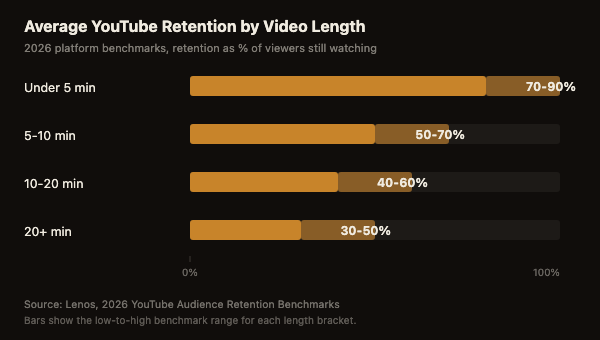
My market-update-style videos run 7 to 9 minutes, which puts me squarely in the 5-to-10-minute bracket where the industry benchmark retention range is 50% to 70%. That's a wide range. The difference between the bottom and the top of it usually isn't the hook. It's whether the middle third of the video, the part carrying your actual argument, holds together or falls apart.
YouTube videos under 5 minutes hold 70% to 90% of viewers on average, videos in the 5-to-10-minute range hold 50% to 70%, and videos over 20 minutes drop to 30% to 50% (Lenos, 2026 YouTube Audience Retention Benchmarks). The longer the video, the more the middle section has to carry the weight of keeping people there.
The Two-Act Structure I Rebuilt the Script Into
The fix was to run the script as two clean acts instead of one long chain. Act one establishes the stakes: the numbers, the mechanic behind them, a real example, and the opinion that example proves. Act two delivers the payoff: the GST rebate that softens the picture, and the negotiating leverage a buyer actually has in this market. Here's the paragraph order before and after the August 7th edit.
| Position | Original Draft | Rebuilt Script (Aug 7) |
|---|---|---|
| P1 | The numbers: starts down 21%, townhome price share 40% to 72% | Unchanged |
| P2 | The mechanic: presale investor fallout | Unchanged |
| P3 | Real example: Stillwater townhome that broke even | Unchanged |
| P4 | GST rebate, up to $50K (sitting right after the example) | Opinion, citing P3 directly, no gap |
| P5 | Opinion, two paragraphs from its own evidence | GST rebate, held for Act Two |
| P6 | Negotiating leverage: national vs. boutique builders | Unchanged |
Four paragraphs never moved. Two swapped places. That's the entire edit, and it's the difference between a script where the opinion has to stand on its own and a script where the opinion has proof standing right next to it. If you're writing anywhere close to Edmonton's market right now, this is worth flagging: the full video walks through the builder slowdown in more detail when it goes live August 21st, and the buyer-facing side of the same story gets its own deep dive in [INTERNAL-LINK: this week's companion post on buying new construction during a builder slowdown → Saturday Aug 22 blog post covering the same housing glut topic in buyer-facing detail].
Why Hold the Good News for Act Two?
The GST rebate is genuinely good news: eligible first-time buyers can save up to $50,000 in GST on qualifying new homes, with a full rebate on homes priced at $1 million or less and a partial rebate up to $1.5 million, for purchase agreements signed on or after March 20, 2025 (Government of Canada, Department of Finance, 2025). It's the kind of stat that makes a viewer feel better about buying new. That's exactly why it can't come before the stakes are set.
First-time buyers can receive a full GST rebate on new homes priced at $1 million or less, and a partial rebate on homes up to $1.5 million, worth up to $50,000 total, for purchase agreements signed on or after March 20, 2025 (Government of Canada, Department of Finance, 2025). It only works as a script payoff if the viewer has already felt the problem it's solving.
If I open with relief, the tension that's supposed to carry a viewer through paragraphs one to four disappears. Nobody sits through a problem they've already been told has a solution. Holding the rebate for act two means a viewer has to sit with the real risk, a townhome that breaks even after three years, before I hand them the offset. The order does the emotional work that no amount of editing or B-roll can fake.
Isn't that just basic storytelling? Sort of. But it's easy to forget when you're writing a market update, because market updates feel like they should just be information delivered in the order you thought of it. They shouldn't. The order is the structure, and the structure is what keeps someone watching past the three-minute mark.

The Fort Saskatchewan Example That Makes the Last Paragraph Work
Paragraph six didn't move, but it needed the new order to land properly. It's about negotiating leverage: national builders with head-office pricing rules have almost none of it right now, while boutique and infill builders carrying unsold inventory have a lot more room to work with. I use a Fort Saskatchewan build in that paragraph as the counterexample, a smaller builder who dropped price and threw in upgrades on a stalled unit rather than let it sit through another season.
That paragraph only works as a closer because everything before it has already made the case that this market rewards buyers who ask. By the time a viewer reaches it, they've seen the numbers, understood the mechanic, absorbed one real example, heard my opinion, and gotten the good news. Paragraph six isn't introducing a new idea. It's telling them what to do with the one they've already been sitting with for six minutes.
How to Run This Test on Your Own Script Before You Film
Before you film anything, read your script and circle two things: your strongest specific example, and the opinion or takeaway it's supposed to prove. If there's more than one paragraph between them, or if a different topic sits in the gap, move one of them. That's the whole test. It takes about ninety seconds and it's the single highest-leverage edit I make on every script now.
- •Find your proof paragraph. The specific example, name, number, or story that backs up your main point.
- •Find your opinion paragraph. The takeaway you actually want the viewer to walk away believing.
- •Close the gap. Move them next to each other. Proof immediately before point, every time.
- •Find your best news. Whatever paragraph makes the viewer feel relief. Check if it's sitting earlier than it needs to be.
- •Hold it for act two. Let the stakes sit uncomfortably for a minute before you offer relief.
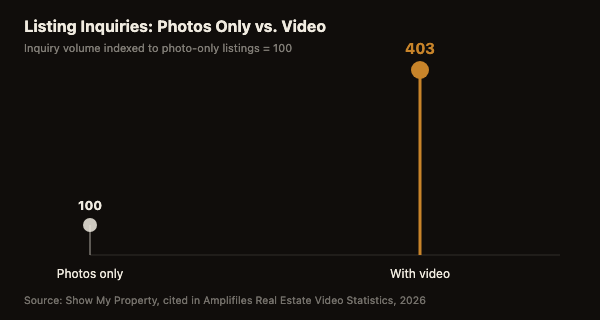
This isn't a small thing for lead generation either. Listings with video get 403% more inquiries than listings without it (Show My Property, cited in Amplifiles, 2026), and video content overall has been shown to help 81% of marketers generate leads. Structure is what decides whether that video actually gets watched long enough to do that job, or gets abandoned two minutes in with your best proof stranded in the middle.
I've seen this play out before on a bigger scale. My "5 Surprising Facts About Living in Edmonton" video didn't front-load its most surprising fact, it built toward it, and it's still my highest performer: 64,737 views and a 4:45 average view duration on a video built almost entirely around ordering, not production value. The camera, the lighting, the editing were the same as everything else I'd filmed that month. The order of the facts was what changed.
If you write your own scripts, do the ninety-second test on the next one before you film it. Circle your proof, circle your opinion, close the gap, and check where your good news is sitting. It's a small edit, and it's also usually the difference between a script that holds and one that just sounds right on paper. It pairs well with [INTERNAL-LINK: how I batch a month of scripts before filming day → Track 2 post on the monthly content planning and filming system].
Watch the Full Breakdown
See the Structure in the Actual Video
"Alberta Builders Are Sitting on a Housing Glut Right Now" goes live August 21st. Subscribe and you'll catch it, plus the breakdowns like this one that follow every video.
Subscribe on YouTubeFrequently Asked Questions
What is the serial position effect, and why does it matter for video scripts?
The serial position effect is the tendency to remember items at the start and end of a sequence better than items in the middle (Glanzer & Cunitz, 1966). In a script, that means proof placed in the middle with nothing supporting it gets forgotten before the opinion it's meant to back up ever arrives.
How long should a real estate YouTube video be for the best retention?
Industry benchmarks put videos under 5 minutes at 70% to 90% retention and videos in the 5-to-10-minute range at 50% to 70% (Lenos, 2026). Most market-update-style real estate content runs 7 to 9 minutes, so structure inside that window matters more than trimming length.
Should I put my best information first or save it for later in the script?
It depends what the "best information" is doing for you. A specific example should sit directly before the opinion it proves. Good news that resolves tension, like a rebate or a discount, works better held until after the stakes are established, not before.
Does script structure actually matter more than the hook?
The hook decides whether someone clicks past the first 30 seconds, where 33% or more of viewers can drop off if the opening doesn't land. Structure decides whether the other 8 minutes hold up. Both matter, but a strong hook on a disorganized middle still bleeds viewers by the halfway mark.
How do I check if my evidence and opinion are too far apart in my own script?
Circle your strongest specific example and the opinion it's meant to support. Count the paragraphs between them. If it's more than zero, or if an unrelated topic sits in the gap, move one of them so proof and point sit back to back.
Same six paragraphs. Same facts. One swap. That's the whole story of this edit, and it's why I now check every script for the gap between proof and point before I ever pick up the camera. If you're building content for your own brokerage or your own YouTube channel, this is the cheapest edit you'll ever make, and it's usually the one nobody thinks to check.
Categories
Recent Posts