$150K Toronto vs Edmonton: The Real 2026 Math | Homes with Tristan

Homes with Tristan — Relocation Guide
Is $150,000 Worth More in Toronto or Edmonton? The Real 2026 Math
By Tristan Boire, REALTOR | Park Realty, Sherwood Park AB
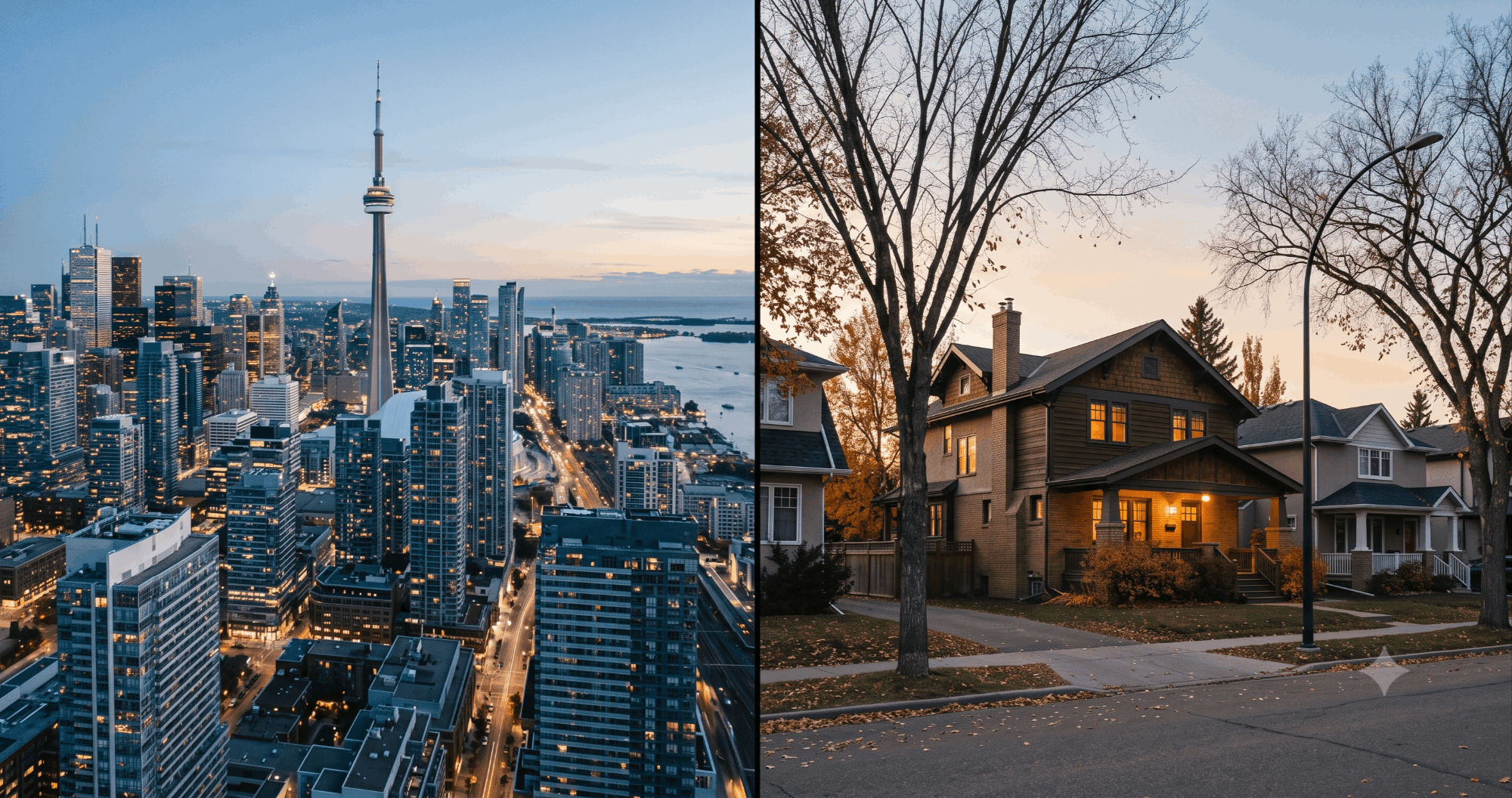
A $150,000 salary sounds like the same number no matter where you cash the paycheque. It isn't. Between provincial income tax, land transfer tax, consumption tax and the price of the house you're financing, a $150K earner in Edmonton keeps meaningfully more of every dollar than the same earner in Toronto, and the gap compounds fast once you factor in the mortgage.
This is the written breakdown behind my video "$150,000 Income in Toronto vs Edmonton: The Honest Math" [YOUTUBE LINK: add once video is live]. I wanted to lay out the actual numbers here, with sources, so you can check my work instead of just taking my word for it.
- On $150,000, Alberta take-home pay is $100,760 versus $98,331 in Ontario, a $2,429/year gap (talent.com, 2026).
- Toronto's median detached home was $1.4M in June 2026 versus $593,254 average in Edmonton (TRREB; RAE, June 2026).
- At today's rates, that's roughly $5,996/month in mortgage payments in Toronto versus $2,541/month in Edmonton on 20% down.
- The 10-year gap I quote in the video, more than $120,000, holds up: taxes and closing costs alone add $74,190, and the extra cost of financing a bigger Toronto mortgage pushes the real number well past that floor.
- For BC movers specifically, the tax math actually favours BC slightly. The real advantage of Alberta is housing, not income tax.
How Much of a $150,000 Salary Do You Actually Keep in Ontario vs. Alberta?
On a $150,000 salary, Alberta take-home pay is $100,760 a year compared to $98,331 in Ontario, a difference of $2,429 (talent.com 2026 payroll calculators). That's the federal tax staying identical in both provinces, with the entire gap coming from Alberta's flatter, lower provincial tax structure. It isn't life-changing on its own, but it's the first domino.
British Columbia actually edges out Alberta here. A $150K earner in BC takes home $102,080, about $1,320 more per year than in Alberta (talent.com, 2026). If you're moving from BC, the income tax line isn't the reason to come to Edmonton. We'll get to what is.
| Province | Net Take-Home on $150K | Consumption Tax |
|---|---|---|
| Ontario | $98,331/yr | 13% HST |
| Alberta | $100,760/yr | 5% GST only |
| British Columbia | $102,080/yr | 12% (7% PST + 5% GST) |
Alberta's provincial income tax is flat and lower across the board, and it doesn't pile on Ontario-style surtaxes as income climbs. That's the whole story on the tax side. It's real money, but it's not the number that actually moves people. Housing is. If you want the full breakdown of what a move actually costs beyond the house itself, see what it actually costs to move to Edmonton.

What Does $150,000 Buy You in Housing, Toronto vs. Edmonton?
In June 2026, the median price for a detached home within the City of Toronto was $1.4 million (TRREB). Zoom out to the wider GTA and the average detached price was $1.36 million, still more than double what the same house costs an hour outside the city limits. In Edmonton, the average detached home sold for $593,254 in June 2026 (Realtors Association of Edmonton, June 2026), down slightly from May's figure but still well under half of Toronto's.
That price gap shows up immediately at the down payment stage. Twenty percent down on the Toronto median is $280,000. Twenty percent down on the Edmonton average is $118,650. That's a $161,350 difference in cash you need to have saved before you even get a mortgage quote.
Land Transfer Tax: The One-Time Hit Ontario Buyers Don't See Coming
On a $1.4 million Toronto purchase, you're paying Ontario's provincial land transfer tax of $12,950 plus Toronto's municipal land transfer tax of another $12,950, for a combined $25,900 due at closing. Alberta has no provincial or municipal land transfer tax at all. Zero. That's not a rebate or a credit, it's a line item that simply doesn't exist here.
In my experience, this is the cost first-time Toronto-area buyers underestimate the most. It doesn't show up on the listing, it doesn't show up in the mortgage pre-approval, and it hits as one lump sum right when every other closing cost is also due.
What Does the Mortgage Payment Gap Look Like at Today's Rates?
At a 4.17% average conventional 5-year fixed rate (Ratehub.ca, July 24, 2026), a $1,120,000 mortgage on the Toronto median, 25-year amortization, runs about $5,996 a month. The equivalent $474,603 mortgage on the Edmonton average runs about $2,541 a month. That's a $3,455 monthly gap, before property tax, insurance, condo fees, or utilities enter the picture.
I ran these numbers myself using the current 4.17% rate rather than relying on last year's estimates, because rates have moved and old math gets stale fast. Over 120 monthly payments, the Toronto mortgage totals $719,568 paid, of which $402,481 is interest. The Edmonton mortgage totals $304,884 paid, of which $171,404 is interest. The interest-paid gap alone, the part of the payment that never turns into equity, is $231,077 over ten years.
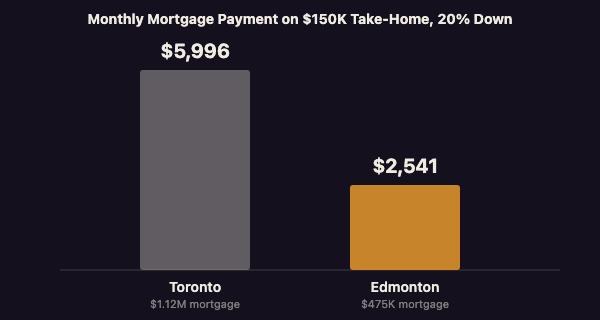
Worth being straight about what this number is and isn't. The principal portion of both mortgages builds equity, it's not lost money, it's forced savings in the form of home value. But the Toronto buyer is putting $161,350 more into that equity upfront and carrying $231,077 more in pure interest cost over a decade to get there. That's the real trade-off: a bigger, more leveraged asset versus a much smaller monthly obligation and far more breathing room.

Does Sales Tax Actually Matter Day to Day?
It adds up more than people expect. On $2,500 a month in non-housing spending, groceries excluded, Ontario's 13% HST costs about $325 a month while Alberta's 5% GST costs about $125, a $200 monthly difference or $2,400 a year (rate comparison per Canada Revenue Agency published provincial rates, 2026). Over ten years that's $24,000, roughly the price of a decent used car, just from the sales tax rate you never think about because it's baked into every price tag.
For BC movers, the gap is smaller since BC's 12% combined PST and GST is closer to Alberta's rate. On the same $2,500 monthly spend, that's roughly a $175 monthly difference, or $2,100 a year.
So Where Does the $120,000+ Gap Actually Come From?
In the video, I put the 10-year gap at more than $120,000. That's a conservative floor, and the math backs it up before you even get to the mortgage. Stack the provincial income tax difference, Ontario's land transfer tax, and the HST-versus-GST gap and Toronto already costs $74,190 more over a decade. Here's the math laid out so you can check it yourself.
| Category | 10-Year Cost, Toronto vs. Edmonton |
|---|---|
| Provincial income tax difference | $24,290 |
| Ontario land transfer tax (one-time) | $25,900 |
| Consumption tax (HST vs. GST) difference | $24,000 |
| Subtotal: taxes and closing costs only | $74,190 |
That's already most of the way to the $120,000+ floor I quote in the video, and it doesn't include a cent of mortgage math yet. The rest comes from financing a mortgage roughly two and a half times the size.
Layer in the mortgage and the number moves fast. Over ten years, the interest paid alone, the part of the payment that never turns into home equity, is $231,077 more in Toronto than in Edmonton at today's 4.17% rate. Add that to the $74,190 tax and closing-cost gap and you're at $305,267, well past the $120,000+ floor I use in the video, which was always meant to be a conservative, defensible number rather than the ceiling.

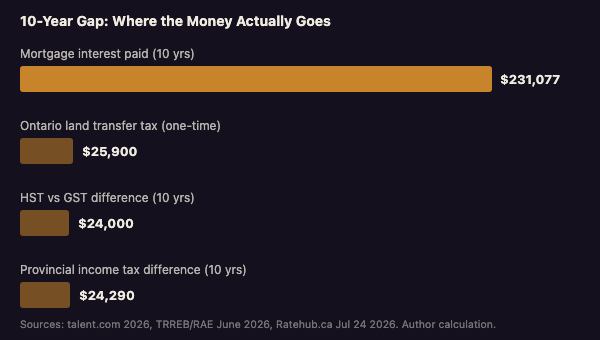
Notice that mortgage interest, not income tax, does almost all of the heavy lifting once you go past that $120,000 floor. People fixate on Alberta's tax advantage because it's the easiest number to Google, but it's actually the smallest piece of the gap. The real driver is that Toronto's home prices force a much bigger loan, and a much bigger loan means a much bigger interest bill, no matter what province you're in.
There's one more layer worth adding. If an Edmonton buyer takes even part of that monthly savings, say $500 a month, and invests it at a 6% annual return, that grows to roughly $82,000 over ten years just from compounding. Stack that on top of the $305,267 figure and you're looking at closer to $387,000 in total financial difference over a decade, not counting whatever the Toronto property appreciates by in the meantime. Either way, more than $120,000 is the floor, not the full story.
Thinking About the Move
Run Your Own Numbers Before You Decide
Every relocation is different depending on your income, your down payment, and your timeline. Grab the Edmonton Budget Buyer's Guide or book a 15-minute call and I'll walk you through what your specific numbers actually look like here.
Get the Budget Buyer's GuideWhat About Moving From BC Instead of Ontario?
Be honest about this one. If you're comparing BC to Alberta, the income tax argument actually runs backwards, BC take-home pay on $150K is about $1,320 higher than Alberta's. The consumption tax gap is smaller too, since BC's combined rate is only a few points above Alberta's flat GST.
So why do BC clients still move here? Housing, full stop. Vancouver and the Lower Mainland carry some of the highest home prices in the country, well above even Toronto in a lot of neighbourhoods. The mortgage math is the same story as Ontario, a much smaller loan on a much smaller monthly payment. If you're coming from BC, don't move here expecting a tax break. Move here for the house you can actually afford.
What This Actually Looks Like for the People Who Move
The numbers are one thing. What I actually watch happen is different. One client came from the GTA with his partner, both engineers, both earning well above average, both feeling like they were falling behind anyway because Toronto rent was eating everything. They moved to Edmonton, bought a home in the $600,000 range, and within six months were telling me they felt like they'd gotten a raise without getting a raise. Their mortgage was less than half what their rent had been.
Another client, a nurse from BC, moved here last year. She told me the thing that surprised her most wasn't the money, it was how fast Edmonton started to feel like home. She'd braced for a long adjustment period. Instead the financial relief made the transition easier, not harder, because she wasn't spending every spare thought on whether she could afford to stay somewhere.
Most of the people I work with on these moves are engineers, nurses, project managers, tech workers, business owners, government employees, and military members leaving service. That last one is personal, I spent over five years in the Canadian Armed Forces before getting into real estate, so I know firsthand what it's like to plan a move to a city you've never lived in on a timeline you don't fully control.

Is Edmonton's Economy Actually Growing, or Is This Just Cheap Housing?
Alberta's real GDP is projected to grow 2.7% in 2026, more than double the national growth rate of 1.3% (ATB Financial 2026 Economic Outlook). Employment in the province is up 104,000 jobs year over year, a 4.1% increase and the largest gain of any province in the country (Statistics Canada, Labour Force Survey, 2026). That matters because cheap housing on its own isn't a reason to move. Cheap housing plus a growing job market is.
I'd be skeptical of any city that's cheap because nothing is happening there. Edmonton isn't that. It's cheap and it's hiring, and that's a very different pitch.
Frequently Asked Questions
Is $150,000 a good salary in Edmonton?
Yes. On $150,000, Alberta take-home pay is $100,760 a year (talent.com, 2026), and the Edmonton average detached home was $593,254 in June 2026 (RAE), keeping the mortgage payment well within a single income's comfortable range.
How much more do you keep in Alberta versus Ontario on the same salary?
On $150,000, Alberta take-home pay is $2,429 higher per year than Ontario's ($100,760 versus $98,331), driven entirely by provincial tax rates since federal tax is identical (talent.com, 2026). Consumption tax and housing costs add far more to the gap than income tax alone.
Does Alberta have a land transfer tax?
No. Alberta has no provincial or municipal land transfer tax on any purchase price. Ontario buyers in Toronto pay both a provincial and a municipal land transfer tax, totaling $25,900 on a $1.4M purchase.
Is moving from BC to Alberta worth it for taxes?
Not for income tax specifically. On $150,000, BC take-home pay ($102,080) is actually about $1,320 higher than Alberta's (talent.com, 2026). The financial case for BC movers is housing cost, not provincial tax rates.
What mortgage rate should I use to estimate payments in 2026?
As of July 24, 2026, the average conventional 5-year fixed rate in Canada was 4.17%, with the best insured rates closer to 3.99% (Ratehub.ca, 2026). Always confirm current rates with a mortgage broker before budgeting a specific purchase.
Same salary, two very different financial lives. The tax line gets the headline, but the real gap between Toronto and Edmonton on $150,000 is the house you're financing and what that does to your monthly number for the next 25 years. Run your own numbers before you decide anything, because your down payment, your timeline, and your specific situation will move these figures around.
Categories
Recent Posts