Buying an Acreage Near Edmonton 2026
Homes with Tristan: Buyer Guide
Buying an Acreage Near Edmonton: The Financing, Water, and Septic Costs Nobody Mentions
By Tristan Boire, REALTOR | Park Realty, Sherwood Park AB
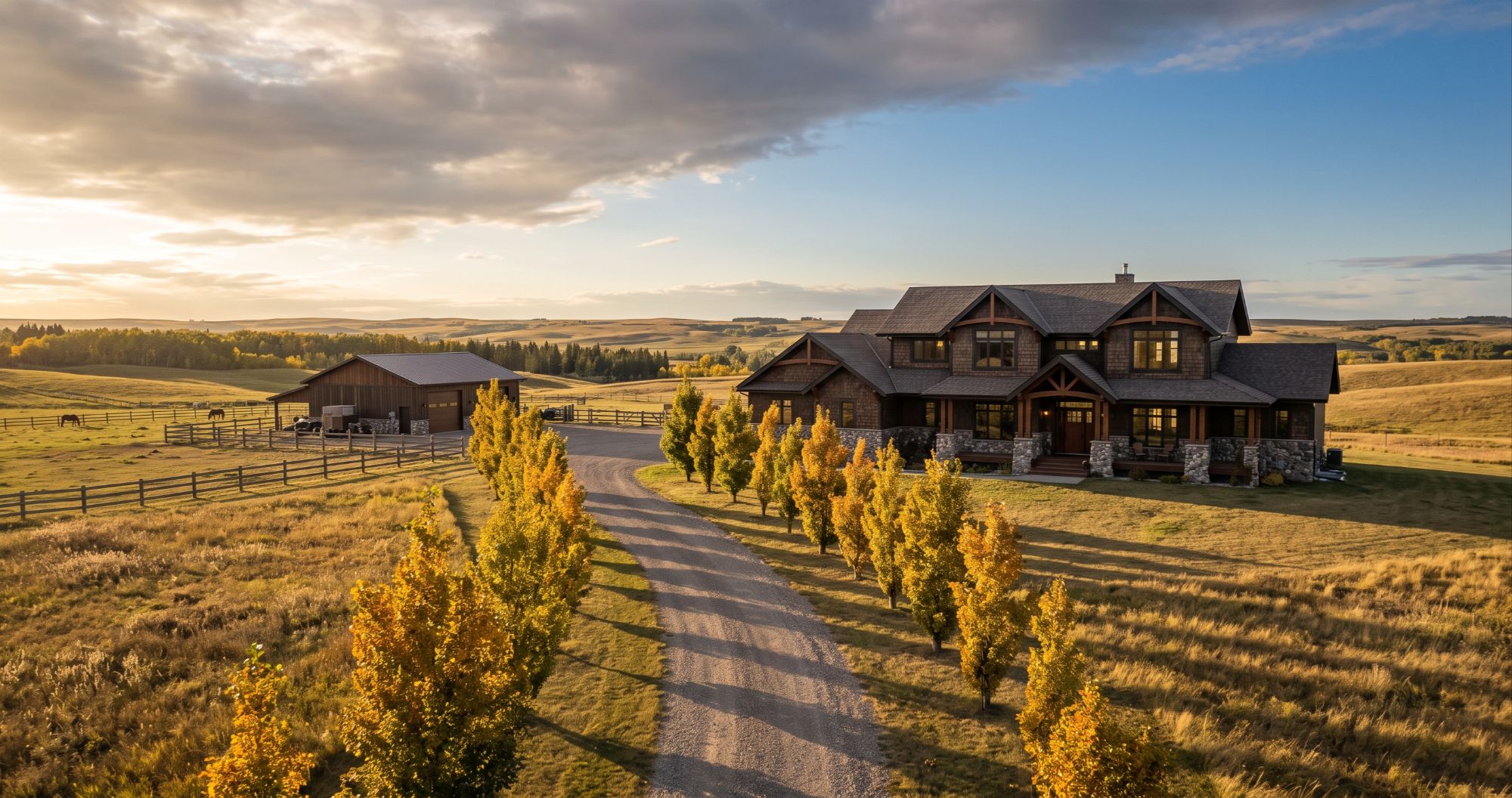
In July 2026, the average acreage sale in rural Strathcona County closed at $917,000, up 18.1% from a year earlier (Century 21 Leading Edmonton, 2026). Buyers keep coming, and most of them assume buying an acreage works the same way buying a house in the city does, just with more land attached. It doesn't.
Financing changes once you cross five acres. Water and sewer stop being a city utility bill and become your responsibility. My license covers residential and rural properties around Edmonton, so I spend a fair amount of time walking these deals with buyers who had no idea what they were signing up for until we got into the well and septic questions. Here's what actually matters before you write an offer.
- Rural Strathcona County acreages averaged $917,000 in July 2026, up 18.1% year over year (Century 21 Leading Edmonton, 2026).
- Most lenders only count about five acres toward your mortgage value, even on a 40-acre parcel (LendCity Mortgages, 2026).
- Down payment on a 5 to 10 acre property typically runs 25 to 35%, well above the 5 to 20% required in the city.
- Septic system replacement costs $20,000 to $40,000 depending on soil type and system design (Inspecus, 2026).
- Alberta does not regulate private well water, so annual testing is on the owner, not the province (Alberta.ca, 2026).
What Counts as an "Acreage" Near Edmonton, and Where Do You Find Them?
An acreage generally means a residential property between 1 and 40 acres, zoned outside city limits, with its own well and septic instead of municipal hookups (LendCity Mortgages, 2026). Around Edmonton, that mostly means Strathcona County, Parkland County, Leduc County, and Sturgeon County, each with its own price band and drive time back into the city.
Those two counties price very differently, and the gap is bigger than most buyers expect walking in.
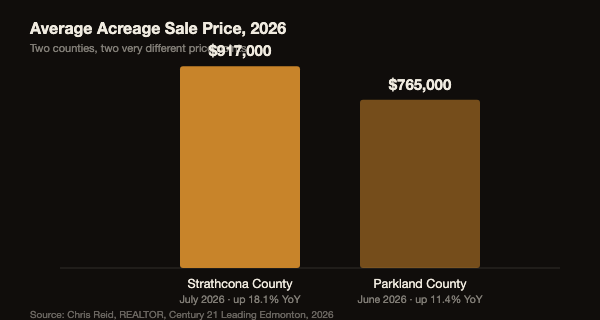
Strathcona County sits closer to Sherwood Park and southeast Edmonton, which is a big part of why it commands a premium. Parkland County, west of the city, stretches your dollar further if you're willing to add ten or fifteen minutes to your commute.
Why Financing an Acreage Costs More Than a City Mortgage
Most conventional lenders only count about five acres toward your mortgage value, no matter how large the legal parcel actually is (LendCity Mortgages, 2026). The rest of the land still shows up in your down payment requirement. It just doesn't help you borrow more.
Here's how that plays out by property size. Down payment requirements climb steadily as acreage grows, and they climb fast once you pass ten acres or the land is zoned agricultural.
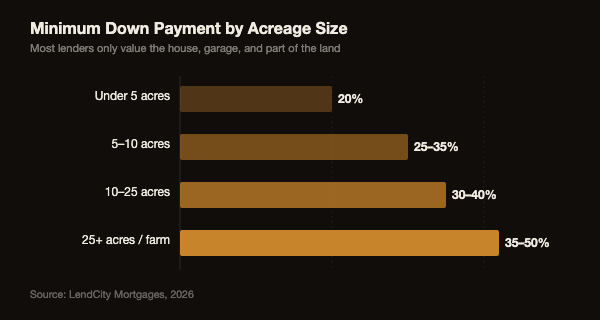
Why the jump? Lenders treat land past that five-acre mark as harder to resell if you default, so they price the risk into your down payment instead of the interest rate. Alberta-based lenders like ATB and Servus tend to be more flexible on non-standard rural properties than the big national banks. If you're buying anything over ten acres, work with a broker who does this regularly, not your regular city mortgage contact.
Your four financing paths on larger acreages
| Path | Best for | Note |
|---|---|---|
| Conventional / insured | Under 5 to 10 acres | Closest to a standard city mortgage |
| Agricultural lending (FCC) | Working farms, larger parcels | Farm Credit Canada, different qualification process |
| Private lending | Unconventional properties, tight timelines | Higher rates, short-term bridge only |
| Seller financing | Rare, but happens on acreages | Negotiated directly, get a lawyer involved early |
What the MLS Listing Won't Tell You About an Acreage
A city listing tells you most of what you need before you even book a showing. An acreage listing tells you the house and leaves the land as an afterthought, which is backwards, because the land is usually the reason you're paying acreage prices in the first place.
Filter your MLS search by county, not just by radius from Edmonton. Strathcona, Parkland, Leduc, and Sturgeon each have their own land use bylaw, and that bylaw decides whether you can add a shop, run a home-based business, or build a secondary suite for a parent or a renter. None of that shows up in the listing photos.
Questions the listing photos can't answer
- What's zoned for the land? Residential, agricultural, and country residential zoning each carry different rules on outbuildings and livestock.
- Who maintains the access road? Shared driveways and approaches need a written maintenance agreement, not a verbal understanding with a neighbour.
- What's actually usable? Ten acres can mean two usable acres and eight acres of slough or treed setback. Walk the property line, don't just look at the total on the listing.
Most buyers spend their showing time in the kitchen and the primary bedroom, the same habits from house-hunting in the city. On an acreage, I spend as much time outside as in. Where does water pool after rain? Which direction do the prevailing winds come from relative to the septic field? Those answers matter more than the countertops.
What You Need to Know About Well Water Before You Buy
Alberta does not regulate private well water, provincially or federally, which means quality and safety are entirely on the owner (Alberta.ca, 2026). The province recommends basic testing at least once a year, and more often for shallow wells or anything fed by surface water. That responsibility transfers to you at possession.

Most lenders will require a water potability test as a condition of financing before closing, and most acreage inspectors also test flow rate, looking for a minimum around 10 gallons per minute (greatalbertahomes.com, 2026). A water quality test runs $200 to $400 and takes 5 to 7 days to come back, so build that into your condition period. I always tell buyers to order it the same week the offer gets accepted, not after the home inspection clears.
I've had two deals in the last year where the well flow tested fine but the water itself came back with elevated nitrates from nearby agricultural runoff. Neither buyer walked away. Both negotiated a filtration system credit instead, which cost far less than the test itself and is worth knowing before you assume a failed water test kills the deal.
What You Need to Know About the Septic System
A septic inspection costs $400 to $800 and should be conditional on every acreage offer, full stop (greatalbertahomes.com, 2026). A full septic replacement, if it comes to that, runs $20,000 to $40,000 depending on soil type and the system design required (Inspecus, 2026). That's not a number you want to discover after you've waived conditions.
Alberta requires a permit before any private sewage system is installed or altered, under the 2021 Alberta Private Sewage Systems Standard of Practice, and the work has to be done by a certified contractor (Alberta.ca, 2026). Vetting that contractor matters as much as the permit itself, see how to find a good contractor in Edmonton for what to check before you hire one. A good inspector checks three things: a tank pump-out with video, the pump and alarm system, and the field itself for soft spots or surfacing that signals the drain field is failing.
- Age matters. Ask for install records. A system past 20 to 25 years old is closer to replacement than maintenance.
- Tank size matters. A typical household tank runs 1,500 to 2,500 gallons; undersized systems back up faster with a growing family.
- Distance matters. Well and septic need a minimum 30 metre separation by regulation, which can limit where you're able to add a shop or a second structure later.
The Costs That Show Up After Closing
Carrying an acreage costs more than carrying a comparable city home, and it's rarely the mortgage payment that surprises people. It's everything wrapped around it: well maintenance, septic servicing, driveway upkeep, fencing, and higher rural insurance premiums, all stacking on top of a normal utility bill.

Shared or private access roads run $500 to $3,000 a year to maintain, more if you're clearing snow yourself every winter (greatalbertahomes.com, 2026). On listings I've shown this year with shared access agreements, I always pull the maintenance agreement before we write an offer. It's a five-minute check that answers who plows, who pays, and who's on the hook if the road washes out.
None of these numbers are deal-breakers on their own. Stacked together, they change the real monthly cost of owning the property by a few hundred dollars, which matters when you're already stretching for a bigger down payment.
Should You Actually Buy an Acreage? My Honest Take
In my opinion, acreage life is worth it if you actually want the land, not just the idea of it. I've walked clients through properties who pictured weekend bonfires and ended up doing the math on driveway plowing and a 35-minute commute instead. That's a fair trade for some people. It isn't for everyone, and there's no shame in figuring that out before you write an offer instead of after.

What tips it in favour, most of the time, is space for kids or animals, a shop for a trade or a hobby, and a genuine willingness to learn a well pump instead of calling the city. What tips it the other way is wanting a bigger yard without wanting any of what comes with it. Ask yourself which one you actually are before the financing conversation even starts.
Frequently Asked Questions
Do I need 20% down to buy an acreage near Edmonton?
Not on a standard city lot, but acreages are different. Once a property runs past five acres, most lenders require 25 to 35% down, climbing to 35 to 50% on agricultural-zoned land or parcels over 25 acres (LendCity Mortgages, 2026). Get pre-approved before you tour.
How many acres will a mortgage lender actually finance?
Most conventional lenders only count about five acres toward your mortgage value, even if the legal parcel is 40 acres (LendCity Mortgages, 2026). The rest of the land adds to your down payment requirement, not your borrowing power. It surprises a lot of first-time acreage buyers.
How much does a septic system cost to replace near Edmonton?
A full septic replacement runs $20,000 to $40,000 depending on soil type and the system required (Inspecus, 2026). A basic inspection before you buy costs $400 to $800 and can save you from inheriting that bill. Always make your offer conditional on it.
How often should I test my well water in Alberta?
Alberta recommends basic testing at least once a year, more often for shallow wells or surface-fed sources (Alberta.ca, 2026). Private wells aren't regulated provincially or federally, so water quality is entirely on the owner. Testing through Alberta Health Services is a smart first move after possession.
Is Strathcona County or Parkland County a better fit for acreage buyers?
Strathcona County acreages averaged $917,000 in July 2026, while Parkland County averaged $765,000 the month before (Chris Reid, REALTOR, Century 21 Leading Edmonton, 2026). Strathcona usually means a shorter commute into Edmonton and Sherwood Park; Parkland stretches your budget further for more land.
Thinking About Rural
Let's Talk About What You're Actually Buying
Financing, well, septic, access roads. I'll walk you through the real numbers before you write an offer on an acreage near Edmonton.
Book a 15-Minute CallAcreage math is different math. Once you know the actual numbers, financing, well, septic, and everything that comes after closing, it stops being a guessing game and starts being a decision you can make with your eyes open.
Categories
Recent Posts