Edmonton Mortgage Arrears: What Rising Rates Mean
Homes with Tristan: Market Update
Edmonton Mortgage Arrears: What Rising Delinquencies Actually Mean for Homeowners Here
By Tristan Boire, REALTOR | Park Realty, Sherwood Park AB
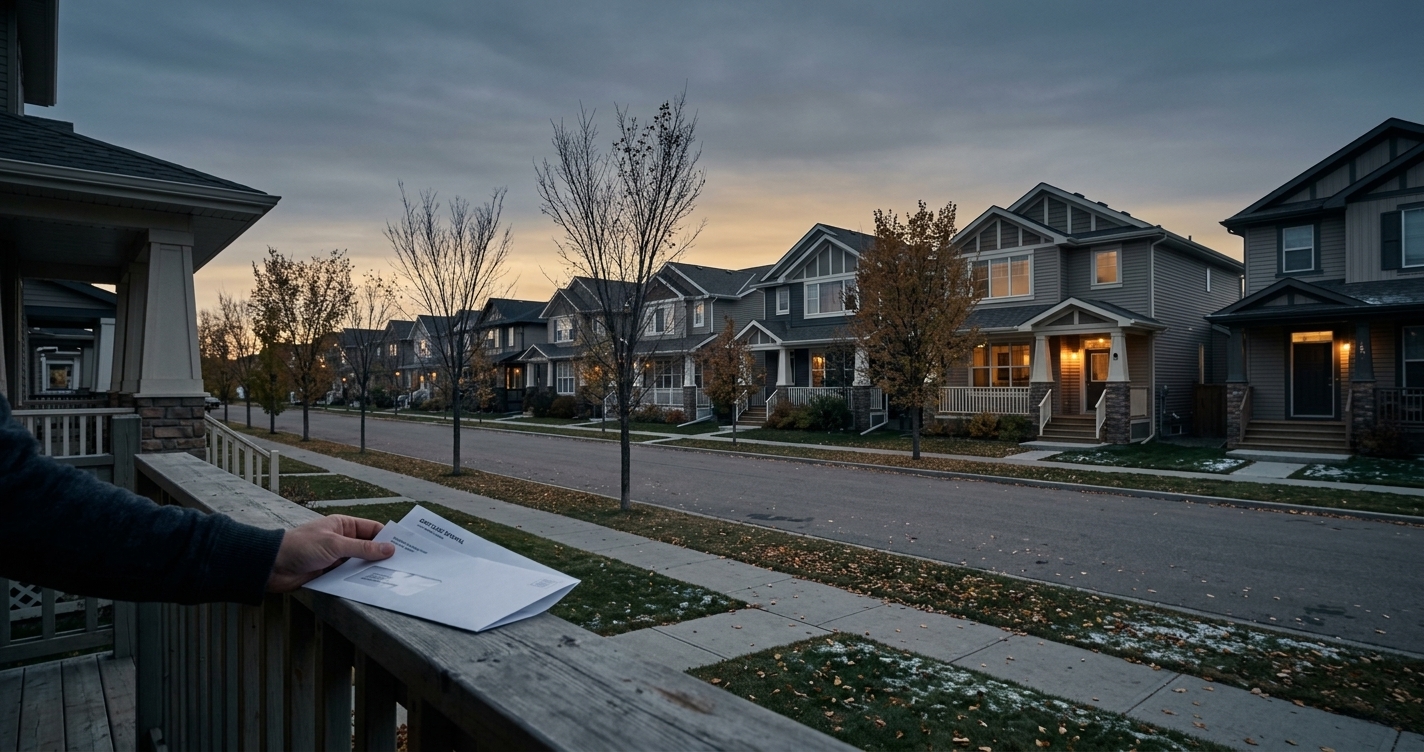
Canadian banks just posted some of their best quarters in years. In that same three month window, the national mortgage arrears rate hit its highest level since 2019. I walked through the national numbers and the mechanics behind that disconnect in this week's video, Banks Are Posting Record Profits While Canadians Lose Their Homes.
What that video does not do is look at Edmonton specifically, because the national number and the Edmonton number are not telling the same story. In my opinion, that is the more useful conversation for anyone reading this who actually owns a home here. So here is the local version: what the data says about Edmonton, how the process actually works if someone does fall behind in Alberta, and what to do long before it ever gets there.
Key Takeaways
- National 90+ day mortgage arrears hit 0.24% in 2026, up from 0.21% a year earlier, the highest level since 2019 (CMHC).
- Edmonton's own arrears rate is already running higher than Calgary's and higher than the national number, tied to labour market sensitivity (CMHC Housing Market Observer, 2026).
- Alberta uses judicial foreclosure through the courts, not power of sale like Ontario, a process that typically runs 12 to 24 months.
- Even at a seven year high, more than 99% of mortgage holders are still paying on time every month.
- The people getting hit hardest bought at the edge of affordability with no rate buffer built in before renewal.
What Is Canada's Mortgage Arrears Rate Right Now?
Canada's national rate of mortgages in arrears 90 days or more sits at 0.24%, up from 0.21% a year earlier and the highest level since 2019 (CMHC, 2026). That is still below the roughly 0.28% rate seen before the pandemic, so this is not uncharted territory, but the direction is what actually matters here.
A 90-day arrears number is also a lagging indicator. It tells you what already happened three months ago or more, not what is happening in real time. Equifax data shows mortgage delinquency balances up 32% nationally year over year, and up 52% in Ontario specifically, with Brampton now sitting around 0.64%, more than double the national average. CMHC points to the 2026 renewal wave as the main driver behind all of it.

Roughly 1.15 million Canadian mortgages are renewing this year, a lot of them at rates well above what people originally signed for. I go through exactly how that connects to record bank profits in this week's video, but the short version is that this story is not finished. It is just getting started.
CMHC's own data shows about 1.15 million Canadian mortgages are renewing in 2026, many at rates well above what borrowers originally signed. CMHC forecasts arrears will keep climbing through the rest of the year as more of those renewals land (CMHC, 2026).
Is Edmonton Actually More at Risk Than Calgary?
Edmonton's own 90+ day arrears rate was already running at roughly 0.29% as of the most recent CMHC data, well above the 0.24% national number and nearly double Calgary's 0.16% (CMHC Housing Market Observer, 2026). That is the opposite of the story most national coverage tells about Alberta.
Most national coverage, including my own video this week, lumps Alberta in as the stable province next to Ontario and BC. That is true when you compare Alberta as a whole to Ontario. It is not equally true inside Alberta. The CMHC Housing Market Observer flags Edmonton specifically as more exposed than Calgary because of labour market sensitivity, meaning Edmonton's economy still leans harder on cyclical sectors tied directly to household income, while Calgary's is more diversified. CMHC projects Edmonton's rate climbing toward roughly 0.31% by the end of 2026, while Calgary is expected to stay closer to 0.18%.
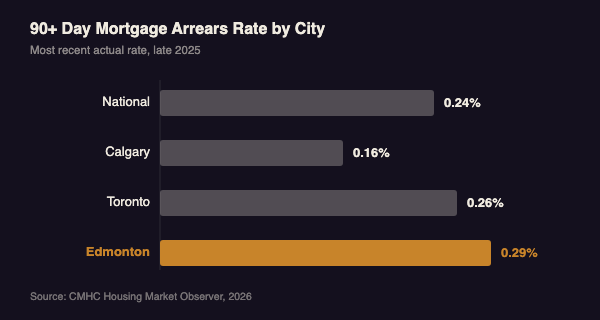
Edmonton is not Toronto. It is not close. But it is also not Calgary, and I think that distinction gets lost every time this story gets told at the national level. If you own a home in Edmonton, the number that actually applies to you is higher than the one making headlines.
By late 2026, CMHC projects Edmonton's arrears rate will sit near 0.31%, compared with roughly 0.18% for Calgary and 0.34% for Toronto (CMHC Housing Market Observer, 2026). Edmonton is not Toronto, but it is not Calgary either.
Why Are Bank Profits Going Up While More Homeowners Fall Behind?
RBC posted $5.5 billion in profit for the quarter, up 25% year over year, and five of the six major banks raised their dividends in the same three months arrears hit a seven year high (Globe and Mail, 2026). I break down exactly how both of those things are true at once in this week's video, but here is the short version for anyone reading instead of watching.
A 0.24% arrears rate means, even at the highest level since 2019, well over 99% of Canadian mortgage holders are still paying on time every single month. Banks do not need every borrower to succeed to post a great quarter. They need the overwhelming majority to keep paying, and they are. Banks also lend against real assets, so when a property does go into default, the lender generally recovers most or all of what it is owed once the property sells, sometimes with the borrower still on the hook for any shortfall.
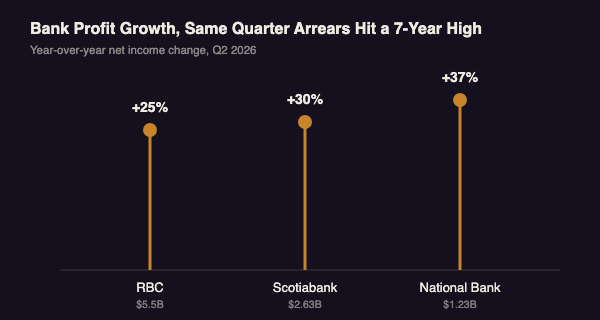
So the pain shows up almost entirely on the homeowner's side, while a bank's overall portfolio stays healthy because it is spread across millions of loans. That is not a conspiracy. It is just how a portfolio of a few million mortgages behaves when a small percentage of it is under stress.
Scotiabank's profit rose to $2.63 billion from $2.03 billion a year earlier, and National Bank's climbed to $1.23 billion from $896 million in the same quarter (Globe and Mail, 2026). Bank portfolios are spread across millions of loans, so the strain shows up almost entirely on the homeowner's side, not the bank's bottom line.
What Actually Happens If You Fall Behind on Your Mortgage in Alberta?
Alberta does not use power of sale the way Ontario does. Alberta uses judicial foreclosure, meaning a lender has to go through the courts to sell a property after a default, a process that typically runs somewhere between 12 and 24 months from the first missed payment (WOWA, 2026). That distinction gets mixed up constantly, including in casual conversation among agents, so it is worth being precise about.
Here is roughly how it plays out. Most lenders allow a short grace period, often around 15 days, before late fees apply. After three or four consecutive missed payments, the account is formally in default, and the lender typically sends a demand letter that gives the homeowner a window, often around 35 days, to cure it. If nothing changes, the lender files a Statement of Claim with the court, usually 90 to 120 days after that first missed payment. From there, court proceedings can run another six to twelve months, and Alberta courts can grant up to six months of redemption time after a sale is even ordered, giving the homeowner room to refinance, sell privately, or otherwise resolve the default before losing the property outright.
What happens to the equity
If the property sells for more than what is owed, the remaining funds go back to the homeowner. If it sells for less, the homeowner can still owe the difference. That is the part people miss most often. Losing the house does not automatically mean the debt is settled.
I am not a mortgage broker, and I do not advise clients on how to manage their finances. What I can tell you, from watching this play out with people I work with, is that the Alberta process gives homeowners more runway than a lot of people assume, but that runway only helps if it gets used early. Waiting until a Statement of Claim shows up is waiting far too long.
In Alberta, a lender pursuing judicial foreclosure must file a Statement of Claim with the court and give the homeowner a cure period before the case can proceed, and courts can grant up to six months of redemption time after a sale is ordered (WOWA; New Homes Alberta, 2026). That is meaningfully longer than Ontario's power of sale timeline.
What Should You Actually Do Before It Gets There?
The homeowners I see handle a rate renewal the easiest are the ones who know their renewal date months ahead of time and have already run the higher-rate number, not the ones who wait for the letter to show up. That is not financial advice, it is just a pattern I have noticed working with buyers and sellers here in Edmonton for the past year and a half.

- Know your renewal date. Check it against today's rates, not the rate you signed at.
- Call before the renewal date, not after. A lender or mortgage broker can only help with time on the clock.
- Build a buffer if you can. Even a small cushion changes how a rate move feels month to month.
- Talk to a mortgage broker, not just your bank. A broker who specializes in renewals can look at options a bank's own renewal letter will not show you.
I keep a short list of mortgage brokers I trust to have this conversation with clients directly, since it is genuinely not something I am licensed or qualified to walk you through myself. If you want an introduction, ask me and I will point you to someone who actually does this for a living.
Know Where You Stand
Not Sure What Your Renewal Will Actually Cost You?
Grab the Edmonton Budget Buyer's Guide, or book a 15 minute call and I'll help you think through where you stand and who to talk to next.
Get the Buyer's GuideSo if you are carrying a mortgage in Edmonton right now, the takeaway is not to panic about a national headline that was never really describing your street in the first place. It is to know your own number, know Edmonton's number, and stress test your renewal against a rate a point or two higher than what you are paying now, well before it becomes a problem instead of after.
Frequently Asked Questions
What counts as mortgage arrears in Canada?
A mortgage is considered in arrears once a payment is 90 or more days overdue. Canada's national 90+ day arrears rate is currently 0.24%, up from 0.21% a year earlier and the highest level since 2019 (CMHC, 2026).
Is Edmonton at risk of a wave of foreclosures?
No. More than 99% of Edmonton mortgage holders are still paying on time. That said, Edmonton's own arrears rate is running higher than Calgary's and the national average, at roughly 0.29%, and CMHC forecasts it climbing toward 0.31% through 2026 (CMHC Housing Market Observer, 2026).
Does Alberta use power of sale or foreclosure?
Alberta uses judicial foreclosure, not power of sale like Ontario. The lender must go through the courts, a process that typically takes 12 to 24 months from the first missed payment, including up to six months of redemption time after a sale is ordered (WOWA, 2026).
Can I still owe money after a foreclosure sale in Alberta?
Yes. If a property sells for less than what is owed on the mortgage, the homeowner can still be responsible for the shortfall. If it sells for more, the remaining equity is returned to the homeowner after the debt is paid.
How do I know if my mortgage renewal will cost more?
Compare your current rate to today's posted rates for your term length, and do it a few months before your renewal date, not the week of. Roughly 1.15 million Canadian mortgages are renewing in 2026, many at rates above what borrowers originally signed (CMHC, 2026).
Categories
Recent Posts