Does the Alberta Separation Referendum Actually Affect Edmonton Home Prices?

Homes with Tristan: Market Update
Does the Alberta Separation Referendum Actually Affect Edmonton Home Prices?
By Tristan Boire, REALTOR | Park Realty, Sherwood Park AB
A poll says 44% of Edmonton residents would consider leaving Alberta if the province actually separates. On October 19, Albertans vote in a referendum that doesn't even decide separation itself, it only decides whether to keep pursuing it. In between those two facts sits a lot of noise, and some of that noise is landing directly on how people think about buying or selling a home here.
I'm not going to tell you how to feel about Alberta separating. That's not my place, and I'm not taking a side on it in this post. What I want to do is walk through the actual real estate numbers: what the poll really says, whether Alberta's economy is genuinely struggling, and whether Edmonton home prices have actually moved because of any of this. I covered the same ground in this week's video, "What the Alberta Separation Referendum Could Actually Do to Your Home's Value," if you'd rather watch it than read it.
Key Takeaways
- A Research Co. poll (Aug 2026) found 44% of Edmonton Metro residents and 49% of Calgary Metro residents would consider leaving a separate Alberta, but that's a hypothetical question, not a moving plan.
- Edmonton's benchmark home price was down just 0.6% year over year in August 2026 (REALTORS Association of Edmonton), a normal seasonal cooldown, not a referendum-driven collapse.
- Toronto (-4.5% YoY) and Vancouver (-5.6% YoY) are both softening far more than Edmonton right now, with zero separation talk driving either market.
- Alberta added roughly 79,000 jobs year over year as of June 2026, a 3% gain that outpaced every province except PEI (RBC Economics).
What Does the October 19 Referendum Actually Vote On?
On October 19, 2026, Alberta holds a referendum on whether to pursue separation, not a vote on separating itself (Globe and Mail, 2026). If it somehow moved forward from there, you're still looking at years of negotiation over debt division, currency, and borders before anything actually changes on the ground. That distinction gets lost in a lot of the coverage, and I think it matters more than almost anything else in this conversation.
That's the backdrop for the poll everyone keeps bringing up. I want to break down what it actually measured, because the way it's being repeated online isn't quite the same as what it asked.
What Does the Research Co. Poll Actually Say?
Research Co.'s August 2026 poll found 44% of residents in the Edmonton Metro Area and 49% in the Calgary Metro Area said they'd consider leaving a sovereign Alberta, compared to 38% in the rest of the province (Research Co., CBC News, 2026). Calgary coming in higher than Edmonton is worth noting on its own, it probably reflects how much more exposed Calgary's economy is to this kind of uncertainty right now given its energy and head-office concentration.
A "would consider" question is not a moving plan. It measures a hypothetical reaction to a hypothetical outcome, six weeks before Albertans even vote on whether to keep pursuing separation at all (Research Co., August 2026).
I'm always a little skeptical when a survey question about a hypothetical gets repeated online as if it's a settled outcome. I work with out-of-province clients constantly, coordinating a real move means selling your current home, buying a new one, switching jobs, maybe pulling kids out of school, and packing up everything you own, all at once. That's a heavy lift for one household. If even a meaningful fraction of that 44% actually listed their homes at the same time, you'd see real downward pressure on prices, and most of those same sellers would end up taking less than they expected. That tension is part of why I don't think the number translates cleanly into "people are leaving." The next part is where the theory actually gets tested against what's really happening in the market, and that's the part I care about more.
Is Alberta's Economy Actually Struggling Because of Separation Talk?
There's also a Calgary Chamber of Commerce survey circulating, and I want to be precise about what it actually measured, because "8 in 10 businesses" is how I keep hearing it summarized. The real numbers: Probe Research surveyed 137 Calgary Chamber members in June 2026, and 63% said the referendum is already having a negative impact on their business, 74% said they see no tangible benefit from it, and 48% said they're likely to relocate if separation moves forward (Calgary Chamber of Commerce, 2026). The Chamber's modeling also points to $10 to $15 billion in foregone investment this year, roughly $3,000 per Albertan.
That's a real number, and I don't think referendum uncertainty is contributing nothing to business hesitation. But it's a survey of Chamber members specifically, not a read on the entire Alberta economy, and when I look at the broader employment data, the picture doesn't match how dire that framing sounds. Alberta's unemployment rate sat at 6.8% in August 2026, down from 7.0% in July (Statistics Canada, Labour Force Survey). And as of June 2026, Alberta had added roughly 79,000 jobs year over year, a 3% gain that outpaced every province in the country except Prince Edward Island (RBC Economics, 2026).
So here's how I actually read it: referendum talk is probably contributing to some business hesitation among Chamber members specifically, and the broader job market is still adding positions faster than almost anywhere else in Canada. Both of those things can be true at once, and I don't think one survey of Chamber members should get to speak for the entire provincial economy any more than one hypothetical poll question should get to speak for the entire housing market. I broke down exactly what's driving Edmonton's slower fall in this month's market update.
Have Edmonton Home Prices Actually Dropped Because of the Referendum?
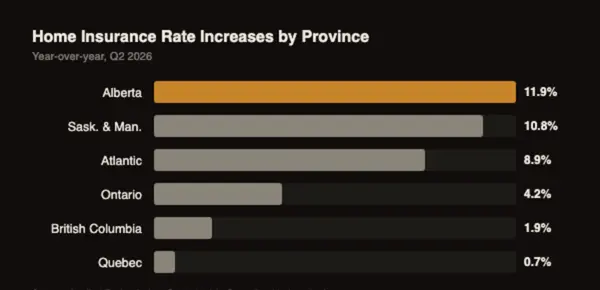
There's a specific claim going around that Alberta home prices have already dropped several percentage points because of separation talk. I want to push back on that directly, because I couldn't find a credible primary source behind the number when I went looking, and it doesn't match Edmonton's actual data. Edmonton's benchmark price was $426,900 in August 2026, down a modest 0.6% year over year (REALTORS Association of Edmonton, CREA, 2026). That's a normal seasonal cooldown, the kind Edmonton sees most years heading into fall, not a referendum-driven collapse. Other reporting backs that up too: Calgary itself has posted roughly 1% year-over-year price declines for four straight months, and Edmonton's own growth slowed to about 1% back in June (The Globe and Mail, 2026), nowhere close to a province-wide 4.2% collapse.
| Market | Benchmark Price (Aug 2026) | YoY Change | Separation Talk? |
|---|---|---|---|
| Edmonton | $426,900 | -0.6% | Yes |
| Greater Toronto Area | $993,410* | -4.5% | No |
| Metro Vancouver | $1,081,900 | -5.6% | No |
Edmonton and Vancouver figures are MLS HPI composite benchmark prices. *Toronto figure is average selling price (TRREB's public release doesn't publish a composite benchmark dollar figure); all year-over-year percentages shown are HPI composite changes. Source: REALTORS Association of Edmonton, Toronto Regional Real Estate Board, Greater Vancouver REALTORS, August 2026.
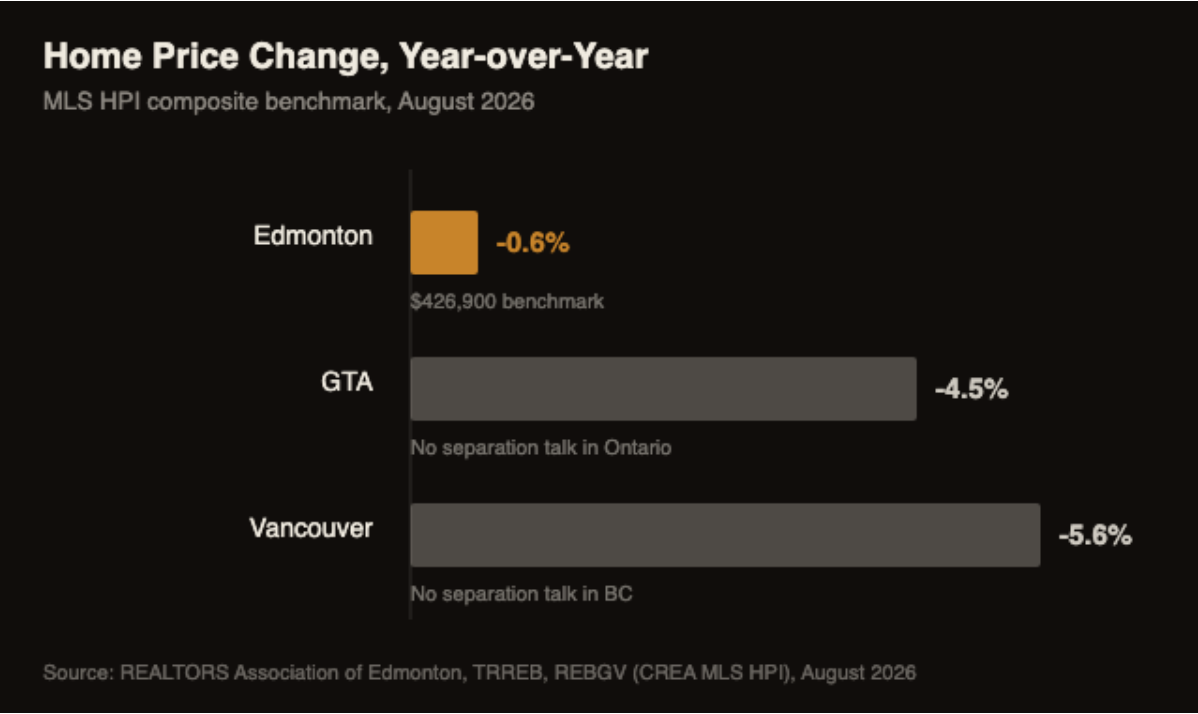
Zoom out and look at what's happening across the rest of the country: nobody's holding a referendum in Ontario or BC, yet both markets are softening far harder than Edmonton is. The Greater Toronto Area is down 4.5% year over year, and Metro Vancouver is down 5.6%, both sitting in balanced-to-buyer territory with more listings and more room to negotiate. So if Edmonton's 0.6% dip is supposedly being driven by referendum fear, what's driving a decline five to ten times larger in cities with zero separation talk at all? If you're weighing where in Edmonton to buy regardless of how any of this plays out, our neighbourhood guides break down where pricing actually sits right now.
To me, that's the actual story here. It's entirely possible the referendum narrative is being used to explain something that's really a much broader national slowdown, one that has nothing to do with Alberta politics at all. Higher borrowing costs, a national dip in interprovincial migration, and a glut of new condo supply in both Calgary and Edmonton are all playing a role too, and those pressures exist whether or not October 19 changes anything.
Should You Wait to Buy or Sell Until After October 19?
Genuinely, no one has asked me that directly yet, and if someone did, I'd be a little surprised, because there's a fair amount of fear-mongering in how this story gets covered. The people I actually talk to day to day, my clients, the people around me, we haven't been having conversations about leaving Alberta over how the referendum turns out. My advice stays centered on the facts of the actual market, not the headlines, and we're heading into the time of year where Edmonton typically slows down anyway. Sellers get a bit less, buyers pay a bit less, and that's true independent of any of this.
- If you've got the benefit of time: there's no reason to rush a decision based on a hypothetical outcome that's still weeks out.
- If you have to move regardless: a job transfer with a hard date, for example, you don't have the luxury of waiting to see what happens either way.
- Either way: the decision comes down to your situation, not the poll numbers circulating online.
Not sure where you stand
Let's Talk Through Your Actual Situation
These decisions are never a simple yes or no. If you want to talk through where you actually stand, buying or selling, I'm happy to have that conversation directly.
Book a 15-Minute CallFrequently Asked Questions
What does the October 19, 2026 Alberta referendum actually vote on?
It's a vote on whether to keep pursuing separation, not a vote to separate itself (Globe and Mail, 2026). If it moved forward from there, years of negotiation over debt, currency, and borders would follow before anything actually changed.
Have Edmonton home prices dropped because of the referendum?
Edmonton's benchmark price was down 0.6% year over year in August 2026 (REALTORS Association of Edmonton), a normal seasonal cooldown. Toronto (-4.5%) and Vancouver (-5.6%) are both softening more, with no referendum driving either market.
Is Alberta's job market actually struggling right now?
No. Alberta added roughly 79,000 jobs year over year as of June 2026, a 3% gain that outpaced every province except PEI (RBC Economics). Unemployment sat at 6.8% in August 2026, down from 7.0% in July (Statistics Canada).
Should I wait to buy or sell a home in Edmonton until after October 19?
It depends entirely on your situation. Buyers or sellers with flexible timelines have no urgent reason to rush a decision around a hypothetical outcome. Those with a hard deadline, like a job transfer, don't have the option to wait regardless. Our Buyer's Guide and Seller's Guide both walk through the current market conditions in more detail.
What did the Research Co. poll actually ask?
It asked whether residents would consider leaving a sovereign Alberta, a hypothetical reaction to a hypothetical outcome. 44% in Edmonton Metro and 49% in Calgary Metro said yes (Research Co., August 2026), which is different from an actual moving plan.
At the end of the day, it's entirely up to you as a buyer or seller when you make your move. My job is to keep that decision grounded in what the market is actually doing, not in whichever number is circulating the loudest that week.
Categories
Recent Posts