Property Tax Assessment Appeal in Alberta

Homes with Tristan | Financial Guide
How to Appeal Your Property Tax Assessment in Alberta (And Win)
By Tristan Boire, REALTOR | Park Realty, Sherwood Park AB
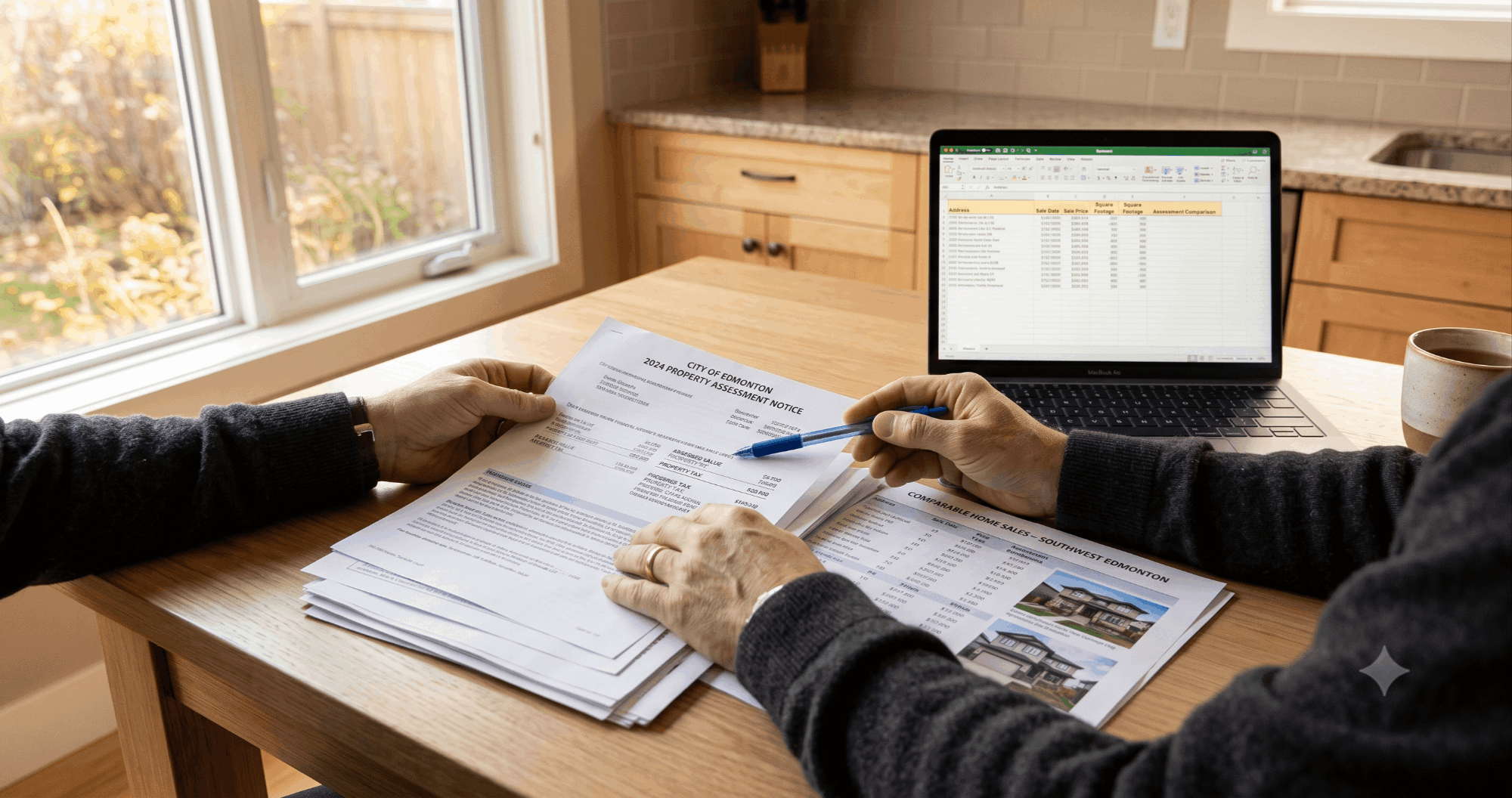
Every homeowner in Edmonton, Sherwood Park, and St. Albert gets a property assessment notice once a year, and most people glance at the number, sigh, and move on. You don't have to. Alberta gives every homeowner the legal right to formally challenge that number if you can show it's wrong, and the process is more straightforward than most people assume.
I've had sellers tell me after the fact that they wished they'd looked into their assessment sooner, especially the ones whose square footage or lot size was recorded wrong on file. This guide walks through how assessment actually works in Alberta, the real deadlines and fees for Edmonton, Sherwood Park, and St. Albert, and what kind of evidence actually moves the needle at a hearing. If you're newer to owning here, our buyer resources page covers a lot of the other paperwork that shows up in that first year.
Key Takeaways
- • Assessed value reflects market value as of July 1 the year before, not today's price (City of Edmonton, 2026).
- • You get 60 days from your Notice of Assessment date to file a formal complaint (Municipal Government Act, s.284(4)).
- • Filing costs $50 for a typical detached home in Edmonton, Sherwood Park, or St. Albert, refunded if you win.
- • Comparable sales and appraisals work. "My taxes are too high" doesn't, since you can only appeal the value, not the bill.
How Property Assessment Actually Works in Alberta
Your assessed value is the city's estimate of what your property would have sold for on the open market as of July 1 of the year before the tax year, adjusted for your home's physical condition as of December 31 (City of Edmonton, Property Assessment, 2026). It isn't today's price. It's a snapshot from seven to eighteen months earlier.
That timing catches a lot of people off guard. If you bought your home in early 2026 for more than your assessment shows, that's normal, the assessment was set before your purchase even happened. If the market cooled off since last summer, your assessed value might sit above what you'd actually get today. Neither situation is an error by itself. What matters is whether the number reflects what similar homes were actually selling for as of that July 1 snapshot.

It's also worth remembering that your property tax bill and your assessed value aren't the same fight. Council sets the mill rate separately from what your home is worth, so a formal complaint can only change your assessed value, never the rate itself. If you're closer to selling than you think, understanding assessed value versus true market value matters for more than your tax bill. Our seller resources page covers how these numbers actually factor into pricing a home correctly.
Alberta's Matters Relating to Assessment and Taxation Regulation sets July 1 as the valuation date and December 31 as the physical condition date for every municipality in the province (Government of Alberta, Municipal Affairs, 2018). Your 2026 notice reflects your home's value in the summer of 2025, not the market today.
The Appeal Timeline: Notice, Deadline, and Hearing
You have 60 days from your municipality's Notice of Assessment date to file a formal complaint, and that clock doesn't wait for you to get organized (Municipal Government Act, s.284(4)). Miss it, even by a day, and the Assessment Review Board can't hear your case until the next assessment cycle opens.
Here's roughly how the process runs, start to finish:
- • Notice mailed. Your assessment notice arrives with a Notice of Assessment date printed on it, that date starts the 60-day clock, not the mailing date itself.
- • Informal review. Talk to a municipal assessor before you file anything. It's free, it's often faster, and it resolves plenty of complaints before a formal one is ever needed.
- • Formal complaint filed. Submit the Assessment Review Board complaint form and the $50 fee before the deadline, online, by mail, or in person depending on your municipality.
- • Hearing scheduled. Boards hear complaints by video, phone, in writing, or in person. Both you and the municipal assessor submit evidence in advance.
- • Decision issued. The board must rule in writing within 30 days of the hearing, or before the end of the tax year, whichever comes first.
Which board hears your case depends on your property type. The Local Assessment Review Board (LARB) handles residential properties with three or fewer dwelling units and farmland, which covers nearly every detached home, duplex, and small infill in the region. The Composite Assessment Review Board (CARB) handles larger multi-family buildings and non-residential property instead, and it always includes one member appointed by the province alongside two local members (Alberta.ca, Assessment Review Boards).
Edmonton vs. Sherwood Park vs. St. Albert: What's Actually Different
The $50 filing fee for a typical detached home is identical across Edmonton, Strathcona County, and St. Albert, but the calendar isn't (City of Edmonton; Strathcona County; City of St. Albert, 2026). Edmonton mails a standalone assessment notice every January with a complaint deadline in March. Strathcona County mails a combined assessment and tax notice in February, and the 60-day complaint window that follows lands in April. St. Albert builds assessment into a combined notice that goes out later in the spring, pushing its deadline into summer.
| Municipality | Notice Timing | 2026 Complaint Deadline | Filing Fee |
|---|---|---|---|
| Edmonton | Standalone assessment notice, mailed early January | March 23, 2026 | $50 (3 or fewer units) |
| St. Albert | Combined assessment and tax notice, mailed spring | July 27, 2026 | $50 (3 or fewer units) |
| Strathcona County (Sherwood Park) | Combined assessment and tax notice, mailed February | 60 days from the Notice of Assessment date printed on your notice; fell in April 2026 | $50 per roll number (3 or fewer units) |
Every municipality prints the actual deadline directly on your notice. Treat the table above as the general pattern for how each municipality's calendar tends to run, not a substitute for the date sitting in your own mailbox.
For a typical detached home in Edmonton, Strathcona County, or St. Albert, the Assessment Review Board filing fee is $50 per roll number, and it's refunded if the board changes your assessed value in your favour (City of Edmonton; Strathcona County, 2026). Multi-family and commercial properties pay a higher, assessed-value-based fee instead.
What Evidence Actually Wins (And What Doesn't)
Assessment Review Boards rule almost entirely on comparable sales and factual errors, not opinions about affordability (Government of Alberta, Filing a Property Assessment Complaint, 2026). The burden of proof sits with you as the complainant, so a complaint without evidence rarely survives a hearing.
What actually works
- • Comparable sales. Pull three to six arm's-length sales of similar homes in your neighbourhood from around the July 1 valuation date, and note how each one differs from your property.
- • An independent appraisal. A certified AACI appraisal carries real weight, especially for higher-value or unusual properties where good comparables are hard to find.
- • Errors in your property's stated characteristics. Wrong square footage, an incorrect lot size, a garage or finished basement on file that doesn't exist, a renovation that never happened.
- • Documentation. Photos, building permits, or a survey that back up whatever correction you're asking for.
What doesn't
- • "My taxes went up too much." You can only appeal the assessed value, not the mill rate or your tax bill (City of Edmonton, 2026).
- • Active listing prices. Boards weigh completed sales, not what a neighbour happens to be asking right now.
- • General frustration. Market commentary without a specific comparable or documented error attached rarely changes a board's mind.

In my experience walking through homes across Edmonton and Sherwood Park, the complaints that actually succeed are almost always about a specific factual mistake on file, a basement listed as finished when it isn't, or a square footage number pulled from an old permit that never matched what actually got built. Vague frustration about the number rarely moves a board. A documented error almost always gets a second look.
Realistic Odds: What to Actually Expect
Winning a complaint usually means proving a specific, provable error, not shaving an arbitrary percentage off your bill (Government of Alberta, Municipal Property Assessment Complaints and Appeals). Filing doesn't pause your tax due date either, so budget for the full amount while your complaint is pending, penalties still apply if you're late regardless of an open complaint.
So is it worth your time? If you've got a genuine comparable sale or a factual error sitting on your file, yes, and the $50 comes back to you if the board agrees. If you're filing because the number simply felt high this year with nothing specific behind it, you're less likely to see a change, and that fee won't be refunded. The board's written decision is close to final too. You can request a judicial review through the Court of King's Bench, but that route is reserved for procedural unfairness, not for disagreeing with the outcome, and it isn't cheap or fast.
Here's the part most guides skip: a corrected assessment doesn't just save you money this year. It cleans up the public record on your property, and that same record is often one of the first things a buyer's agent pulls when your home eventually goes on the market. A wrong square footage figure sitting uncorrected for years can quietly work against you at resale, not just at tax time. Our seller resources page has more on getting your file resale-ready before you list.
If You Just Missed This Year's Deadline
If you're reading this in August, Edmonton's 2026 window closed back in March and St. Albert's closed in late July, so a formal complaint for this tax year is off the table for most homeowners (City of Edmonton; City of St. Albert, 2026). That doesn't mean the year is wasted.
Call your municipal assessor now anyway. The informal review that happens before a formal complaint is free, available year-round, and often the fastest way to flag an error even outside the window. While you're at it, start collecting comparable sales and photos for next year, and set a calendar reminder for whenever your notice usually lands, January for Edmonton, February for Strathcona County, later spring for St. Albert. If you're relocating to the region and want to understand how assessment and property tax factor into your monthly costs before you buy, our buyer's guide walks through the numbers.
Thinking Ahead
Whether you appeal or not, know what your home is actually worth
If your assessment notice got you curious about your home's real market value, or you're thinking about your next move, I'll run the numbers with you. No pressure, just real numbers.
Get Your Free Home ValuationFrequently Asked Questions
Can I appeal my property tax bill directly?
No, you can only appeal your assessed value, not your tax bill or the mill rate council sets (City of Edmonton, 2026). If your assessed value is accurate, appealing won't lower your taxes even if the total feels high.
What happens if I miss the deadline?
Your complaint can't be scheduled until next year's assessment cycle opens, since the Municipal Government Act sets a hard 60-day window per notice (MGA, s.284(4)). Missing it by even a day means waiting for your next assessment notice.
Do I need a lawyer or an appraiser to file?
No, most residential homeowners represent themselves successfully, especially for straightforward cases with a documented error or clear comparable sales (Government of Alberta, filing guidance). An appraisal helps for higher-value or unusual properties, but it isn't required.
Does filing a complaint delay my property tax payment?
No, your tax due date stays the same regardless of an open complaint, and late payment penalties still apply if you miss it (Strathcona County; City of St. Albert). Strathcona County's 2026 final tax due date was Tuesday, June 30, 2026. Any refund from a successful complaint gets applied after the fact.
What's the difference between the Local and Composite Assessment Review Board?
The Local Assessment Review Board (LARB) hears complaints on residential properties with three or fewer dwelling units and farmland, while the Composite Assessment Review Board (CARB) hears multi-family and non-residential complaints, with one of three members appointed by the province (Alberta.ca, Assessment Review Boards).
Most homeowners never look twice at their assessment notice, and most years that's fine. But if your notice shows a square footage that's wrong, a finished basement you don't have, or a value that's clearly out of step with what similar homes actually sold for, the appeal process exists for exactly that. I talk through real Edmonton numbers like this every week on my YouTube channel, and if you're weighing whether now's the time to sell, upsize, or just get a read on where your home actually sits in this market, that's a conversation I'm glad to have anytime.
Categories
Recent Posts