HELOC in Alberta: How It Works & What It Costs
Understanding a HELOC in Alberta: How It Works, What It Costs, and When It Makes Sense
A HELOC, or home equity line of credit, is revolving credit secured against your home that lets you borrow, repay, and borrow again up to an approved limit, paying interest only on what you actually draw. That's the short version. The confusing part is everything after it: is it a second mortgage? A credit card tied to your house? Something you pay back monthly, or only when you feel like it? That confusion is normal, and it's also why so many Albertans either avoid a genuinely useful tool or misuse one that can get expensive fast.
Over three million Canadians currently hold a HELOC, carrying an average balance of $65,000 (Financial Consumer Agency of Canada). Here's exactly how a HELOC works for Edmonton and Alberta homeowners, what it actually costs in 2026, and the honest answer on when it makes sense to open one and when it doesn't.
- A HELOC is revolving credit secured against your home. You borrow, repay, and borrow again, paying interest only on what you've drawn, unlike a mortgage refinance that hands you a lump sum.
- Alberta lenders cap a standalone HELOC at 65% of your home's value, and 80% when combined with your existing mortgage (OSFI / FCAC guidance).
- Big bank HELOC rates run around prime plus 0.5%, about 4.95% as of August 2026 with prime at 4.45% (WOWA.ca).
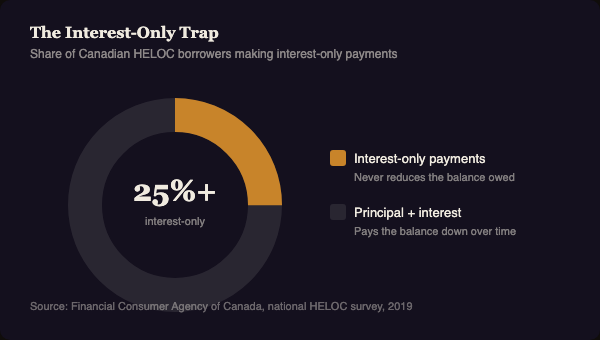
- Renovations and debt consolidation are the two most common reasons Canadians open a HELOC, but more than 25% of borrowers make only interest-only payments and never touch the principal (FCAC national survey).
What Is a HELOC and How Does It Actually Work?
A home equity line of credit, or HELOC, is revolving credit secured against the equity you've built in your home. You get approved for a limit, then borrow, repay, and borrow again as needed, similar to a credit card, except the interest rate is a fraction of what a credit card charges because your house backs the debt (Ratehub.ca).
I get HELOC questions from Edmonton clients constantly, almost always around mortgage renewal time. That's not a coincidence. Renewal is when you can restructure your mortgage without a penalty, and it's the easiest window to add a HELOC alongside it instead of applying separately later.

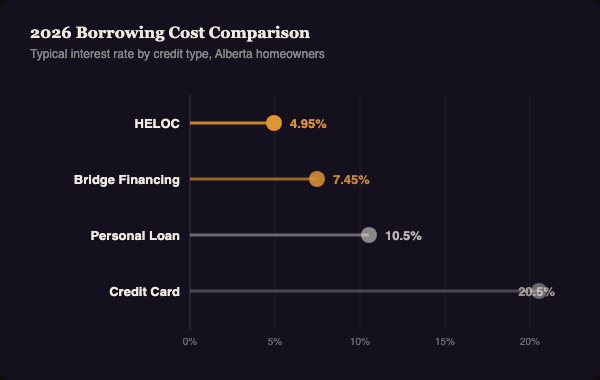
The rate is almost always variable, tied to bank prime. Most major Canadian lenders price a HELOC at prime plus roughly 0.5%, which puts it near 4.95% as of late August 2026, with prime holding at 4.45% since the Bank of Canada's October 2025 rate hold (WOWA.ca). That rate moves every time the Bank of Canada changes its overnight rate, which is the trade-off for paying less than a fixed-rate loan.
A standard mortgage refinance, by comparison, gives you one lump sum at a fixed or variable rate and a set amortization schedule. A HELOC gives you access, not a payout. You could open a $100,000 HELOC and never draw a dollar of it, paying nothing until the day you actually use it.
How Much Can You Borrow With a HELOC in Alberta?
A standalone HELOC is capped at 65% of your home's appraised value, and if you combine it with your existing mortgage, the total secured against your home can't exceed 80% (Ratehub.ca; FCAC guidance). Whichever number is lower between those two caps is your real ceiling, and most homeowners hit the combined 80% limit first.
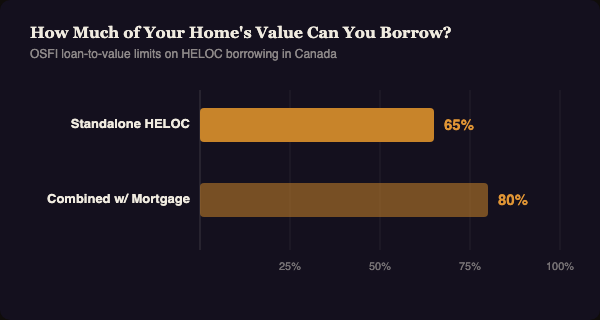
Say your home is worth $650,000, in the range a lot of Terwillegar or Sherwood Park detached homes sell for in the greater Edmonton market, and you owe $300,000 on your mortgage. The 65% standalone cap would allow $422,500. But the combined 80% cap allows $520,000 total, and $520,000 minus your $300,000 mortgage leaves only $220,000 of room. That $220,000 is your actual HELOC limit, not the larger number.
You'll also need to pass a stress test. Lenders qualify you at whichever is higher: your contract rate plus 2%, or the federal floor of 5.25% (Ratehub.ca; OSFI). On a HELOC priced at 4.95%, that means qualifying at 6.95%, not the rate you'll actually pay. Most lenders also want a minimum 20% equity position and a credit score of 680 or better for their best pricing, though some will go as low as 600.
Rather know exactly what your home is worth before you run these numbers with a lender? Get a free home valuation and I'll walk you through what your equity actually looks like today.
What Does a HELOC Actually Cost in Alberta?
Beyond the interest rate, opening a HELOC in Alberta typically runs $500 to $1,000 in legal fees, plus a Land Titles registration fee calculated on the full face value of the charge, not just what you plan to borrow right away.

Most national HELOC guides quote a generic "$500 to $1,500 in closing costs" without explaining where the number comes from in Alberta specifically. As of the January 2025 amendments to the Land Titles Act, Alberta's registration fee is $50 plus $5 for every $5,000 (or portion of it) of the mortgage's face value (Cassels.com). On the $220,000 HELOC limit from the example above, that works out to $50 plus 44 portions of $5, or $270 in registration fees alone, on top of the $500 to $1,000 legal fee.
Then there's the ongoing cost, which is where a HELOC earns its reputation as the cheaper option. If you draw $50,000 from that $220,000 limit at 4.95%, an interest-only payment runs about $206 a month. That's roughly a quarter of what the same balance would cost on an average unsecured personal loan at 10.5%, and a fraction of the 20.5% average Canadian credit card rate (Finder.ca; Bank of Canada).
How Is a HELOC Different From Refinancing or Bridge Financing?
A HELOC, a mortgage refinance, and bridge financing all use your home's equity, but they solve different problems. A refinance replaces your whole mortgage with a new one, usually to get a better rate or pull out a lump sum. Bridge financing is short-term money to cover the gap between selling one home and closing on the next, and it costs more because it's arranged fast, after you already have a firm sale.
| Feature | HELOC | Mortgage Refinance | Bridge Financing |
|---|---|---|---|
| Structure | Revolving credit line | New lump-sum mortgage | Short-term lump sum |
| Typical 2026 rate | ~4.95% (prime + 0.5%) | Standard mortgage rates apply | Prime + 1% to prime + 5% |
| Repayment | Interest-only or principal, your choice | Fixed amortization schedule | Interest paid as a closing cost |
| When it's used | Ongoing or repeat access to funds | One-time lump sum, better rate | Covering a closing-date gap |
If you're specifically weighing bridge financing against a HELOC because you're buying before you've sold, the full cost breakdown and worked example is in my guide to bridge financing in Alberta. The short version: a HELOC has to be set up before your current home sells, often before it's even listed, while bridge financing gets arranged after you're firm on a sale but costs noticeably more for the convenience.
When Does a HELOC Actually Make Sense?
A HELOC makes the most sense for costs with a real payoff and a repayment plan already in mind: renovations that add value, consolidating higher-interest debt at a lower blended rate, or a standing emergency fund you hope to never touch. These line up with how Canadians actually use them, since renovations and debt consolidation are consistently the top two reasons homeowners open one (FCAC national survey).
- Renovation financing. Draw as the project progresses instead of borrowing the full amount upfront and paying interest on money that's sitting unused.
- Debt consolidation. Rolling high-interest credit card or personal loan balances into a HELOC at 4.95% instead of 10.5% to 20.5% can meaningfully cut your monthly interest cost, provided you actually stop re-accumulating the old debt.
- An emergency buffer. Having access costs nothing if you don't draw on it. That's different from carrying a balance you're not actively paying down.
What ties these together isn't the dollar amount, it's having an actual end point. Good HELOC use has a plan for paying the drawn balance back down, not just a plan for spending it.
When Is a HELOC a Bad Idea?
A HELOC becomes a problem when it turns into a source of ongoing lifestyle spending rather than a tool with a repayment plan, and the data backs up how often that happens. More than 25% of HELOC borrowers make only interest-only payments, never reducing what they actually owe, and 19% admit they borrowed more than they originally intended to (FCAC national survey).
So how does a HELOC that started as a smart move end up costing more than expected? The pattern I notice with clients isn't reckless spending, it's drift. Nobody opens a HELOC planning to carry it forever. It happens gradually: a vacation here, a vehicle there, and eighteen months later the balance hasn't moved because only the interest ever got paid. The credit card at 20.5% would have forced a harder conversation sooner. The HELOC, priced near prime, is quiet enough to ignore.
The other real risk is the variable rate itself. Because a HELOC is secured against your home and your home is the collateral, missed payments put the house at risk in a way an unsecured line of credit doesn't. If the Bank of Canada starts hiking again after this stretch of holds, a HELOC payment that felt manageable at 4.95% can climb without warning, and there's no fixed-rate version to fall back on.
Want to know what your equity is actually worth before you talk to a lender?
Knowing your home's current value is the first real number in any HELOC conversation. I'll give you an honest read on where you stand, no pressure attached.
Get a Free Home ValuationFrequently Asked Questions
What's the difference between a HELOC and refinancing my mortgage?
A refinance replaces your entire mortgage with a new one and pays out a lump sum on a fixed amortization schedule. A HELOC sits alongside or separate from your mortgage as revolving credit you draw from as needed, paying interest only on what you've actually borrowed (Ratehub.ca, 2026).
How much equity do I need to qualify for a HELOC in Alberta?
Most lenders require a minimum of 20% equity in your home. Your HELOC limit is capped at 65% of your home's value on its own, or 80% when combined with your existing mortgage balance, whichever number is lower (Ratehub.ca; OSFI guidance).
What's the difference between bridge financing and a HELOC?
A HELOC is set up in advance against your home's existing equity and prices near prime. Bridge financing is arranged after you have a firm sale on your current home, is short-term by design, and typically costs prime plus 1% to prime plus 5% (WOWA.ca, 2026). See the full breakdown in my bridge financing guide.
Are HELOC interest rates fixed or variable?
Variable, almost always. HELOC rates are tied to bank prime, currently 4.45% as of August 2026, plus a lender markup that's typically around 0.5% for well-qualified borrowers at the major banks (WOWA.ca, 2026).
Can I use a HELOC to pay off other debt?
Yes, debt consolidation is one of the most common HELOC uses in Canada. Moving a high-interest balance to a HELOC near 4.95% instead of a 20.5% average credit card rate can lower your monthly interest cost significantly, as long as you have a real plan to pay the balance down (FCAC national survey; Bank of Canada).
A HELOC isn't complicated once you see the mechanics: revolving credit, variable rate, your home as collateral, interest only on what you draw. What matters more than understanding how it works is being honest about why you're opening one. If there's a plan and a payoff date attached, it's usually a smart, cheap way for an Edmonton or Alberta homeowner to borrow. If it's replacing a plan you haven't made yet, it's worth waiting until you have one.
Categories
Recent Posts