Edmonton Is Now Canada's #1 City for Movers: Here's the Data

Homes with Tristan: Relocation Data
Edmonton Just Became Canada’s #1 City for Movers: Here’s What the Data Shows
By Tristan Boire, REALTOR | Park Realty, Sherwood Park AB | June 6, 2026
For years, Calgary got most of the attention when Canadians were looking to relocate. Lower cost of living than Toronto, proximity to the mountains, a booming economy. The data backed it up. Calgary was consistently the top destination for people leaving Ontario and BC.
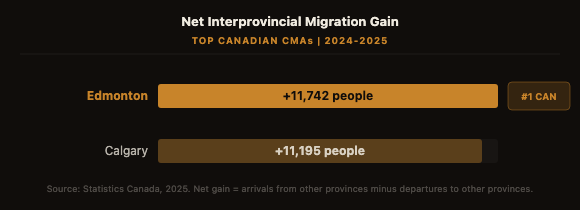
In 2025, that changed. Edmonton surpassed Calgary as the number one destination for interprovincial migration in Canada. According to Statistics Canada, the Edmonton census metropolitan area recorded a net gain of 11,742 people from interprovincial migration in 2024–2025, edging out Calgary’s 11,195. First time this has happened in approximately a decade.
I’m Tristan Boire, a realtor at Park Realty in Edmonton. The majority of my clients in 2026 have been people relocating from Ontario and BC, so I have a front-row seat to this shift. Here’s what the numbers actually mean and why Canadians are landing on Edmonton over every other city in the country.
Key Takeaways
- → Edmonton posted a net interprovincial migration gain of 11,742 in 2024–2025, surpassing Calgary (11,195) to lead all Canadian CMAs for the first time in a decade (Statistics Canada, 2025).
- → A comparable detached home in Edmonton costs roughly $590,000 vs. $1.66M in Toronto and $1.93M across Metro Vancouver.
- → Alberta’s no-PST advantage saves a typical household roughly $4,800 per year compared to Ontario’s 13% HST (Government of Alberta, 2026).
- → Calgary’s average detached home rose from roughly $630K to over $800K in three years, narrowing the affordability gap that once defined it as the obvious answer.
What Do the Migration Numbers Actually Mean?
Edmonton’s CMA posted a net interprovincial migration gain of 11,742 people in 2024–2025, making it the top destination in Canada among all census metropolitan areas (Statistics Canada, 2025). That number beat Calgary’s 11,195, which had held the top spot for years. It’s the first time Edmonton has led the country in approximately a decade, and when you look at the underlying drivers, it makes sense.
This isn’t a one-year story. Alberta as a province has been the number one destination for interprovincial migration for 14 consecutive quarters. Three and a half years straight, without a single quarter where another province overtook it. The Alberta government is projecting 24,000 net interprovincial arrivals in 2026 alone. That’s structural demand, not a trend.
The population growth numbers back this up. The Edmonton metro area grew by roughly 15% between 2021 and 2025, from 1.47 million to 1.69 million. The city proper crossed 1.2 million residents. Between July 2024 and July 2025, Edmonton’s growth rate hit 3.0%, the fastest of any CMA in Canada, ahead of Calgary’s 2.9% and well ahead of Toronto and Vancouver (Edmonton Global / Statistics Canada, 2025). Edmonton added more than 50,000 people in a single year for the third straight year.
Between July 2024 and July 2025, the Edmonton census metropolitan area posted a 3.0% population growth rate, the highest of any CMA in Canada (Statistics Canada, 2025). Edmonton added more than 50,000 people in a single year for the third straight year, driven by both international immigration and domestic migration from Ontario and BC.

Where Are All These People Coming From?
Overwhelmingly, Ontario and BC. In a single quarter of 2025, 8,780 people moved from Ontario to Alberta, and 8,931 came from BC. That’s more than 17,000 people from two provinces in three months (Statistics Canada, 2025). Extrapolate across a full year and you’re looking at roughly 70,000 arrivals from those two provinces alone.
These aren’t people leaving because they’re forced to. The clients I’ve worked with in 2026 are professionals, families, people with choices. A lot of them lived in genuinely good neighbourhoods in Toronto or the Lower Mainland. What changed wasn’t their circumstances. It was their math.
What I hear consistently from these clients: they didn’t want to spend another decade renting a two-bedroom apartment and hoping the housing market would eventually make sense for them. In Edmonton, it makes sense right now. The calculation isn’t close. That’s what’s driving the migration, and the data reflects it clearly.
The Housing Price Gap: What Are We Actually Talking About?
In Toronto, the average detached home sits at around $1.66 million. In Edmonton, a comparable property with the same backyard, two-car garage, and school zone quality runs about $590,000. That’s a gap of over $1 million in purchase price. At current mortgage rates of around 4.3% with 20% down, that gap translates to roughly $5,200 to $5,800 more per month in mortgage payments that Edmonton buyers simply aren’t making (Bank of Canada / CREA, 2026).
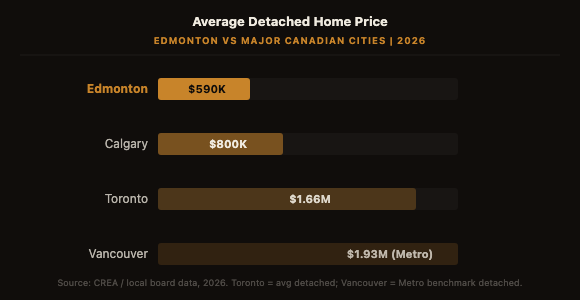
Vancouver makes the math look even more extreme. The average detached home across Metro Vancouver sits at around $1.93 million. If you want to stay within the city of Vancouver proper rather than the broader metro, the benchmark price approaches $2.6 million. Against Edmonton’s $590,000, that’s a gap of more than $1.3 million at the metro level, approaching $2 million for an apples-to-apples comparison within each city.
A buyer purchasing a $590,000 detached home in Edmonton at 4.3% with 20% down carries an estimated monthly mortgage of roughly $2,600. The equivalent buyer in Metro Vancouver, purchasing at $1.93 million with the same down payment percentage, faces an estimated monthly payment near $8,400 (CREA / Bank of Canada, 2026). That’s a difference of over $5,800 every single month.
What does that difference look like in practice? That’s maxing your TFSA and RRSP every year. That’s your kids’ education fund. The monthly gap between Vancouver and Edmonton isn’t an abstraction. It’s the difference between building wealth and falling further behind. For a full breakdown of the financial math, see how much you actually save moving from Ontario to Alberta.
It’s Not Just Housing: The Full Financial Picture
Alberta has no provincial sales tax. In Ontario, you’re paying 13% HST on most purchases. In Alberta, it’s 5% GST. On a household spending $60,000 per year, that 8-point difference works out to roughly $4,800 staying in your pocket every year (Government of Alberta, 2026). Over a decade, that’s close to $50,000 in cumulative savings before you account for any investment growth on the difference.
Most people who run this math for the first time are surprised by how fast it adds up. The conversation with out-of-province clients usually goes the same way: they expect the housing gap to be significant, but they’re not accounting for the PST savings, the land transfer tax they won’t pay in Alberta, or the income tax rate difference. When they see the full picture side by side, the hesitation tends to dissolve quickly.
There’s also no provincial land transfer tax in Alberta. Someone buying a $700,000 home in Ontario pays over $10,000 in provincial land transfer tax on closing day alone, before lawyer fees, inspection, or title insurance. The same buyer in Alberta pays roughly $500 in land title registration fees. Zero provincial LTT. The first-day cost difference is immediate and significant.

Why Are People Choosing Edmonton Over Calgary Now?
Calgary used to be the clear answer for Canadians leaving Ontario or BC. The mountains nearby, a strong economic reputation, and a well-documented growth story. But three years ago Calgary’s average detached home was sitting around $630,000. Today it’s over $800,000. That’s a price increase of nearly 27% in three years, narrowing Calgary’s affordability advantage significantly (CREA Calgary, 2026).
At current mortgage rates, the $210,000 spread between Calgary and Edmonton works out to roughly $700–$900 more per month in Calgary than in Edmonton. For a lot of families, that’s the difference between buying now and waiting three more years. The migration data is reflecting exactly this calculation.
Edmonton also has something that doesn’t show up in a listing price but absolutely changes what the city feels like to live in. The North Saskatchewan River valley runs through the middle of Edmonton, covering more than 7,400 hectares of connected trails, ravines, and green space. It’s one of the largest urban park systems in North America. You can be on a trail through the trees on a Tuesday morning and back at your desk within 20 minutes. That’s not something you can build into a new development. It’s either there or it isn’t.
Edmonton’s North Saskatchewan River valley encompasses more than 7,400 hectares of connected urban green space, making it one of the largest urban park systems in North America. This network spans the full width of the city and connects more than 160 kilometres of trails, giving residents year-round access to nature without leaving the city.
What Does This Mean for Edmonton’s Housing Market?
When you have nearly 12,000 net new residents arriving annually from within Canada alone, people who have arrived and stayed rather than people passing through, you have structural demand. These people need somewhere to live. They’re buying or they’re renting, and either way it creates consistent upward pressure on prices (Statistics Canada / CMHC, 2025).
Edmonton’s economy is more diversified than most people outside Alberta realize. Yes, energy is here. But Edmonton is also the provincial capital with significant government employment. It has one of Canada’s largest health systems, the University of Alberta, a growing tech sector, and a strong logistics and distribution base. The employment base isn’t tied to oil prices the way it was a decade ago.
What I can tell you from ground level: the majority of transactions I’ve closed in 2026 have involved buyers from out of province. By the time someone has listed their home in Toronto or Vancouver, organized a cross-country move, and landed in Edmonton, they are ready to buy. They know their number. They close quickly. The window where Edmonton felt like the fallback option, the city you chose when you couldn’t afford Calgary, is closing. The data says it. The prices say it. And the clients showing up every week say it. See which Edmonton neighbourhoods are worth buying in right now.
Thinking About the Move?
Get the Free Edmonton Relocation Guide
Neighbourhood breakdowns by budget, the full Alberta buying process, and cost comparisons from working with relocators every week.
Download the GuideFrequently Asked Questions
Is Edmonton really the number one city in Canada for movers right now?
Yes. Statistics Canada reported the Edmonton CMA recorded a net interprovincial migration gain of 11,742 in 2024–2025, surpassing Calgary’s 11,195 to lead all Canadian census metropolitan areas. It’s the first time Edmonton has held this position in approximately a decade.
What is the average home price in Edmonton compared to Toronto and Vancouver?
A comparable detached home in Edmonton averages around $590,000. Toronto’s average detached sits at approximately $1.66 million, and Metro Vancouver’s benchmark is roughly $1.93 million. The purchase price gap between Vancouver and Edmonton at the metro level exceeds $1.3 million.
Why are people choosing Edmonton over Calgary now?
Calgary’s average detached home rose from roughly $630,000 to over $800,000 in three years, narrowing its affordability advantage. Edmonton also has a 7,400-hectare river valley, a more manageable commute structure, and a detached home market still starting well below $600,000.
How much does the no-PST advantage actually save in Alberta?
Alberta charges only 5% GST vs. Ontario’s 13% HST. On $60,000 in annual household spending, that 8-point difference saves approximately $4,800 per year. Over a decade, accounting for typical spending growth, the cumulative savings approach $50,000 before any investment returns.
What should I know before moving to Edmonton from Ontario or BC?
Plan for a 7–10 business day condition period, no provincial land transfer tax, and a real winter. You have 90 days to convert your driver’s licence and register with AHCIP. Most people who make the move say they’d do it again without hesitation. Read the full Edmonton relocation guide for the complete picture.
Categories
Recent Posts