Alberta's Economy Is Growing Fastest in Canada: What That Means for Edmonton Home Buyers

Homes with Tristan: Alberta Market
Alberta’s Economy Is Growing Faster Than Every Other Province: What It Means If You’re Moving Here
By Tristan Boire, REALTOR | Park Realty, Sherwood Park AB | July 19, 2026
Alberta’s GDP grew at 2.7% in 2025 , more than double Ontario’s 1.1% and more than double the national average of 1.3%. That gap isn’t a blip. It’s been building for a few years and it’s directly reshaping where Canadians choose to live, work, and buy a home. If you’re thinking about making the move to Edmonton, this economic story matters, not just as a headline, but in your actual paycheck, your mortgage qualification, and what your money buys when you get here.
This post breaks down what Alberta’s economic outperformance actually means on the ground: the job growth driving it, why Edmonton is now Canada’s fastest-growing city, and the real financial math of what you keep in your pocket when you swap Ontario for Alberta. These are the numbers I walk through with every out-of-province buyer I work with.
Key Takeaways
- • Alberta’s GDP grew 2.7% in 2025, more than twice Ontario’s 1.1% rate (ATB Financial, Statistics Canada)
- • Alberta added 104,000 net new jobs year-over-year , across energy, tech, healthcare, and construction (Statistics Canada)
- • Edmonton is the fastest-growing Census Metropolitan Area in Canada at 3.1% growth (Statistics Canada, 2025)
- • Edmonton median detached home price: $593,254. Toronto median: $1,400,000. That’s $806,746 less (CREA, TRREB 2025)
- • Over 10 years, the combined tax and income advantages of living in Alberta vs Ontario total $120,000+ in your pocket
Alberta’s Economy Is Leaving the Rest of Canada Behind
Alberta posted 2.7% GDP growth in 2025 against a national average of 1.3% and an Ontario figure of just 1.1% (ATB Financial, Statistics Canada 2025). That’s not a slight edge. It’s more than double the Ontario rate., and it reflects years of structural change in how Alberta’s economy is built.
Three things are driving it. First, the energy sector has diversified well beyond conventional oil: carbon capture investment, hydrogen, LNG export infrastructure, and petrochemical upgrades are all adding economic output. Second, the province is a net recipient of interprovincial migration, which compounds on itself: more people means more construction, more retail, more healthcare demand. Third, Edmonton specifically has seen meaningful tech and professional services growth that doesn’t show up in older narratives about Alberta being a one-industry province.
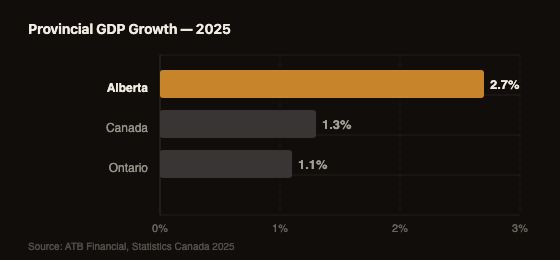
Alberta’s GDP grew at 2.7% in 2025, more than double both the national average of 1.3% and Ontario’s 1.1% growth rate. The province has now outperformed the Canadian average for three consecutive years, driven by energy sector diversification, net interprovincial migration, and expanding tech and professional services sectors. (ATB Financial, Statistics Canada 2025)
I see this in the Edmonton market directly. The buyers I work with who come from Ontario often expect Edmonton to feel like a secondary city with a discounted economy. What they actually find is a city with a construction crane on every major corridor, new schools being built in the southwest, and a commercial real estate market that’s tighter than it’s been in years. The economic data matches what you see on the ground when you get here.
104,000 New Jobs: Why That Number Actually Matters
Alberta added 104,000 net new jobs year-over-year as of 2025 (Statistics Canada). That’s not gross job creation , that’s net, after accounting for jobs lost. To put that in context, 104,000 new jobs in a province of roughly 4.9 million people is a significant employment expansion, and it’s spread across sectors in a way that matters for people moving here from other provinces.
Energy obviously contributes, but look at what’s actually growing: healthcare and social services are expanding fast because the population is young and growing. Construction is running near capacity because residential demand outpaces supply in virtually every Edmonton suburb. Tech and professional services are increasingly choosing Edmonton for cost-per-talent-dollar reasons. And government services in the capital city are stable by definition.

Here’s the chain that matters for real estate: jobs attract people. People need homes. More demand against limited supply puts upward pressure on prices, which is exactly what’s been happening in Edmonton, but from a base price that’s still dramatically lower than Toronto or Vancouver. The buyers who recognize this and move early lock in that price before the compression closes the gap further.
Alberta added 104,000 net new jobs in the year to 2025 (Statistics Canada). Job growth draws interprovincial migrants, who in turn drive housing demand. Edmonton’s population grew 3.1% in 2025 alone, the fastest of any Census Metropolitan Area in the country, and every new resident needs somewhere to live.
Edmonton Is the Fastest-Growing City in Canada
Edmonton grew at 3.1% in 2025, the fastest rate of any Census Metropolitan Area in Canada, according to Statistics Canada. Alberta as a province grew 4.5% in a single year, which is the fastest provincial population growth in the country. These aren’t abstract census figures. They translate directly into housing demand, and the supply side hasn’t caught up.
What it means practically: neighbourhoods like Windermere and Keswick in the southwest, Glenridding, and the Terwillegar corridor are seeing consistent demand with limited resale inventory. New build timelines are stretching out because trades are fully committed. Sherwood Park continues to absorb buyers who want more space and a quieter setting while still being 20 minutes from downtown Edmonton. The growth pressure is real and it’s moving through multiple price points simultaneously.
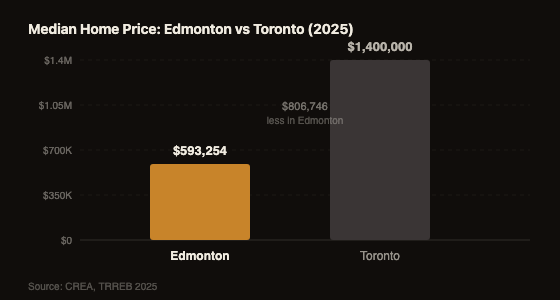
The detached median in Edmonton sits at $593,254 (CREA, 2025). Toronto’s median is $1,400,000 (TRREB, 2025). That’s an $806,746 gap. People often hear that and assume Edmonton is cheaper because it’s a lesser city in some way. But the fastest-growing CMA in Canada, with the strongest GDP growth rate in Canada, isn’t a lesser city. It’s an underpriced one.. That gap will compress over time. The only question is whether you buy before or after it does.
The Real Financial Math: Edmonton vs Toronto in 10 Years
The purchase price gap is obvious, but the ongoing financial advantage of living in Alberta versus Ontario is something most people underestimate. Let’s run through the three main levers and what they actually add up to over a decade.
Land Transfer Tax: $25,900 Saved on Day One
Alberta has no provincial land transfer tax. Zero. In Ontario, on a $1,000,000 purchase, you’re paying a combined provincial and municipal (Toronto) land transfer tax of $25,900 (Ontario Ministry of Finance, 2025). That money is gone the day you close. You never see it again and you don’t get to put it toward a down payment, renovations, or investments. In Alberta, that $25,900 stays in your pocket.
Take-Home Pay: $2,429 More Per Year in Alberta
On a gross salary of $150,000, your Alberta take-home is $100,760. Your Ontario take-home is $98,331. That’s $2,429 more per year in Alberta (Wealthsimple Tax Calculator, 2025). Over 10 years, that’s roughly $24,290 in additional income just from the provincial tax difference. Alberta does have provincial income tax (every province does), but Alberta’s rate is lower than Ontario’s, particularly at higher income levels.
No PST: Everything You Buy Is 5% Cheaper
Alberta has no provincial sales tax. Ontario charges 8% HST on top of the federal 5% GST , so 13% total on most purchases. In Alberta, you pay only the 5% federal GST. On a household that spends $50,000 a year on taxable goods and services, that’s roughly $4,000 in annual PST savings. Over 10 years, that compounds to somewhere between $30,000 and $40,000, depending on your spending. (Canada Revenue Agency).
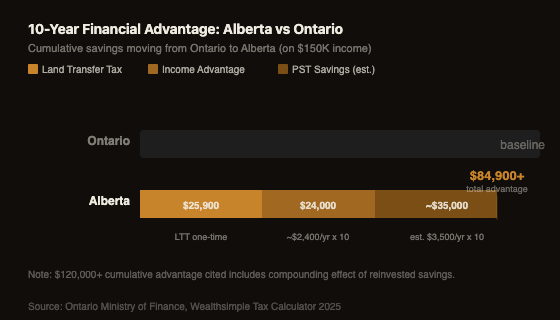
Add it up and the 10-year cumulative advantage of being in Alberta versus Ontario is over $120,000, factoring in the LTT one-time savings, the annual income gap, and the ongoing PST difference. That’s real money. And it doesn’t include the $806,746 you’re not spending on the home itself. If you’re moving from Ontario and buying in Edmonton, you’re not just getting a cheaper house. You’re restructuring your financial life in a meaningful way.
For a full walkthrough of what the buying process looks like as an out-of-province buyer, head to the Edmonton Buyer’s Guide here.
What Relocators Are Actually Asking Me
I talk to buyers from Ontario and BC every week who are seriously considering Edmonton. Three questions come up almost every time, so I’ll answer them directly here.
“Is the job market actually strong for non-energy workers?”
Yes, and this surprises people. The 104,000 net new jobs Alberta added aren’t all oil workers. Healthcare is one of the fastest-growing employment sectors because the population is young and expanding. Construction trades are in high demand and have been for several years. Edmonton specifically, as the provincial capital, has a large and stable public sector. Tech is growing, particularly in areas connected to agricultural and energy data. If your career is in finance, healthcare, education, engineering, or trades, you will find Edmonton’s job market competitive.
“What’s the cost of living really like?”
Housing is dramatically cheaper, as we’ve covered. Groceries and utilities are comparable to Ontario , not dramatically different. Car insurance is actually cheaper in Alberta than Ontario, which surprises a lot of people. There’s no health premium (Ontario charges one). You’re not paying PST on anything. The summary is: your fixed costs (housing, taxes, insurance) are materially lower. Your variable costs (food, restaurants, entertainment) are broadly similar to a mid-sized Ontario city.
“How competitive is the Edmonton housing market?”
It depends on the price point and neighbourhood. At $500K to $650K in the southwest, areas like Terwillegar, Glenridding, Keswick , you’ll see multiple offers on well-priced properties, particularly detached homes. In Sherwood Park, the $500K to $700K range is active but not chaotic. You can generally get a condition period and conduct proper due diligence. Above $800K, it thins out considerably and you have more negotiating room. It’s competitive by Edmonton standards, but nothing like what Ontario buyers are used to. The conditions still happen here. The inspections still happen. You get to be a normal human being during the buying process.
Free Resource
Thinking About Moving to Edmonton?
Get the Edmonton Buyer’s Guide: real costs, real neighbourhoods, and what the buying process actually looks like as an out-of-province buyer.
Book a CallFrequently Asked Questions
Is Alberta’s economy stable or just an oil boom?
Alberta’s economy is more diversified than the boom-bust narrative suggests. The province posted 2.7% GDP growth in 2025 (ATB Financial) driven by energy, healthcare, construction, and professional services. Alberta also grew its population 4.5% in a single year. Permanent residents don’t move somewhere they think is a temporary opportunity.
What’s the fastest-growing neighbourhood in Edmonton right now?
The southwest is the primary growth corridor. Keswick, Glenridding Heights, Glenridding Ravine, and Windermere are all seeing strong new construction and resale demand. Keswick has an average active listing price of around $750,000, while Glenridding entries start in the mid-$500s. Sherwood Park is also absorbing significant demand from buyers who want more space.
How much do I actually save on taxes moving from Ontario to Alberta?
On a $150,000 gross salary, Alberta take-home is $100,760 versus $98,331 in Ontario , roughly $2,429 more per year (Wealthsimple, 2025). Add the land transfer tax saving of $25,900 on a $1M purchase and the absence of Ontario’s 8% provincial portion of HST, and the 10-year combined advantage exceeds $120,000.
Is now a good time to buy in Edmonton?
Edmonton’s median detached home is $593,254 (CREA, 2025), and the city is growing at 3.1% per year , the fastest of any Canadian CMA (Statistics Canada). More people chasing limited inventory is a basic supply/demand story. Prices in Edmonton have climbed but remain dramatically lower than Toronto or Vancouver, with more room to grow as population inflow continues.
What’s the average home price in Edmonton vs Toronto?
Edmonton’s detached median is $593,254 (CREA, 2025). Toronto’s median is $1,400,000 (TRREB, 2025). That’s a gap of $806,746. In Edmonton, you can buy a four-bedroom detached home in a growing southwest neighbourhood for what a condo costs in a Toronto suburb.
The Bottom Line
Alberta’s economic outperformance isn’t just a number in a Statistics Canada release. It’s showing up in job postings, in population growth, in housing demand, and in the take-home pay of everyone who makes the move. The province grew its population 4.5% in a single year. Edmonton is the fastest-growing city in the country. The median home here costs $806,746 less than in Toronto. And over 10 years, the tax and income advantages alone put over $120,000 more in your pocket.
None of this means Edmonton is a perfect fit for everyone. But if the economic case for a move matters to you , and for most people making a decision this big, it should , the numbers point in one direction. The people I work with who move here from Ontario consistently say the same thing: they wish they’d done it sooner.
If you want to understand what the buying process looks like as an out-of-province buyer, or just want to talk through the numbers for your specific situation, I’m easy to reach. No pressure, no pitch , just a straight conversation about whether Edmonton makes sense for you.
Categories
Recent Posts