Moving to Edmonton from Ontario: The Complete 2026 Relocation Guide
Homes with Tristan: Relocation Guide
Moving to Edmonton from Ontario: The Complete 2026 Relocation Guide
By Tristan Boire, REALTOR | Park Realty, Sherwood Park AB | Published June 10, 2026 | Updated July 25, 2026
Moving from Ontario to Edmonton is, for most buyers, one of the more financially significant relocation decisions available in Canada right now: lower home prices, no provincial land transfer tax, no PST, and a genuinely fast-growing city behind it. Edmonton is the fastest-growing census metropolitan area in the country. Statistics Canada put the region’s growth at 3.0% between July 2024 and July 2025, adding more than 50,000 people in a single year, and a meaningful share of that is people making the exact decision you might be considering right now.
I work with relocators from Ontario and BC every week. The questions are consistent. Which neighbourhoods should I look at? How does the buying process work here? What do I need to sort out when I land? This guide covers all of it in one place.
Key Takeaways
- → Edmonton’s detached home market starts around $550,000 in entry-level neighbourhoods and ranges up to $2M+ in established luxury areas like Crestwood and Glenora.
- → The Alberta buying process has a 7–10 business day condition period, no provincial land transfer tax, and is done entirely by digital signing. No in-person signing required.
- → When you arrive, register with AHCIP immediately. Your Ontario OHIP coverage typically continues for up to 90 days during the transition.
- → Edmonton added 50,717 residents in a single year, making it the fastest-growing CMA in Canada at 3.0% growth (Statistics Canada, 2025).
Why Are So Many People Moving to Edmonton Right Now?
Alberta as a province has been the top destination for interprovincial migration for 14 consecutive quarters, and within Alberta, Edmonton recently surpassed Calgary to lead all Canadian CMAs in net interprovincial migration at 11,742 new residents (Statistics Canada, 2025). The driving force is straightforward: the combination of housing affordability, no provincial sales tax, no land transfer tax, and a genuine city with real employment creates a financial case that’s difficult to argue against.
A detached home that would cost $1.66 million in Toronto costs roughly $590,000 in Edmonton. The monthly mortgage difference at current rates works out to over $4,600 per month. Over a decade, the combined savings from lower housing costs and no PST exceed $600,000. That’s not an abstraction. That’s what people are choosing when they move. For the full financial breakdown of moving from Ontario to Alberta, see the dedicated finance guide.
What Can You Actually Afford in Edmonton? A Budget Breakdown
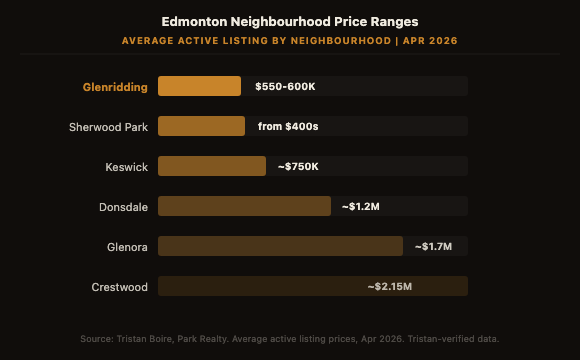
Edmonton’s detached home market covers a wide range. Entry-level communities in the west and south start around $550,000 for a newer detached home. Mid-market established neighbourhoods run $700,000 to $900,000. The luxury market starts at around $1 million and extends to $2M+ in Crestwood and Glenora (Tristan Boire, Park Realty, active listing data, Apr 2026).
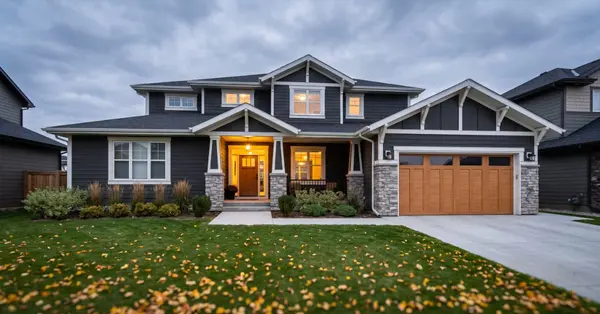
If you’re arriving with $200,000 to put toward a purchase, at current rates you can qualify comfortably for a $700,000 to $800,000 home. That gets you into a good neighbourhood with real square footage, a double car garage, and a backyard. The same budget in Toronto puts you in a two-bedroom condo. The lifestyle comparison is immediate and visible.
Sherwood Park is worth mentioning separately. Technically its own municipality (Strathcona County) but functionally part of the Edmonton metro, Sherwood Park offers detached homes starting in the $400s and a community feel that a lot of Ontario families find familiar. Schools are strong, the infrastructure is solid, and it’s a 15–20 minute drive to downtown Edmonton.

Which Edmonton Neighbourhoods Should You Consider?
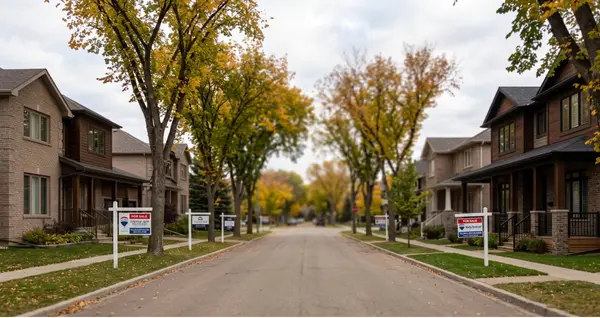
The right neighbourhood depends on your budget, your commute priorities, and how much you value green space vs. walkability. Here are the areas I recommend most consistently to relocating clients, organized by price range (Tristan Boire, Park Realty, active listing data, Apr 2026).
Entry-Level: $550K–$700K
Glenridding Heights and Glenridding Ravine are in Edmonton’s southwest, near a large natural ravine with trail access. Heights averages $550,000–$600,000 for detached. Ravine averages $625,000–$675,000. The community is newer, the builds are good quality, and it has the kind of trail and green space access that would cost three times as much to be near in Vancouver or Toronto.
Terwillegar is one of Edmonton’s most established family communities in the southwest, averaging $550,000–$750,000 for detached homes. The area has the Terwillegar Community Recreation Centre, strong schools, and easy access to the Anthony Henday ring road. People who want the feel of a mature suburban community tend to land here.
Mid-Market: $700K–$900K
Keswick sits at the south end of the river valley corridor in Edmonton’s southwest, with average active listings around $750,000. It’s a premium newer community with thoughtful landscaping, river valley views in some areas, and a level of finish that attracts a lot of move-up buyers from other Edmonton communities.
Westmount is one of Edmonton’s character neighbourhoods near the core, with average active listings around $800,000. It has older craftsman-style homes, walkability to Stony Plain Road amenities, and a neighbourhood feel that’s rare in a prairie city. For Ontario buyers who are used to character neighbourhoods, this tends to resonate.
Luxury: $1M+
The west end river valley communities are where Edmonton’s established wealth concentrates. Donsdale averages $1.2M, Quesnell Heights around $1.1M, and Glenora at approximately $1.7M. These are mature neighbourhoods with large lots, river valley adjacency, and the kind of architectural character that takes decades to develop. Crestwood at $2.15M average is Edmonton’s most exclusive established community.
Schools, Daycare, and Getting Around Edmonton
Families relocating with kids usually ask about this before anything else, and it is a fair gap in most relocation guides. Edmonton runs two large public school systems, Edmonton Public Schools and Edmonton Catholic Schools, both with schools across every part of the city, plus francophone and charter options for specific programs.
Childcare availability and cost vary by neighbourhood and have been shifting as Alberta rolls out the federal child care fee reduction agreement. Fees and wait lists change often enough that it is worth confirming both directly for your target neighbourhood before you lock in a moving timeline, rather than assuming it will sort itself out after you land.
Getting around Edmonton feels different from most Ontario cities. The city is geographically large, so a drive that looks long on a map often covers real distance rather than crawling through downtown traffic. The LRT system connects downtown to the south side, the west end, and Mill Woods, and most of the neighbourhoods above sit a short drive from a ring road entry point, the Anthony Henday or Whitemud Drive.
How Does the Alberta Buying Process Work?
The Alberta purchase process is straightforward and runs entirely digitally. No in-person signing is required at any stage. Here’s how it unfolds from accepted offer to possession (Alberta Real Estate Association process guidelines, 2026).
Step 1: The Offer
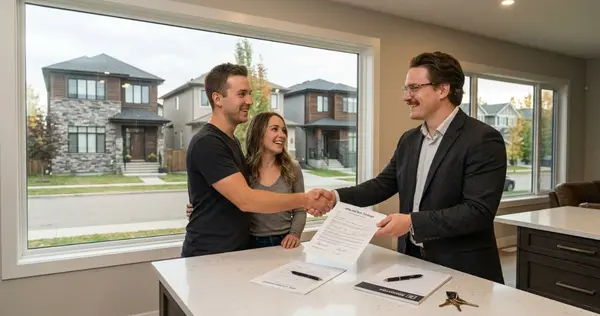
Once you find a property, you submit an offer with a price, a deposit amount (typically $5,000 to $10,000 depending on the purchase price), and conditions. Standard conditions include a home inspection and financing. Everything is signed digitally via DocuSign or a similar platform.
Step 2: The Deposit
The deposit is due within the first five business days of the accepted offer. Alberta accepts e-transfer, bank draft, wire transfer, Payload, or direct deposit. Which method is accepted depends on the seller’s brokerage, so confirm before writing the offer.
Step 3: Condition Period
You typically have 7 to 10 business days from the accepted offer to complete your home inspection and confirm financing. Budget $500 to $650 for the inspection. Once both conditions are satisfied and waived, the sale is firm. From that point, it’s a matter of choosing a real estate lawyer and waiting for possession day.
Step 4: Final Walkthrough and Possession
The final walkthrough is typically scheduled within the two days before possession, not on possession day itself. On possession day, your lawyer registers the title and releases the funds. You get the keys through your realtor once the transfer is confirmed.
The Alberta buying process typically runs 30 to 60 days from accepted offer to possession. The condition period of 7 to 10 business days is shorter than what some Ontario buyers are used to, so having your financing pre-approved before you search is important. Every step from offer to close is done digitally via DocuSign or similar platforms. No in-person signing required at any stage.
Practical Things to Sort Out When You Arrive in Edmonton
The logistics of establishing residency in Alberta are manageable if you handle them in the right order. Here’s what most Ontario buyers need to take care of in the first 90 days (Government of Alberta relocation guidelines, 2026).
- →Healthcare (AHCIP): Register with Alberta Health Care Insurance Plan as soon as you arrive. Your Ontario OHIP coverage typically continues for up to 90 days during the transition, so there’s no gap, but registering immediately is important.
- →Driver’s licence: You have 90 days to convert your Ontario driver’s licence to an Alberta licence. Ontario driving history transfers. No re-testing required for standard passenger vehicles.
- →Vehicle registration: If your vehicle is registered in Ontario, you’ll need an out-of-province vehicle inspection before you can register it in Alberta. This is a separate requirement from the driver’s licence conversion.
- →Banking and address updates: Update your address with CRA first. TFSA and RRSP contribution rules are federal, so no provincial impact there. Update your provincial benefits if applicable.
What Are People’s Biggest Surprises After Moving to Edmonton?
The consistent surprises I hear from clients after they’ve been here 6 to 12 months fall into a few categories. Most of them are positive (Statistics Canada interprovincial migration follow-up data / first-hand client conversations, 2025–2026).
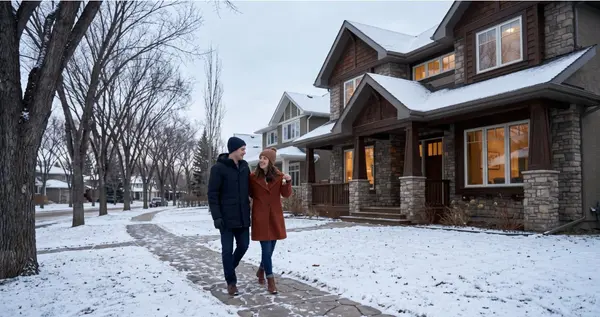
The winter adjustment is easier than expected. Almost every client who moved from Ontario says the same thing: they thought the cold would be harder than it was. Edmonton winters are real, and January averages around -11C with cold snaps well below that. But with the right gear and an understanding that outdoor life continues year-round here, the adjustment typically takes one winter to complete.
The city is bigger and more complete than they expected. People arrive expecting a smaller-city experience and find a city of 1.2 million with a serious restaurant scene, professional sports, major concerts, and a university with 40,000 students. The river valley trails are immediately visible and used year-round. The airport has direct flights across North America.
The financial relief is immediate and tangible. Clients consistently describe the psychological shift of not having a $7,000 or $8,000 monthly mortgage. The financial freedom that comes with a $2,600 mortgage on a detached home with a backyard allows them to save, invest, and live in a way that simply wasn’t possible in their previous city. Most say they’d make the same decision again without hesitation.
Ready to Plan the Move?
Talk to Tristan Before You Move
I do free consultation calls for out-of-province buyers. We’ll walk through budget, neighbourhood fit, and the buying process before you set foot in Edmonton.
Book a Free CallFrequently Asked Questions
What is the cheapest neighbourhood in Edmonton to buy a detached home?
Glenridding Heights in the southwest starts around $550,000–$600,000 for detached homes. Sherwood Park offers detached options starting in the $400s. Terwillegar runs $550,000–$750,000 and offers established community amenities. All three are consistently recommended for relocating families (Tristan Boire, Park Realty, Apr 2026).
How long does the home buying process take in Alberta?
From accepted offer to possession, typically 30 to 60 days. The condition period is 7 to 10 business days, during which you complete your inspection and confirm financing. Signing is done digitally throughout. There is no in-person signing requirement at any stage of the Alberta purchase process.
Do I need a new driver’s licence when I move to Alberta from Ontario?
Yes, but you have 90 days from establishing Alberta residency to convert your Ontario licence. No re-testing is required for a standard passenger licence. Ontario driving history transfers to Alberta. Additionally, you’ll need an out-of-province vehicle inspection before registering your Ontario-plated vehicle in Alberta.
What happens to my Ontario OHIP when I move to Alberta?
Register with AHCIP (Alberta Health Care Insurance Plan) as soon as you arrive in Alberta. Your Ontario OHIP coverage typically continues for up to 90 days during the transition, providing continuous coverage. Register immediately rather than waiting, as AHCIP requires proof of Alberta residency to activate.
Is Edmonton a good city for families moving from Ontario?
Yes. Edmonton offers strong public and Catholic school systems, affordable detached housing with yards, extensive trail networks including the 7,400-hectare river valley system, and a metro population of 1.69 million with full urban amenities. Most families who move from Ontario report that their quality of life improved significantly, largely because of the financial freedom that comes with lower housing costs (Statistics Canada interprovincial migration data, 2025).
What are schools and daycare like in Edmonton for relocating families?
Edmonton has two large public school systems, Edmonton Public and Edmonton Catholic, plus francophone and charter options. Daycare cost and availability vary by neighbourhood and have been shifting under Alberta’s rollout of the federal child care fee reduction agreement, so it is worth confirming current fees and wait times for your target neighbourhood directly before you finalize a moving timeline.
Categories
Recent Posts