New Construction vs Resale in Edmonton: The Real Cost Difference
Homes with Tristan: Alberta Buyer Finance
New Construction vs Resale in Edmonton: The Real Cost Difference
By Tristan Boire, REALTOR | Park Realty, Sherwood Park AB
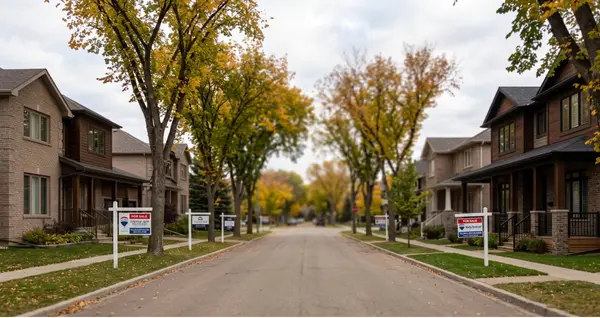
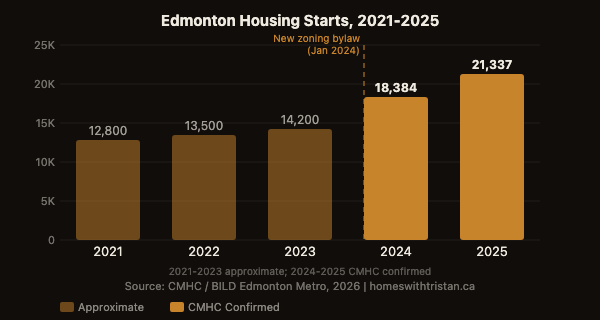
Edmonton built more homes in 2025 than in any year on record. CMHC data shows 21,337 housing starts in the Edmonton CMA, the highest annual total in the city’s history. With that much supply hitting the market, a lot of buyers are weighing new construction against resale, and most of them are doing that math wrong.
New construction isn’t just the base price on the builder’s website. Resale isn’t just the MLS listing price. Both paths come with costs and trade-offs that don’t show up in the initial numbers, sometimes not until after possession day.
Here’s a clear breakdown of what each option actually costs in Edmonton right now, and what you’re getting for your money.
Key Takeaways
- •Edmonton built a record 21,337 homes in 2025, the highest annual total in the city’s history (CMHC, 2026)
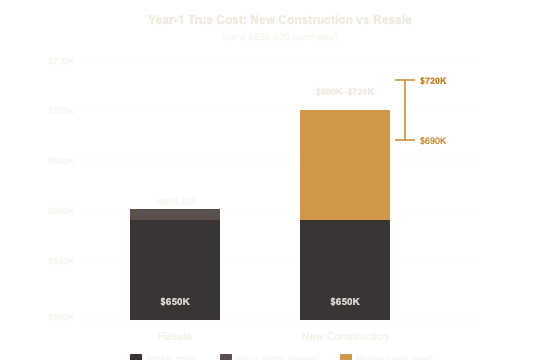
- •New construction on a $650,000 home typically adds $40,000 to $70,000 in Year-1 costs beyond the builder’s listed price (CHBA, 2025)
- •Alberta’s New Home Warranty covers your purchase for up to 10 years; resale homes carry no equivalent statutory protection
- •The federal GST rebate on new homes cuts off at $450,000 in fair market value; above that, 5% GST applies with no offset (Government of Canada, 2025)
Spec Homes vs Pre-Construction: What’s Actually on the Market in Edmonton
Before comparing costs, it helps to understand what “new construction” actually means in Edmonton in 2026. There are two types, and they work very differently.
A spec home (short for speculative) is already built or nearly complete when you buy it. The builder financed construction without a confirmed buyer, betting the market would absorb it. You can walk through the home, see the finishes in person, and take possession within weeks to a couple of months. The trade-off: you can’t change much. The layout, colours, and upgrades are already locked.
Pre-construction is the opposite. You buy off a floor plan, choose your lot and finishes, then wait. In Edmonton’s current market, that wait typically runs 12 to 18 months from signing to possession. Both types are classified as new construction, and both carry GST. The key difference is timeline and flexibility.
Edmonton recorded 21,337 housing starts in 2025, the highest annual total in the city’s history according to CMHC (Canada Mortgage and Housing Corporation, 2026). This surge in new inventory means buyers now have genuine options across multiple builders and communities, a meaningful shift from the constrained supply environment of 2021 and 2022.
The Real Year-One Cost of New Construction in Edmonton
The Canadian Home Builders’ Association estimates that new construction buyers spend $40,000 to $70,000 beyond the builder’s listed price in the first 12 months of ownership (CHBA, 2025). These aren’t optional extras. They’re costs that come due whether you budget for them or not.
I’ve walked through this math with buyers who genuinely didn’t realize how much was missing from the purchase price until we sat down and listed it out. Here’s what typically gets overlooked.
Landscaping: $8,000 to $20,000
New builds come with a graded lot. No sod, no fence, no deck, no driveway apron in most cases. Getting a standard 40-foot lot to a liveable standard, sod, a fence, and a basic patio, typically costs $8,000 to $20,000 depending on scope. Some builders include a landscaping allowance or basic sod package. Confirm this in writing before you sign.
Window Coverings: $3,000 to $8,000
It sounds minor until you’re standing in a 2,400-square-foot home with no blinds and a south-facing living room. Covering all the windows in a new build typically runs $3,000 to $8,000. Custom shutters or motorized blinds push that number higher.
Appliances: $5,000 to $12,000
Many new builds don’t include appliances, or include a builder-grade package that doesn’t match the quality of the finishes elsewhere in the home. A proper package for a family home, fridge, stove, dishwasher, microwave, and washer/dryer, typically costs $5,000 to $12,000.
GST: 5% on Purchase Price
This is the one that catches the most buyers off guard. New residential construction in Canada is subject to 5% GST. On a $650,000 home, that’s $32,500 additional. The federal GST New Housing Rebate partially offsets this, but the rebate phases out entirely for homes with a fair market value above $450,000 (Government of Canada, 2025). At $650,000, there is no rebate. The full 5% applies.
Confirm your specific GST situation with your mortgage broker or real estate lawyer before writing an offer. The calculation can vary depending on how the purchase price is structured.
Lot Premiums and Upgrades: $10,000 to $40,000+
Builder base prices are not what most buyers actually pay. Lot premiums for backing onto a park, greenspace, or pond can add $10,000 to $40,000 before a single upgrade is selected. Structural upgrades, legal suite additions, raised ceilings, or exterior elevation changes layer on top of that. It’s common for a $600,000 base price to land at $680,000 to $700,000 by the time a buyer finalizes their selections.
Alberta’s New Home Warranty: The Real Advantage of Buying New
New construction has one clear, quantifiable edge over resale in Alberta: warranty protection. The Alberta New Home Warranty Program, governed under the New Home Buyer Protection Act, gives buyers a structured safety net that no resale home can provide (Government of Alberta, 2025).
1 Year: Labour and Materials
Defects in workmanship and materials are covered for the first year after possession. This includes drywall cracks from settling, paint finish failures, and improperly installed fixtures.
2 Years: Distribution Systems
Defects in plumbing, electrical, heating, and ventilation are covered for two years. If your furnace, HRV unit, or hot water tank fails due to an installation defect within that window, the builder is responsible.
5 Years: Building Envelope
The building envelope, exterior cladding, windows, roof, and everything that keeps water out, is covered for five years. Water ingress issues are among the most costly repairs a homeowner can face. Five years of coverage on this tier is meaningful protection.
10 Years: Structural Defects
Major structural defects, issues with the foundation, load-bearing walls, or primary framing, are covered for a full decade. Most buyers never need this tier. Having it is still worth something.
Resale homes have no equivalent warranty. A thorough home inspection before condition removal is your primary protection, and it isn’t a substitute for statutory coverage. That’s not an argument against resale. It’s a real difference you should factor into the comparison.
Alberta’s New Home Buyer Protection Act mandates warranty coverage on all newly built homes: one year for labour and materials, two years for distribution systems including plumbing and HVAC, five years for the building envelope, and ten years for structural defects (Government of Alberta, 2025). No resale home in Alberta carries any equivalent statutory protection.
Edmonton’s Building Boom and What It Means for Buyers in 2026
Edmonton’s 21,337 housing starts in 2025 (CMHC, 2026) isn’t just a record. It’s a shift in market dynamics that changes how you should approach a builder negotiation.
When new home inventory is high, builders compete for buyers. Right now some are offering rate buydowns, free upgrade packages, reduced lot premiums, or extended deposit structures to close deals. If you’re seriously considering new construction, having a REALTOR negotiate on your behalf matters. Builder sales reps work for the builder, not for you.
The high starts also mean more resale supply is coming. Buyers who purchased pre-construction in 2023 and 2024 are reaching possession now, and some will resell within the first year. That adds to the total pool of available homes and maintains some natural downward pressure on pricing in both segments.
When Resale Makes More Financial Sense in Edmonton
Resale homes carry no GST. That single fact changes the math significantly at the $550,000 to $750,000 price point that makes up most of Edmonton’s active detached market (REALTORS Association of Edmonton, 2026). Removing $27,500 to $37,500 from the true cost comparison shifts the financial picture meaningfully toward resale for buyers without a strong preference for a new product.
Resale also gives you established neighbourhoods. Schools are open, transit routes run, trees are mature, and the community has a track record you can research. If you’re relocating to Edmonton and don’t want to gamble on how a new development will look in five years, resale in Terwillegar, Sherwood Park, or St. Albert gives you known quantities.
Resale also offers more price negotiation room right now. Overall inventory is higher than it’s been since 2020. A motivated seller in an established neighbourhood often gives more ground than a builder working to a fixed margin and a monthly sales target.
Edmonton’s resale detached market is most active in the $550,000 to $750,000 range (REALTORS Association of Edmonton, 2026). At those price points, the absence of GST on resale homes represents a $27,500 to $37,500 cost advantage over a comparable new build before any other differences are considered.
New construction makes more sense when you want a warranty-backed product, you’re buying in a new community where resale options are thin, or you’re planning to hold for ten or more years and want certainty about what’s behind the walls. Neither path is right for everyone. The decision comes down to your timeline, your actual budget (including the Year-1 costs above), and where you want to live.
Buying in Edmonton
Not Sure Which Path Is Right for You?
I work with buyers on both new construction and resale across Edmonton. Let’s look at the numbers for your specific situation before you decide.
Book a Buyer ConsultationFrequently Asked Questions
Is new construction more expensive than resale in Edmonton?
On a comparable sticker price, new construction typically costs $40,000 to $70,000 more in Year 1 once you factor in GST, landscaping, appliances, window coverings, and lot premiums not included in the builder’s base price. Resale homes carry no GST, which alone represents $32,500 on a $650,000 purchase (CHBA, 2025).
Do first-time buyers in Alberta get a GST rebate on new homes?
The federal GST New Housing Rebate provides a partial rebate for homes with a fair market value under $450,000. Above that threshold, no rebate applies. Most new builds in Edmonton in the $550,000 to $750,000 range do not qualify. Confirm your eligibility with your mortgage broker or lawyer before signing (Government of Canada, 2025).
What does Alberta’s new home warranty actually cover?
Alberta’s New Home Buyer Protection Act requires four tiers of coverage on all new builds: 1 year for labour and materials, 2 years for distribution systems (plumbing, electrical, HVAC), 5 years for the building envelope, and 10 years for structural defects. Builders must provide this by law. Resale homes carry no equivalent protection (Government of Alberta, 2025).
How long does it take to build a new home in Edmonton?
Pre-construction homes in Edmonton typically take 12 to 18 months from signing to possession, though timelines vary by builder. Spec homes that are already built can close in weeks. Delays from permitting, labour, or material supply are common on pre-construction builds, so plan your timeline with some buffer built in.
Can you negotiate with builders in Edmonton right now?
Yes, more so than in 2021 or 2022. Edmonton’s record housing starts have increased builder inventory, which means more competition for buyers. Buyers are successfully negotiating lot premium reductions, free upgrade packages, rate buydown contributions, and extended deposit terms. Having a REALTOR represent you matters here since builder sales reps work for the builder, not you.
Categories
Recent Posts