Moving from Ontario to Alberta: The Financial Math Most People Get Wrong

Homes with Tristan: Buyer Finance
Moving from Ontario to Alberta: The Financial Math Most People Get Wrong
By Tristan Boire, REALTOR | Park Realty, Sherwood Park AB | June 8, 2026
People who are thinking about moving from Ontario to Alberta tend to focus on the housing price gap. And it’s real: Edmonton’s average detached home runs around $590,000, while Toronto’s sits at $1.66 million. That gap alone gets most people interested.
But the housing gap is just the start. Once you layer in closing costs, the PST savings, the land transfer tax Alberta doesn’t charge, and the FHSA tools available to first-time buyers, the total financial picture is considerably more dramatic than most people expect. Here’s how the math actually works.
I’m Tristan Boire, a realtor at Park Realty in Edmonton. I work primarily with buyers relocating from Ontario and BC. These are the numbers I walk through with every out-of-province client, usually in the first conversation.
Key Takeaways
- → Alberta has no provincial land transfer tax. An Ontario buyer purchasing a $590K home pays over $8,000 in provincial LTT alone at closing. In Alberta: $0.
- → Alberta’s total buyer closing costs typically run $2,500–$4,500 (1–1.5% of purchase price). Ontario runs 2–4%, or $11,000+ on an equivalent home.
- → Alberta first-time buyers can use the FHSA ($8,000/yr, $40,000 lifetime) plus the RRSP Home Buyers’ Plan ($35,000) for a combined $75,000 tax-advantaged down payment per person.
- → Over 10 years, the combined savings from lower mortgage payments and no PST in Alberta vs. Ontario exceeds $600,000 on equivalent detached home purchases.
What Are the Actual Closing Costs in Alberta?
Alberta buyer closing costs on a $590,000 purchase typically total between $2,500 and $4,500, or roughly 1 to 1.5% of the purchase price (WOWA.ca / Alberta real estate data, 2026). That breaks down to legal fees of around $1,100 to $1,800, title insurance of $300 to $500, a home inspection of $500 to $650, and land titles registration fees of approximately $200 to $600. That’s it. No provincial land transfer tax. No municipal land transfer tax. Just the actual cost of completing the transaction.
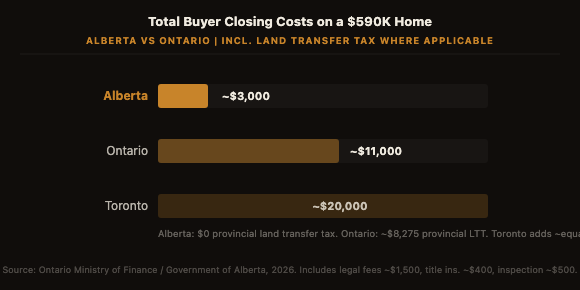
Compare that to Ontario. A buyer purchasing at the same $590,000 price in Ontario owes roughly $8,275 in provincial land transfer tax alone, calculated across Ontario’s tiered rate schedule. Outside of Toronto, total closing costs on the same purchase run approximately $11,000. Inside Toronto, the city adds a near-identical municipal land transfer tax on top of the provincial amount, pushing the total to roughly $20,000 before you’ve paid your lawyer or your inspector.
An Ontario buyer purchasing a $590,000 home faces a provincial land transfer tax of approximately $8,275 on closing day alone. In Alberta, the equivalent land titles registration fee on the same purchase totals roughly $500. The first-day savings of moving to Alberta rather than Ontario exceeds $7,700 on a comparable transaction (Ontario Ministry of Finance / Government of Alberta, 2026).
How Much Does Alberta’s No-PST Advantage Actually Save You?
Alberta charges 5% GST on most purchases. Ontario charges 13% HST. That 8-point difference sounds modest until you run it against a year of real household spending. A family spending $60,000 annually on groceries, services, clothing, and household costs saves approximately $4,800 per year in Alberta vs. Ontario (Government of Alberta, 2026). That’s a straightforward calculation: $60,000 multiplied by 0.08.
The number that surprises clients most consistently is the 10-year figure. At $4,800 per year and assuming modest spending growth of around 3% annually, the cumulative PST savings over a decade work out to roughly $54,000. That’s before counting any investment return on the money you didn’t spend. Put that $400 per month into a TFSA earning 6% per year and the 10-year value climbs closer to $65,000. Most people aren’t thinking about the PST gap when they’re comparing cities. They should be.
Alberta also has no provincial sales tax on new home construction, renovations, or major home appliances, unlike Ontario where HST applies to all of those purchases. A kitchen renovation that costs $25,000 in Ontario carries $2,000 in HST that you don’t pay in Alberta. For the full Edmonton neighbourhood breakdown by budget, see the complete relocation guide.
What Does the Monthly Mortgage Look Like Side by Side?
At current 5-year fixed rates of approximately 4.3% and a 25-year amortization with 20% down, a buyer purchasing an Edmonton home at $590,000 carries an estimated monthly mortgage payment of roughly $2,600. The same buyer purchasing a comparable Toronto detached home at $1.66 million faces a monthly payment of approximately $7,200 (Bank of Canada rate data / CREA, 2026). That’s a difference of about $4,600 per month.
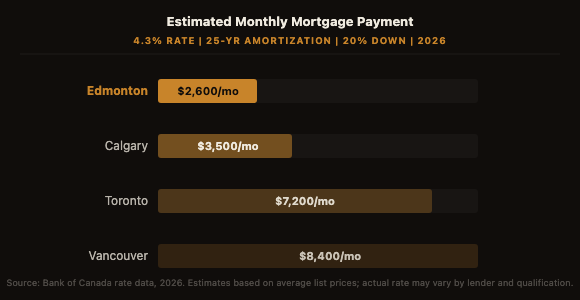
Over 10 years, that $4,600/month gap in mortgage payments totals roughly $552,000. Add the $54,000 in cumulative PST savings. Add the $8,000+ in land transfer tax you didn’t pay at closing. The total 10-year financial advantage of buying in Edmonton rather than Toronto on equivalent homes exceeds $614,000. This is why 8,780 Ontarians moved to Alberta in a single quarter of 2025 (Statistics Canada, 2025). The math isn’t subtle once you run it all together.
Over 10 years, an Edmonton buyer purchasing at $590,000 vs. a Toronto buyer purchasing at $1.66 million faces a combined advantage of more than $614,000 in lower mortgage payments, eliminated land transfer tax, and PST savings (based on Bank of Canada rates, Ontario Ministry of Finance data, and Government of Alberta figures, 2026). On a Vancouver comparison the gap exceeds $700,000.
Using the FHSA as an Alberta First-Time Buyer
The First Home Savings Account allows first-time buyers across Canada, including Alberta, to contribute up to $8,000 per year toward a home purchase, to a lifetime maximum of $40,000 per person (Canada Revenue Agency, 2026). Contributions are tax-deductible like an RRSP, and qualifying withdrawals are tax-free like a TFSA. It’s the best of both accounts, specifically for first-time buyers.
You can carry forward one year of unused contribution room, meaning if you opened an FHSA in 2025 and contributed nothing, you can contribute up to $16,000 in 2026. The tax savings on a maximum $8,000 contribution for someone in Alberta’s 40% combined marginal tax bracket works out to $3,200 in deductions for that year. Stack both partners’ accounts and you’re looking at $6,400 in tax refunds on a single year of contributions.
Combined with the RRSP Home Buyers’ Plan, which lets first-time buyers withdraw up to $35,000 from their RRSP tax-free for a home purchase, a couple can access up to $150,000 in tax-advantaged down payment funds. On a $590,000 Edmonton home, that covers a 25% down payment with room to spare. For the full Alberta buying process explained, see the buyer’s guide.
What Does the Stress Test Mean for Alberta Buyers?
Canada’s mortgage stress test requires buyers to qualify at the greater of their contracted rate plus 2%, or 5.25% (OSFI, 2026). At a 4.3% contracted rate, that means qualifying at 6.3%. Here’s where the Edmonton price advantage pays a second dividend: because the purchase price is lower, the required qualifying income is dramatically lower.
To qualify for the Edmonton mortgage of $472,000 at 6.3% stress test with a 25-year amortization, a buyer needs a household income of roughly $95,000 to $100,000 per year. To qualify for the Toronto equivalent of $1.328 million at the same stress test rate, that buyer needs closer to $265,000 per year in household income. The same professional couple with a combined income of $130,000 qualifies easily in Edmonton and can’t get close in Toronto.
I’ve had this conversation dozens of times in the past year. Clients who spent three or four years being told their income wasn’t enough to buy in their home city arrive in Edmonton and find out they qualify for a detached home in a good neighbourhood without stretching. The relief is visible. The decision to stay and buy tends to happen fast after that conversation.
Want the Full Picture?
Download the Edmonton Buyer’s Guide
Neighbourhood breakdowns, full closing cost tables, and the Alberta buying process explained in plain terms.
Get the GuideFrequently Asked Questions
Does Alberta really have no land transfer tax?
Correct. Alberta charges no provincial land transfer tax. Instead, buyers pay a land titles registration fee calculated at roughly $50 plus $2 per $5,000 of property value and mortgage value. On a $590,000 purchase, total registration fees run approximately $500, compared to $8,275+ in Ontario provincial LTT alone (Government of Alberta, 2026).
What are the typical total closing costs for a buyer in Alberta?
Budget 1 to 1.5% of the purchase price for closing costs in Alberta. On a $590,000 home, that works out to roughly $3,000 to $4,500 covering legal fees, title insurance, home inspection, and registration. This compares to 2 to 4% in provinces with land transfer taxes (WOWA.ca, 2026).
How does the FHSA work for Alberta first-time buyers?
The First Home Savings Account allows first-time buyers to contribute $8,000 per year (up to $40,000 lifetime) with full tax deductibility and tax-free qualifying withdrawals. Combined with the RRSP Home Buyers’ Plan ($35,000 per person), a couple can access up to $150,000 in tax-advantaged down payment funds (CRA, 2026).
Is Alberta’s no-PST advantage significant compared to Ontario?
Very. Alberta charges 5% GST. Ontario charges 13% HST. On $60,000 in annual household spending, that 8-point gap saves approximately $4,800 per year in Alberta. Over 10 years with modest spending growth, the cumulative savings exceed $54,000 before any investment return on the difference (Government of Alberta, 2026).
What income do I need to qualify for a home in Edmonton?
To qualify for a $472,000 mortgage (20% down on $590K) at the stress test rate of 6.3%, a household needs roughly $95,000 to $100,000 in annual income. The same stress test on a $1.328M Toronto mortgage requires approximately $265,000 in household income (OSFI stress test guidelines, 2026). See the Edmonton buying process step by step.
Categories
Recent Posts