Edmonton Property Tax 2027: What to Expect
Homes with Tristan: Buyer Finance Guide
Edmonton Property Tax 2027: What Homeowners Need to Know Before Council Votes
By Tristan Boire, REALTOR | Park Realty, Sherwood Park AB
Edmonton City Council is about to decide how much more you'll pay in property tax starting in 2027. The proposed 2027-2030 budget goes to council this November, with a final vote expected in December. If you own a home here, or you're planning to buy one, this is the number that quietly shapes your monthly budget more than almost anything else on your closing statement.
I'm not going to pretend this is exciting. Property tax is the least sexy line item in real estate. But every buyer I work with eventually asks me what their tax bill is actually going to look like, and right now the honest answer is: it depends on a vote that hasn't happened yet. Here's what we already know, what's being forecast, and how to budget for it before council makes it official.
Key Takeaways
- Edmonton's 2026 property tax rose 6.9% municipally, 7.7% once the provincial education tax is added, costing the average homeowner about $245 more a year (CTV News; Global News, 2025-2026).
- City administration's own 10-year outlook forecasts a 5.6% tax levy increase for 2027, but council sets the real number in December 2026 (CBC News, Jan. 2026).
- Without new restraint measures, the same report projects Edmonton property taxes could climb nearly 44% cumulatively by 2036.
- Buyers budgeting for a 2027 purchase should treat property tax as a rising cost, not a fixed one, and build in room for it.
How Much Did Edmonton Property Tax Actually Go Up in 2026?
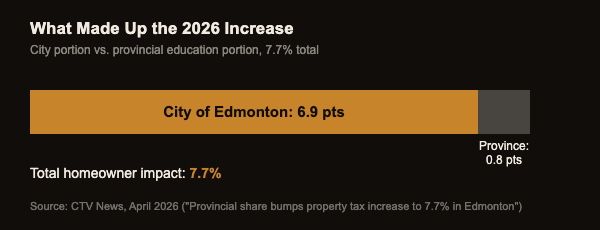
Edmonton City Council approved a 6.9% municipal property tax increase for 2026 in a vote finalized on December 4, 2025 (CTV News; City of Edmonton, 2026 Budget Highlights). That's the city's portion only. Once the provincial education tax requisition gets layered on top, the total increase for the average homeowner climbs to 7.7%.

Edmonton's municipal tax increase for 2026 landed at 6.9%, but once the province's education tax requisition is added, the total bill climbs 7.7% for the average homeowner. "The city's portion is 6.9 per cent, and the provincial tax brings it to 7.7 per cent," CTV News reported in April 2026.
In dollar terms, the average Edmonton homeowner is paying about $245 more in property tax in 2026 than they did the year before. That works out to roughly $816 a year for every $100,000 of assessed home value, up from about $763 in 2025 (Global News). On a $500,000 assessed home, that's a jump of roughly $265 in a single year, and that's before you factor in any change to your own property's assessed value.
What's Actually Driving the 2027 Budget Conversation?
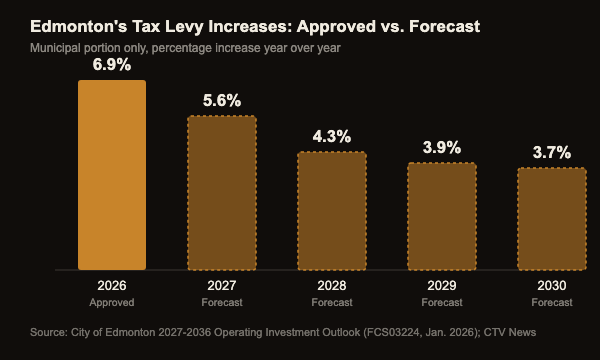
On January 27, 2026, city administration presented council with a 10-year financial outlook called the 2027-2036 Operating Investment Outlook, or OIO. It forecasts annual municipal tax levy increases of 5.6% in 2027, 4.3% in 2028, 3.9% in 2029, and 3.7% in 2030, just to maintain Edmonton's current service levels as the city keeps growing (CBC News).
Why does a growing city cost more to run, not less? Mayor Andrew Knack put it plainly to reporters: "We have an ever-expanding city that adds substantial costs every time we're adding a new neighbourhood." New subdivisions need new roads, new fire halls, new transit routes, and new pipes long before they generate enough tax revenue to pay for themselves.
City administration's own 10-year outlook, presented to council on January 27, 2026, forecasts a 5.6% tax levy increase for 2027, followed by 4.3% in 2028 and 3.9% in 2029, just to maintain current service levels as Edmonton keeps growing.
Here's the part that should actually get your attention. Without a change in direction, administration told council that Edmonton property taxes could climb nearly 44% cumulatively by 2036. A homeowner paying $2,000 a year today could be looking at close to $3,000 within a decade, based on that same report. And that figure doesn't include any new programs or debt-financed capital projects council might approve on top of it.
Without a change in direction, city administration told council that Edmonton property taxes could climb nearly 44% cumulatively by 2036. A homeowner paying $2,000 a year today could be looking at close to $3,000 within a decade, according to the same report.
To be fair to council, none of this is locked in. The City opened public engagement on the 2027-2030 budget from March 23 to May 1, 2026, and heard from close to 12,000 Edmontonians. The findings were summarized in a "What We Heard" report released in September 2026, and that feedback is part of what council weighs before the final vote.
How Is Your Property Tax Bill Actually Calculated?
Your property tax bill comes from two numbers multiplied together: your home's assessed value and the tax rate council sets that year. Edmonton assesses every property annually based on market value as of July 1 of the prior year, and the physical condition of the home as of December 31. That assessed value is not the same thing as what your home would sell for today. It's a snapshot from months earlier, which is why two nearly identical homes can have different tax bills if they were assessed at different points in the market.
Municipal tax vs. education tax
Your bill actually has two components. The municipal portion pays for city services: roads, police, fire, parks, transit, waste pickup. The education portion is set by the Alberta government, not the City, and Edmonton simply collects it on the province's behalf. That's why the 2026 increase shows up as two numbers in the news: 6.9% for the city's own decisions, 7.7% once the province's share is folded in. When council debates the 2027 rate this December, they're only debating their own 6.9%-equivalent slice, not the provincial portion.
- Assessed value. Based on market conditions as of the prior July 1, mailed out early each year.
- Municipal tax rate. Set by City Council each budget cycle, currently debated for 2027-2030.
- Education tax rate. Set by the Alberta government, collected by the City on its behalf.
Here's a rough illustration, using the city's own per-$100,000 figures rather than exact bylaw rates. A $500,000 assessed home paid roughly $4,080 in total property tax in 2026, up about $265 from 2025. If 2027 lands close to the administration's 5.6% forecast and your assessment doesn't change, that same home would owe somewhere around $4,309, an increase of roughly $229. That's a planning number worth stress-testing against your mortgage budget now, not something to discover on your first tax notice as a new owner.
What Should Buyers and Homeowners Budget For Right Now?
If you already own in Edmonton, the move is simple: build the forecasted increase into next year's budget before it's official, not after. Most people only react to their tax bill in the spring, when it's too late to adjust anything. Every client I've walked through a possession day gets the same reminder from me: your mortgage payment is not your only housing cost, and property tax is the one that moves every single year whether you like it or not.
| Year | Municipal Tax Change | Status |
|---|---|---|
| 2026 | 6.9% | Approved, Dec. 4, 2025 |
| 2027 | 5.6% forecast | Council votes Dec. 2026 |
| 2028 | 4.3% forecast | Part of same 4-year budget |
| 2029-2030 | 3.9% / 3.7% forecast | Subject to future votes |
If you're buying in 2027, ask your mortgage broker to stress-test your budget against next year's forecast, not just this year's bill. A pre-approval that's comfortable today should still be comfortable after a 5-6% property tax bump. For a deeper look at what else your monthly costs will include, our buyers page walks through the full process, deposit to possession.
Does This Change Anything If You're Relocating From Ontario or BC?
Not really, and that's the point worth hearing. Even after back-to-back increases, Edmonton's property tax load stays well below what homeowners pay in Toronto or Vancouver on a comparably priced property, and Alberta still has no provincial land transfer tax on top of it. On a $550,000 purchase, that alone saves a buyer thousands of dollars that an Ontario buyer would owe at closing. Rising a few percentage points a year doesn't erase that gap.
One thing worth knowing if you're moving to Sherwood Park or St. Albert instead of Edmonton proper: those are separate municipalities with their own councils and their own budget cycles. Edmonton's 2027-2030 budget vote doesn't set the tax rate for Strathcona County or St. Albert. If you're weighing Edmonton against the surrounding area, our Moving Here guide breaks down what else differs between them.
Buying in Edmonton in 2027?
Get the Edmonton Budget Buyer's Guide
A plain-English breakdown of every cost in an Edmonton purchase, deposit to property tax, so nothing shows up as a surprise after you close.
Get the Free GuideWhat Happens Next, and What to Watch For
The proposed 2027-2030 operating, capital, and climate budgets go to City Council this November, with deliberation and a final vote expected in December 2026. Whatever rate council lands on becomes the real 2027 number, not the 5.6% administration forecast. Councillors can approve something lower, something higher, or add new spending that pushes the levy past the baseline forecast entirely.
Will council hold the line closer to inflation, or will new project costs push the number higher again? That's genuinely up in the air until the vote happens. I'll be watching the December deliberations closely, and I'll update this once the actual 2027 rate is confirmed.
Frequently Asked Questions
When will Edmonton set the official 2027 property tax rate?
The proposed 2027-2030 budget goes to City Council this November, with deliberation and a final vote expected in December 2026. The official 2027 rate won't be locked in until that vote wraps up (City of Edmonton Budget Engagement, 2026).
How much did Edmonton property taxes go up in 2026?
Council approved a 6.9% municipal increase for 2026 on December 4, 2025. Once the provincial education tax is added, the total increase lands at 7.7% for the average homeowner (CTV News, 2026).
Is a 5.6% increase locked in for 2027?
No. 5.6% is administration's own forecast from the 2027-2036 Operating Investment Outlook, built to maintain current service levels. Council can approve something higher, lower, or add new costs when it votes in December 2026 (CBC News, 2026).
How is my Edmonton property tax actually calculated?
Your bill equals your home's assessed value multiplied by the combined municipal and provincial education tax rate. Assessed value is based on market conditions as of the prior July 1, not today's market, which is why it can lag behind what your home would actually sell for.
Is Edmonton property tax still lower than other major Canadian cities?
Yes. Even with back-to-back increases, Edmonton's property tax load stays well below Toronto's or Vancouver's on a comparable home, and Alberta charges no provincial land transfer tax, a real savings for anyone relocating from Ontario or BC.
Property tax won't be the reason you fall in love with a house, but it's one of the few housing costs that's guaranteed to move every single year. Knowing roughly where it's headed before council votes means you're budgeting with your eyes open instead of reacting to a notice in the mail next spring. If you want help running these numbers against a specific property or purchase price, that's exactly the kind of question I answer on a quick call, no pressure attached.
Categories
Recent Posts