Alberta vs Ontario Home Buying Costs 2026
Homes with Tristan: Alberta Buyer Finance
Alberta vs. Ontario Home Buying Costs: The $16,950 Difference in 2026
By Tristan Boire, REALTOR | Park Realty, Sherwood Park AB
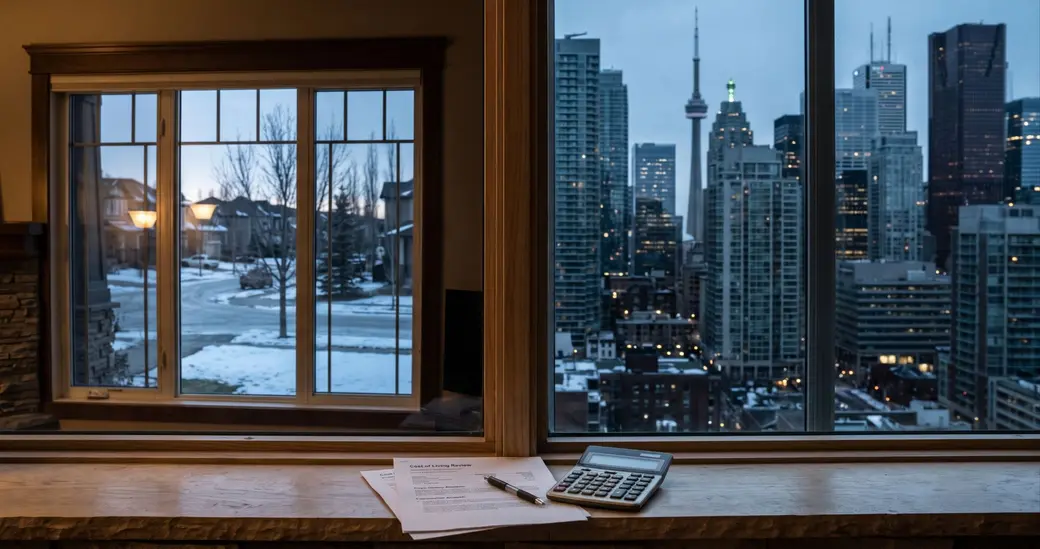
A buyer moving a $600,000 purchase from Edmonton to Toronto owes roughly $16,950 in land transfer tax the day they close, on top of everything else, according to 2026 Ontario Ministry of Finance and City of Toronto rate schedules. In Alberta, the same purchase costs about $1,180 in registration fees. I talk to people making this exact move almost every week, and the land transfer number is usually the first thing that stops them cold.
This isn't a "which province is better" post. It's the actual math: what Alberta charges you at closing versus what Ontario charges you, what the first-time buyer rebates do and don't cover, and why the income tax and home price gaps change the whole affordability picture once you add them up.
Key Takeaways
- Alberta charges no land transfer tax. On a $600,000 home, Ontario's provincial tax alone runs $8,475, and Toronto's combined provincial plus municipal tax runs $16,950 (Ontario Ministry of Finance, City of Toronto, 2026).
- Ontario's first-time buyer rebates (up to $8,475 combined provincial and Toronto municipal) soften the hit, but only for first-time buyers, and only up to that cap.
- Alberta's top combined marginal tax rate is 48.00% versus Ontario's 53.53% (lifemoney.ca 2026 marginal rate tables), though the gap narrows considerably at everyday income levels.
- Edmonton's average home price was $466,080 in September 2026 versus $1,006,409 in the Greater Toronto Area (RAE, TRREB via wowa.ca), a gap that matters more to your monthly payment than any single tax line.
How Much Does Land Transfer Tax Actually Cost in Ontario vs. Alberta?
Alberta buyers pay land title registration fees of $50 plus $5 per $5,000 of the purchase price, plus the same formula again on the mortgage amount (Alberta Land Titles fee schedule, 2026, via ratehub.ca and wowa.ca). There's no percentage-based land transfer tax at all. Ontario charges a marginal land transfer tax starting at 0.5% and climbing to 2.5%, and if the property is in Toronto, the city charges its own matching tax on top.
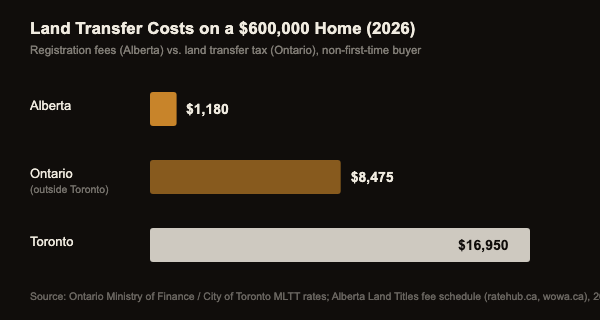
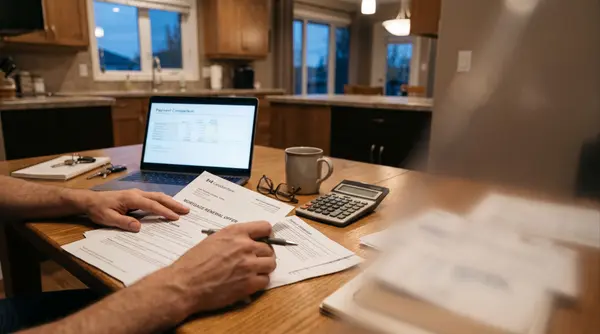
I ran the numbers myself on a $600,000 purchase using the published 2026 rate tables. Alberta's registration fees land around $1,180 total (transfer plus mortgage registration). Ontario's provincial land transfer tax alone is $8,475. In Toronto specifically, add the city's matching municipal tax and the total climbs to $16,950, assuming a standard 20% down payment and no first-time buyer rebate.
A buyer purchasing a $600,000 home in Toronto pays roughly $16,950 in combined provincial and municipal land transfer tax, while an Alberta buyer on the same purchase pays about $1,180 in registration fees (Ontario Ministry of Finance and City of Toronto rate schedules, 2026). That's a $15,770 difference in cash due before you even move in.
The gap only widens as the price goes up, since Ontario's tax is marginal and Alberta's fee scale is flat and small by comparison. On an $800,000 Toronto purchase, you're looking at close to $25,000 in land transfer tax alone. For a deeper breakdown of every line item due at closing on an Edmonton purchase, see our full Edmonton closing costs guide.

Do First-Time Buyer Rebates Close the Gap?
Ontario's first-time buyer rebate covers up to $4,000 of the provincial land transfer tax, and Toronto adds its own municipal rebate of up to $4,475, for a combined maximum of $8,475 (wowa.ca, 2026). That's real money. It's also only half the bill on our $600,000 Toronto example, and it disappears entirely if you've owned a home anywhere in the world before.
Alberta doesn't offer a land transfer rebate because there isn't a tax to rebate in the first place. A move-up buyer, a second-time buyer, or someone buying an investment property in Alberta still only pays the small registration fee. In Ontario, that same buyer pays full freight with no rebate available at all. The rebate conversation misses the real point: Alberta's system treats every buyer the same way, so you're not relying on a one-time exemption to make the math work.
Ontario's combined first-time buyer land transfer rebate tops out at $8,475 across the provincial and Toronto municipal programs (wowa.ca, 2026). A repeat buyer in the same market gets zero rebate and pays the full tax, while every Alberta buyer, first-time or not, pays the same low registration fee.
If you're weighing a first purchase in Alberta, our buyer resources page walks through the FHSA and RRSP Home Buyers' Plan programs that actually apply here, since those are the incentives Alberta buyers should be stacking instead.
Is Alberta's Income Tax Actually Lower Than Ontario's?
At the top bracket, yes, clearly. Alberta's top combined federal and provincial marginal rate sits at 48.00%, while Ontario's reaches 53.53% once Ontario's surtaxes stack on top of its 13.16% provincial bracket (lifemoney.ca 2026 marginal rate tables). Alberta has no surtax at all, just a flat 15% top provincial rate layered under the 33% federal rate.
Where it gets less clean is at the income levels most of my clients are actually at. Alberta's provincial brackets start at a higher rate (8% versus Ontario's 5.05%), so the gap between the two provinces is much smaller for a $60,000 or $90,000 earner than it is for someone clearing $300,000. Alberta also has no provincial sales tax, just the 5% federal GST, compared to Ontario's 13% HST. On $40,000 of annual spending, that's roughly $3,200 a year back in your pocket regardless of what tax bracket you're in.
So the honest answer is: Alberta's tax advantage is real, but it's concentrated at higher incomes and in day-to-day sales tax savings, not necessarily in your paycheque if you're early in your career.

Why Are Edmonton Homes Still Half the Price of Toronto Homes?
Edmonton's average home price was $466,080 in September 2026, compared to $1,006,409 across the Greater Toronto Area, more than double (REALTORS® Association of Edmonton, TRREB via wowa.ca, 2026). That gap drives your mortgage payment, your default insurance premium if you're putting less than 20% down, and how much house you can actually qualify for under the federal stress test.
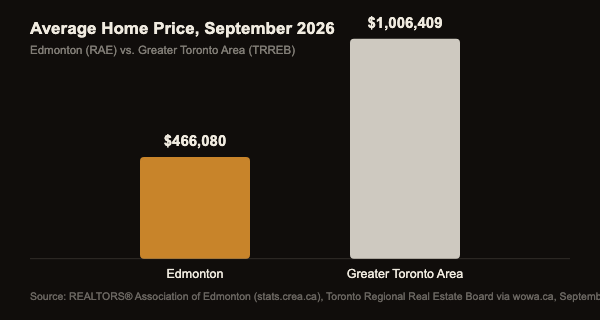
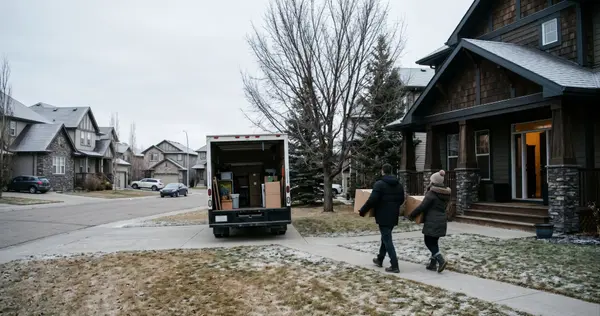
I've had clients from Toronto sit across from me doing this math out loud for the first time, and the reaction is almost always the same: they ask me to repeat the number because they assume I made a mistake. A $540,000 difference in purchase price changes your monthly payment by well over $2,500, which matters a lot more over 25 years than any single tax line item.
Isn't the land transfer tax number still shocking on its own? It is. But it's a one-time cost. The price gap is a monthly cost that compounds for as long as you hold the mortgage.
What Does This Actually Mean for Your Move?
Stack all three numbers together and the total cost difference on a comparable $600,000 purchase comes to roughly $15,770 in land transfer tax alone, before you factor in the $540,000 average price gap or the sales tax difference on everything you'll buy after you move. Alberta also has no provincial land transfer tax of any kind, and GST is the only sales tax that applies, 5%, not the 13% HST you'd pay in Ontario on services like legal fees and moving costs.
One thing that doesn't change between provinces: your deposit timing and condition period. In Alberta, your deposit is typically due within 5 business days of an accepted offer, and your condition period usually runs 7 to 10 business days for inspection and financing. Budget for that cash to move quickly, on top of whatever you're saving on land transfer costs. For the full relocation picture, including driver's licence and healthcare timelines, see our complete guide to moving to Edmonton from Ontario.

Planning a Move from Ontario or BC
Get the Edmonton Budget Buyer's Guide
A plain-English breakdown of closing costs, deposit timing, and what your budget actually buys in Edmonton right now, built for buyers coming from out of province.
Get the GuideFrequently Asked Questions
Does Alberta have a land transfer tax?
No. Alberta charges land title registration fees instead, $50 plus $5 per $5,000 of the purchase price and the same formula on the mortgage amount (Alberta Land Titles fee schedule, 2026). On a $600,000 home that totals about $1,180, versus $8,475 in Ontario's provincial land transfer tax alone.
How much more are closing costs in Toronto than in Edmonton?
On a $600,000 purchase, Toronto's combined provincial and municipal land transfer tax is about $16,950, compared to roughly $1,180 in Alberta registration fees (Ontario Ministry of Finance, City of Toronto, 2026). That single line item is the biggest closing cost difference between the two markets.
Is Alberta's income tax really lower than Ontario's?
At the top bracket, yes: 48.00% combined in Alberta versus 53.53% in Ontario (lifemoney.ca 2026 marginal rate tables). The gap is smaller for median earners, but Alberta's lack of provincial sales tax, just 5% GST versus 13% HST, saves most households a few thousand dollars a year regardless of income.
Why are Edmonton homes so much cheaper than Toronto homes?
Edmonton's average home price was $466,080 in September 2026, compared to $1,006,409 in the Greater Toronto Area (RAE, TRREB via wowa.ca, 2026). It comes down to decades of land supply and density differences between the two markets, not a temporary dip in either one.
Do I still pay GST when I buy a resale home in Alberta?
No. GST applies to new construction, not resale homes. On services tied to your purchase, like legal fees, you'll pay Alberta's 5% GST only, with no provincial sales tax on top, compared to Ontario's 13% HST on the same services.
The land transfer tax gap gets the attention because it's the number that hits your bank account on closing day. The real difference is the combination: no land transfer tax, a lower top tax bracket, lower sales tax, and a home price that's less than half of what the same buyer would pay in the GTA. Run your own numbers before you move, not after.
Categories
Recent Posts