Mortgage Renewal Cost Alberta 2026
What a Mortgage Renewal Actually Costs Alberta Homeowners in 2026
If your mortgage comes up for renewal this year or next, the payment on your renewal letter is probably going to be higher than what you're used to, and it's not a small gap. Roughly 60% of Canadian mortgage holders renewing in 2025 and 2026 are facing a higher payment, and for a lot of Alberta homeowners who locked in a five-year fixed rate back in 2020 or 2021, that increase is landing in the 15% to 24% range.
I talk to a handful of these clients every month, usually a few weeks before their renewal date, and the reaction is almost always the same: shock, then a scramble to figure out what their actual options are. This guide walks through the real math on an Alberta mortgage renewal in 2026, what's driving it, who gets hit hardest, and what you can actually do about it before your letter arrives.
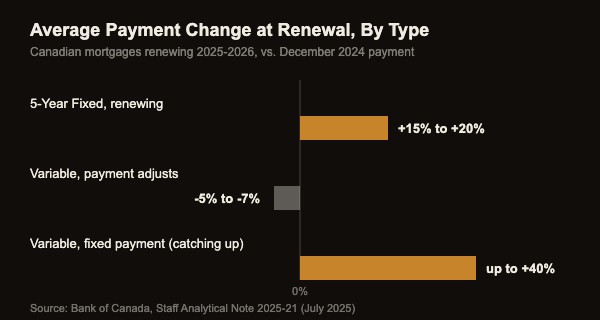
- About 60% of mortgage holders renewing in 2025-2026 face a higher payment, and 5-year fixed renewers specifically are seeing average increases of 15-20% (Bank of Canada, Staff Analytical Note 2025-21).
- On a $550,000 balance renewing from a 2021-era 2.09% five-year fixed into an Oct 2026 rate of 4.34%, the payment jumps by roughly $617 a month, about 22%.
- Alberta's current lowest 5-year fixed rate is around 4.34%, with the lowest 5-year variable near 3.65% (Ratehub.ca, Oct 9, 2026).
- Variable-rate borrowers whose payment stayed fixed while rates rose may need to raise that payment by up to 40% to stay on their original schedule (Bank of Canada). Lenders also let you lock a renewal rate up to 120 days early, the single biggest lever most people don't use in time.
What's Actually Driving Mortgage Renewal Shock in Alberta Right Now?
Renewal shock is happening because mortgages signed in 2020 and 2021, when five-year fixed rates sat between 1.8% and 2.5%, are now coming due into a rate environment more than double that. A large share of Canadian mortgages renew in this exact window, and most of them were written at those rock-bottom pandemic-era rates.
It isn't only the rate itself. A lot of these mortgages were also written on 25 or 30-year amortizations, and five years of payments barely touches the principal in the early years of a mortgage. So you're renewing a balance that's barely smaller than what you started with, at a rate that's more than doubled. That's the combination that produces the sharpest increases.
How Much More Will Your Payment Actually Be?
On a $550,000 balance renewing from 2.09% into today's 4.34% five-year fixed, with 20 years left on the amortization, the payment moves from roughly $2,803 a month to $3,420, an increase of about $617 a month, or 22%. On a $400,000 balance under the same rate change, it's $2,039 to $2,487, up $448 a month.
I ran both of these numbers myself using the actual rate spread homeowners are facing right now, rather than quoting someone else's example, because the exact dollar amount depends heavily on your specific balance and how much amortization you have left. Call your lender or broker for your exact number, but this gives you a realistic range to plan around before that conversation.
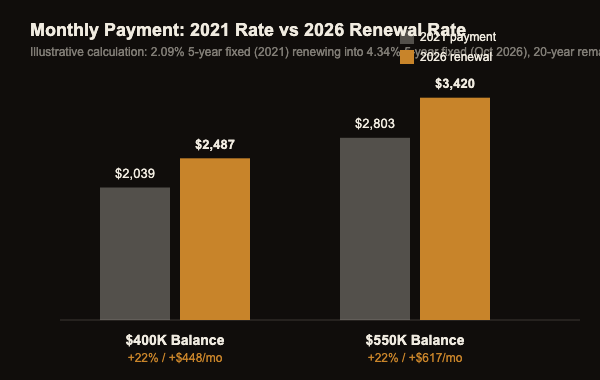
| Balance | 2021 Payment (2.09%) | 2026 Renewal (4.34%) | Monthly Increase |
|---|---|---|---|
| $400,000 | $2,039 | $2,487 | +$448 (22%) |
| $550,000 | $2,803 | $3,420 | +$617 (22%) |
If you went variable instead of fixed at renewal, the picture looks different right now. Variable rates have actually been easing off their 2023 peak, so homeowners whose payments adjust automatically with their rate are seeing payments drop 5% to 7% on average, not rise. The people who got hurt on the variable side are the smaller group on a variable-rate mortgage with a fixed payment, where the extra interest just quietly extended their amortization instead of raising the payment. The Bank of Canada notes that group may need to raise their payment by up to 40% to get back on their original amortization schedule.
Who's Most Exposed to Renewal Shock?
Not every renewer is in the same position. The households facing the steepest increases are the ones who bought at the top of the 2020-2021 rate window, stretched their budget to qualify at a 25 to 30-year amortization, and chose a fixed-payment variable product rather than a standard variable or fixed mortgage.
If you're in that higher-exposure group, the gap between what you can afford and what the renewal letter says isn't something to find out about the week the letter shows up. It's worth running your own numbers now.
What Are Your Actual Options Before You Renew?
Every renewing client I've talked to this year assumed their only choice was to sign whatever their current lender offered. That's almost never true, and it's the single most expensive assumption in this whole process.
- Shop 120 days before your renewal date. Most lenders let you lock a rate up to four months before your renewal without any penalty. That window is the easiest lever you have, and most people let it close without using it.
- Get three numbers first. What your home is worth, what you still owe, and the total of every monthly debt payment you're carrying. Those three numbers decide which options are actually available to you, long before you talk rate.
- Extend your amortization. Stretching back out to 25 or 30 years at renewal lowers the monthly payment, though it adds interest cost over the life of the loan. For someone facing real payment shock, it can be the difference between staying in the home and not.
- Blend and extend, or switch lenders entirely. Some lenders will blend your old rate with a new one if you want to extend before maturity. Switching lenders at renewal, with no penalty since your term is actually up, is often the most overlooked way to get a meaningfully better rate.
[FACT CHECK: insert names of Tristan's 3 recommended mortgage brokers for this section, per the standing referral-partner rule of recommending a minimum of 3 per category]
Should You Lock In Fixed or Go Variable at Renewal?
In my opinion, if a payment increase at the high end of that 15-24% range would genuinely strain your budget, fixed is the safer call simply because you know the number for five years. If you've got room to absorb some volatility and think rates have more room to fall than rise over the next couple of years, variable is worth a real look, especially with payments already trending down 5-7% for people who took that route.
Not sure what your renewal actually looks like?
Send me your mortgage balance, rate, and remaining amortization and I'll walk you through what a realistic renewal payment looks like, no cost, no pressure.
Get the Buyer's GuideFrequently Asked Questions
How much will my mortgage payment go up at renewal in Alberta in 2026?
Most 5-year fixed renewers are seeing average increases of 15% to 20%, per the Bank of Canada. On a $550,000 balance moving from a 2021-era 2.09% rate to a 2026 rate near 4.34%, that works out to roughly $617 more a month, about 22% (Bank of Canada, Staff Analytical Note 2025-21, July 2025).
How early can I lock in my mortgage renewal rate in Alberta?
Most lenders let you lock a renewal rate up to 120 days, about four months, before your actual renewal date with no penalty. Shopping and locking in that window is the easiest way to protect yourself from a rate increase between now and your renewal date.
Is it better to go fixed or variable when renewing a mortgage in 2026?
As of October 2026, Alberta's lowest 5-year fixed sits near 4.34% versus roughly 3.65% for variable (Ratehub.ca, Oct 9, 2026). There's no universal right answer: fixed gives payment certainty for five years, while variable holders have actually seen payments drop 5-7% recently as rates have eased (Bank of Canada, Staff Analytical Note 2025-21, July 2025).
Can extending my amortization at renewal actually help?
Yes. Stretching your remaining amortization back out to 25 or 30 years lowers your monthly payment immediately, which can meaningfully ease a renewal that would otherwise strain your budget, though you'll pay more interest over the life of the mortgage as a tradeoff.
What should I do first if my mortgage renews in the next year?
Get three numbers before you talk to anyone: your home's current value, your remaining balance, and your total monthly debt load. Those three decide whether you're shopping lenders, extending amortization, or something else, and knowing them before the conversation puts you in control of it.
A renewal letter with a bigger number on it isn't a verdict, it's a starting point for a conversation you have more leverage in than most people realize. If you want a second set of eyes on what your specific renewal actually looks like before you sign anything, that's exactly the kind of thing I help clients work through, no cost to you either way.
Categories
Recent Posts