When Should You Refinance Your Mortgage in Alberta?

Homes with Tristan: Homeowner Finance Guide
When Should You Refinance Your Mortgage in Alberta?
By Tristan Boire, REALTOR | Park Realty, Sherwood Park AB

Refinancing replaces your whole mortgage before your term ends. Renewing just signs a new term when your old one expires, with no penalty at all. Mixing those two up is the single most expensive mistake I see Alberta homeowners make, because one of them can cost you five figures and the other costs you nothing.
About 60% of Canadians renewing a mortgage in 2025 and 2026 are facing a higher payment, and fixed-rate borrowers renewing in 2026 are looking at a 20% average increase (Bank of Canada, 2025). That's pushing a lot of homeowners to ask whether they should break their mortgage early instead of riding it out. Sometimes the math says yes. Most of the time, it says wait.
Key Takeaways
- Fixed-rate mortgages pay the greater of three months' interest or the Interest Rate Differential (IRD), which can run 3 to 4 times higher.
- Alberta homeowners catch a real break here: no provincial land transfer tax on a refinance, and the discharge registration fee is only $50 (Service Alberta).
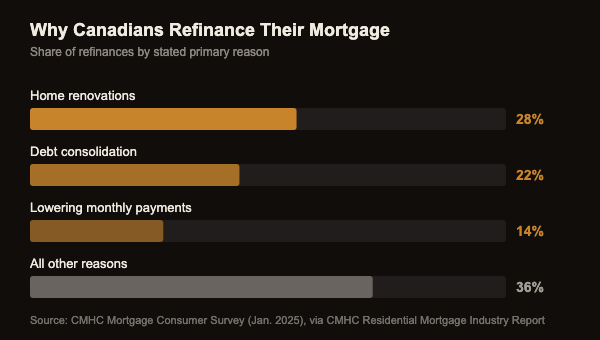
- Most Canadians who refinance aren't chasing a better rate at all: 28% are funding renovations and 22% are consolidating debt (CMHC, 2025).
- If you're within 6 to 12 months of your renewal date, waiting almost always beats paying a penalty to refinance now.
What's the Real Difference Between Refinancing and Renewing?
Renewing means your term ends and you sign a new one, at your lender or a new one, with no penalty and minimal cost (CMHC). Refinancing means breaking your current term early to change the loan itself, your rate, your amortization, or the balance, which triggers a prepayment penalty.
Here's the part that trips people up: a renewal costs you nothing extra because you're not breaking a contract, you're letting it expire on schedule. A mid-term refinance means the lender is losing interest income they were counting on, and the penalty exists to cover that loss. Once you're within shouting distance of your renewal date, that penalty math almost never works in your favour, which is exactly what the next section walks through in dollars.

How Much Does the Penalty Actually Cost?
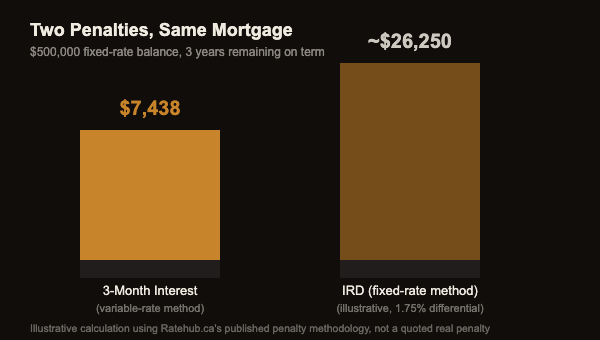
Your penalty is the greater of three months' interest or the Interest Rate Differential, and on a fixed-rate mortgage the IRD almost always wins (Ratehub.ca). On a $500,000 variable-rate balance at 5.95%, three months' interest runs about $7,438. That's the whole calculation for a variable mortgage, full stop.
Fixed-rate mortgages aren't that simple. The lender compares your contract rate to what they'd charge today for your remaining term. Ratehub's own worked example uses a 5.50% contract rate against a 3.75% comparable rate today, a 1.75% differential. Apply that same differential to a $500,000 balance with three years left and you land around $26,250, more than three times the variable penalty on an identical balance.
The big banks tend to use their posted rate, not their discounted rate, to calculate your current comparable rate. That inflates the gap and can push an IRD penalty well past what the math above shows. [UNIQUE INSIGHT] If you're with one of the Big Six, ask your lender for the exact comparable rate they're using in the calculation before you sign anything, because that single number is doing most of the work in whatever penalty they quote you.
What Are Most People Actually Refinancing For?
Chasing a lower rate isn't even the top reason Canadians refinance. CMHC's own Mortgage Consumer Survey found 28% refinance to fund renovations and 22% to consolidate higher-interest debt, with only 14% doing it purely to lower their monthly payment (CMHC, 2025). That matters because the penalty math changes completely depending on which bucket you're in.
If you're consolidating debt at 22% credit card interest into a mortgage at 5%, the penalty can pay for itself inside a year even on a fixed mortgage, because the interest you're currently bleeding is so much higher than anything a bank will charge you to break early. [PERSONAL EXPERIENCE] I've sat across the table from clients who were paying more in credit card interest every month than their entire mortgage payment. In those cases, eating a $15,000 penalty to fix the bigger problem was the obvious call, and it wasn't close.
It's a different conversation if you're only trying to shave 0.3% off your rate with two years left on your term. Worth running the actual numbers before you assume refinancing helps. For a plain breakdown of what your payment actually looks like at renewal without breaking anything early, see [INTERNAL-LINK: our mortgage renewal cost guide → the companion Track 3 post on what a 2026 Alberta renewal actually costs per month, published this same week].

Why Alberta's Math Is a Little Easier Than Ontario's or BC's
Alberta charges no provincial land transfer tax on a refinance, and the provincial registration fee to discharge your existing mortgage is only $50 (Service Alberta land titles schedule). Legal fees for the refinance itself typically run $750 to $1,250, which means your out-of-pocket closing costs, separate from any penalty, usually land under $2,000 total.
That's a genuinely smaller bill than what homeowners in Ontario or BC deal with on the same transaction, since both of those provinces layer on transfer tax that Alberta simply doesn't charge. It doesn't make a bad penalty math problem good, but it does mean the fixed costs around the refinance itself are rarely the deciding factor here. The penalty almost always is.
The rough rule of thumb
Add up your penalty plus legal and appraisal fees, then divide by how much you'd save per month at the new rate. That tells you your break-even point in months. If that number is longer than the time you have left on your current term, or longer than how long you plan to stay in the home, wait. If it's shorter and you've got years left on the mortgage, the math is genuinely worth running with a broker.
Refinance or HELOC? They Solve Different Problems
A HELOC sits on top of your existing mortgage without touching it, so you keep your current rate and only pay interest on what you actually draw. A refinance replaces the whole mortgage, which means you start paying interest on the full new balance right away, even the part you haven't spent yet.
If you locked a mortgage rate back when they were cheap, a HELOC lets you borrow against your equity without breaking that good rate. If you need one lump sum for something specific, like consolidating debt once and being done with it, a refinance gives you payment certainty a HELOC's variable rate can't. Neither one is automatically better. It depends on whether what you need is ongoing flexibility or a single clean number.
Not Sure Which Side of This You're On
Let's Run Your Actual Numbers
Every renewal date, every balance, and every lender's penalty formula is different. I'll walk through your specific situation with you, no pressure, no sales pitch.
Book a CallFrequently Asked Questions
Can I refinance before my mortgage term is up in Alberta?
Yes, at any point, but you'll pay a prepayment penalty for breaking the term early, the greater of three months' interest or the Interest Rate Differential on fixed mortgages (Ratehub.ca). There's no legal waiting period in Alberta, only the cost of the penalty itself.
Is it worth refinancing to save half a percent on my rate?
Usually not if you have more than a year left on your term. A 0.5% savings on a $450,000 balance is roughly $150 to $190 a month, which typically takes well over a year to clear even a modest penalty. Run your specific break-even math before deciding.
Does Alberta charge land transfer tax on a mortgage refinance?
No. Alberta has no provincial land transfer tax at all, on a purchase or a refinance. You'll still pay a $50 provincial registration fee to discharge the old mortgage, plus typical legal fees of $750 to $1,250.
What's the fastest way to know if I should refinance or just wait?
Ask your lender for your exact penalty quote in writing, then divide that number by your projected monthly savings at the new rate. If the resulting break-even period is longer than the time left on your term, waiting for renewal almost always wins.
Categories
Recent Posts