FHSA + RRSP Home Buyers' Plan Combined: Maximizing Your Down Payment
Homes with Tristan — Alberta Buyer Finance
FHSA + RRSP Home Buyers' Plan Combined: Maximizing Your First Home Down Payment
By Tristan Boire, REALTOR | Park Realty, Sherwood Park AB
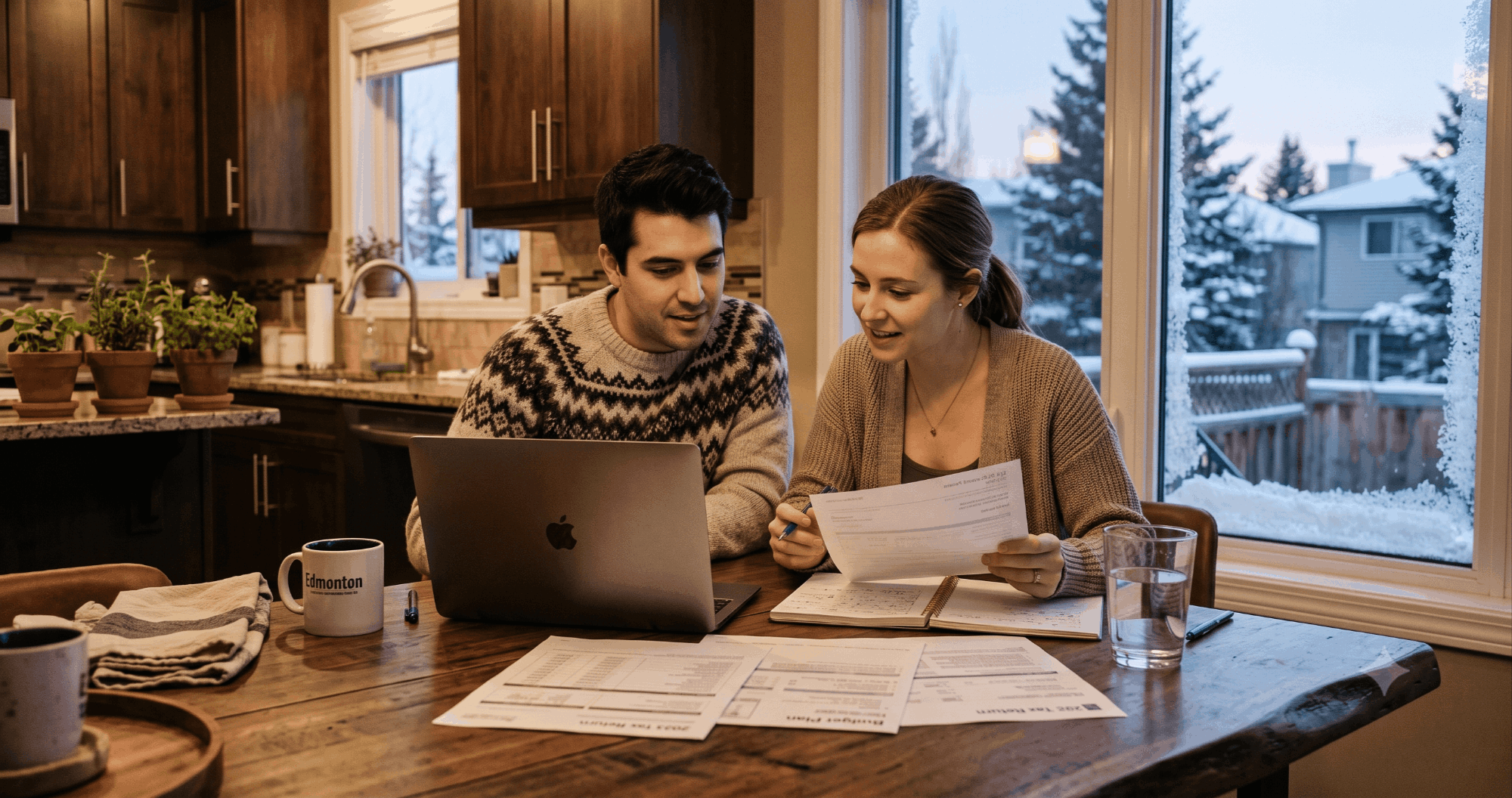
A single first-time buyer in Alberta can pull together up to $100,000 tax-free between two government programs: the First Home Savings Account (FHSA) and the RRSP Home Buyers' Plan (HBP). A couple buying jointly, where both partners qualify as first-time buyers, can theoretically stack up to $200,000. That's not a rounding error on a down payment. On a $600,000 Edmonton purchase, it's a third of the price before a mortgage even enters the conversation.
The FHSA and the HBP aren't the same program wearing two names. One is a permanent gift from the government. The other is an interest-free loan from your own retirement savings. Mixing them up costs buyers real money every year. Here is how each one works on its own, how they stack together, and what a first-time buyer or couple in Edmonton can realistically expect to have in hand on closing day.
- A single buyer can combine $40,000 lifetime from an FHSA with $60,000 from an RRSP under the HBP, for $100,000 total (Canada Revenue Agency, 2026).
- A couple where both partners are first-time buyers can each use their own FHSA and HBP, doubling the potential combined total to $200,000.
- FHSA withdrawals for a qualifying home purchase never have to be repaid. HBP withdrawals must be repaid to your RRSP over 15 years or the unpaid portion is added to your taxable income.
- RRSP contributions need to sit in the account for at least 90 days before an HBP withdrawal or you risk losing the tax deduction on them.
How Much Can You Actually Combine From the FHSA and HBP?
A first-time buyer can withdraw up to $40,000 lifetime from an FHSA and up to $60,000 from an RRSP under the Home Buyers' Plan, for a combined $100,000 toward the same home purchase (Canada Revenue Agency, 2026). There is no rule against using both. In fact, the CRA explicitly allows a qualifying FHSA withdrawal and an HBP withdrawal on the same qualifying home, as long as you meet the conditions for each program separately.
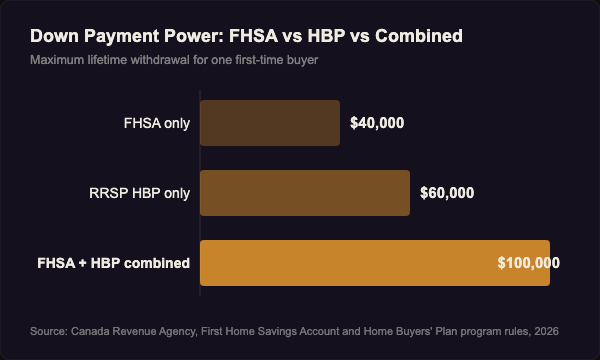
Both programs run per person, not per household. If you're buying with a partner and you both qualify as first-time buyers, that combined figure effectively doubles to $200,000 between you. I'll walk through both scenarios with real dollar amounts further down, but the headline number is the one most buyers don't realize: this isn't an either-or choice. Used correctly, the two programs are additive.
For a buyer weighing whether to save inside an FHSA, an RRSP, or a plain high-interest account, this is worth building into the plan from year one. Our buyers page walks through the rest of the Edmonton purchase process once the down payment is sorted.
What Each Program Allows on Its Own
The FHSA and the HBP grew up in different eras of Canadian housing policy and it shows in how they are structured. One builds contribution room slowly, one hands you a lump sum from savings you already have. Knowing the mechanics of each matters more than knowing the headline number, because the mechanics determine how fast you can actually get to that number.
First Home Savings Account (FHSA)
You can contribute up to $8,000 per year to an FHSA, with a lifetime cap of $40,000 (Canada Revenue Agency, 2026). Contributions are tax-deductible the same way an RRSP contribution is, and growth inside the account is completely tax-free when you eventually withdraw it for a qualifying home purchase.
If you don't use your full $8,000 in a given year, you can carry forward up to $8,000 of unused room to the following year, but only one year's worth at a time. That means the fastest you can max out an FHSA is five years of consistent $8,000 contributions, unless you open the account in a year you can front-load, in which case a maximum of $16,000 is possible in year two if you skipped year one entirely.
- Room only starts the year you open the account. You can't backdate contribution room to years before your first FHSA existed.
- You have 15 years to use the room, or until age 71. Whichever comes first closes the account, and any balance rolls into an RRSP or gets paid out as taxable income.
- No minimum holding period. Unlike the HBP, money contributed to an FHSA can be withdrawn as a qualifying withdrawal without waiting 90 days.
RRSP Home Buyers' Plan (HBP)
The HBP lets a first-time buyer withdraw up to $60,000 from an RRSP, tax-free at the time of withdrawal, to put toward a qualifying home (Canada Revenue Agency, 2026). Unlike the FHSA, there's no annual contribution limit tied specifically to the HBP. The limit is what you've already built up in your RRSP, subject to standard RRSP contribution room rules based on your income.
The catch is timing. RRSP contributions have to sit in the account for at least 90 days before they qualify for HBP withdrawal, or you lose the tax deduction on the amount contributed during that window (Canada Revenue Agency, 2026). If you're dumping a lump sum into an RRSP the week before an accepted offer, plan around that 90-day rule or you'll pay for it at tax time.
Practically, this means the HBP rewards buyers who already had an RRSP going into their house hunt, whether from years of retirement saving or a recent lump-sum contribution made with enough runway before the purchase closes.

Do You Have to Pay Any of It Back?
FHSA withdrawals have no repayment obligation at all. You don't need to repay a qualifying FHSA withdrawal you make to buy a home (Canada Revenue Agency, 2026). That $40,000 is simply yours, the same as if it had sat in a TFSA. HBP withdrawals are the opposite: every dollar has to go back into your RRSP over 15 years, or it counts as income the year you missed the payment.
This is the single most important distinction between the two programs and the one most first-time buyers get wrong. It is tempting to treat a $100,000 combined withdrawal as one pool of "free" down payment money. Two-thirds of it, at most, is genuinely free. The other third is a loan you owe to your own future retirement account.
HBP repayments begin the second year after the year you withdrew the funds, and you have 15 years total to repay the full amount (Canada Revenue Agency, 2026). Withdraw $60,000 in 2026, and your first required repayment year is 2028, at a minimum of $4,000 per year for 15 years. Miss a year's minimum payment and the CRA adds the missed amount directly to your taxable income for that year, the same as if you had cashed out RRSP savings early.
The practical takeaway: prioritize maxing your FHSA before leaning on your RRSP. Every dollar of FHSA room you leave unused is a dollar of permanently tax-free down payment you gave up. The HBP is still worth using, it just comes with fifteen years of homework attached.
When to Withdraw Relative to Your Purchase
Both programs require a written agreement to buy or build a qualifying home before you make a qualifying withdrawal, and the home has to become your principal residence within a reasonable time after possession. Neither program lets you withdraw funds speculatively months before you have an accepted offer in hand.
In Alberta, most purchases run on a 7 to 10 business day condition period from accepted offer, covering the home inspection and financing confirmation, with the initial deposit due within the first 5 business days (RECA-standard purchase contract terms). That's a tight window to move large sums of money if you haven't already lined up your FHSA and RRSP withdrawal requests in advance.
My advice to clients: once you're actively house hunting and expect to have an accepted offer within 60 to 90 days, get your withdrawal paperwork started with your financial institution. FHSA withdrawals can move quickly since there is no holding period. HBP withdrawals need that 90-day RRSP seasoning already satisfied, so any last-minute RRSP top-up needs to happen well before you are house hunting, not after you find the house.
Worked Example: A Single Buyer in Edmonton
Say a single buyer has maxed their FHSA at $40,000 and has $60,000 sitting in an RRSP, seasoned well past the 90-day mark. Combined, that is a $100,000 down payment on a home in the Glenridding Heights or Terwillegar range, where detached homes typically run $550,000 to $750,000.
| Item | Amount |
|---|---|
| Home price (Terwillegar detached) | $620,000 |
| FHSA withdrawal (tax-free, no repayment) | $40,000 |
| RRSP HBP withdrawal (repayable over 15 years) | $60,000 |
| Combined down payment | $100,000 (16% of price) |
| Minimum annual HBP repayment | $4,000/year starting 2028 |
That $100,000 gets this buyer past the 20% down payment threshold on a $620,000 home, which matters for two reasons: it avoids CMHC mortgage default insurance premiums, and it typically qualifies for better mortgage rates. It also means only $60,000 of that down payment is technically owed back, at $4,000 a year, a manageable line item most buyers can fold into their annual budget without much strain.
Worked Example: A Couple Buying Jointly in Edmonton
Now take a couple, both first-time buyers, each with a maxed FHSA and $60,000 built up in their own RRSP. Between the two of them, that is $80,000 in permanently tax-free FHSA money and $120,000 in repayable HBP money, for a combined $200,000.
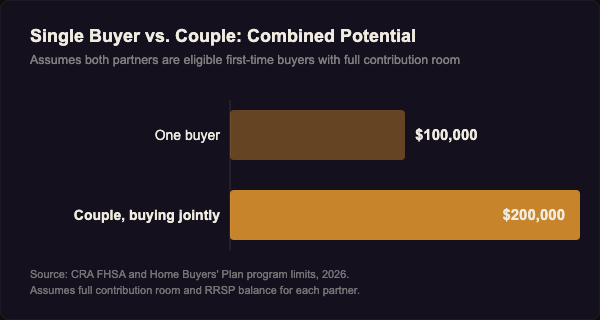
On a $750,000 Windermere entry-level purchase, $200,000 is more than a quarter of the price before either partner's regular savings or a mortgage pre-approval even factors in. The repayment side scales the same way: $120,000 in combined HBP withdrawals means $8,000 a year in minimum repayments between the two of them, or $4,000 each, starting the second year after each partner's individual withdrawal.
Worth noting: each partner's HBP repayment schedule tracks their own withdrawal date individually, not a shared household clock. If one partner withdraws in 2025 and the other tops up their RRSP and withdraws in 2026, they will be on two different 15-year repayment timelines. Keep that on a calendar somewhere, because the CRA will not remind you.
If one of you already owns a home and this purchase is really a move-up rather than a first buy, your FHSA and HBP totals are only part of the picture. Start with a free Edmonton home value estimate to see how much equity your current place adds on top of the numbers above.
Plan Your Down Payment
Not Sure How Much House Your FHSA and RRSP Actually Buy?
Grab the Edmonton Budget Buyer's Guide for a realistic breakdown of what different down payment amounts get you across Edmonton neighbourhoods, or book a call and we will run your actual numbers together.
Get the Budget Buyer's GuideFrequently Asked Questions
Can my spouse and I both use an FHSA and HBP on the same home?
Yes. Each partner qualifies individually if each meets the first-time buyer definition, which generally means neither of you owned and lived in a home as a principal residence in the current year or the four preceding years (Canada Revenue Agency, 2026). That means a couple can combine up to $200,000 between two FHSAs and two HBP withdrawals. It also means a buyer who sold a previous home more than four years ago can requalify, so if you're on the other side of that clock, our sellers page walks through what listing looks like when you're ready to move up.
Do I have to repay my FHSA withdrawal?
No. A qualifying FHSA withdrawal used to buy your first home never needs to be repaid (Canada Revenue Agency, 2026). This is the biggest structural difference from the RRSP Home Buyers' Plan, which does require repayment over 15 years.
What happens if I miss an HBP repayment?
The missed portion, generally 1/15 of your original withdrawal, gets added directly to your income for that tax year and taxed at your marginal rate (Canada Revenue Agency, 2026). It isn't a separate penalty fee, it simply increases your reported income the year you miss it.
How much contribution room do I need before I can withdraw the full amount?
For the FHSA, you need to have actually contributed the full $40,000 over time, since the account only grows through your own $8,000-a-year contributions (Canada Revenue Agency, 2026). For the HBP, the limit is $60,000 or your available RRSP balance, whichever is lower, with contributions needing at least 90 days of seasoning first.
Can I use the FHSA and HBP for closing costs, not just the down payment?
FHSA funds can go toward either your down payment or closing costs, since there is no restriction on use once withdrawn as a qualifying withdrawal. HBP funds are more limited in practice, since most lenders and lawyers apply them directly to the down payment portion of your purchase rather than closing costs.
The math is straightforward once you separate the two programs in your head: FHSA money is a gift, HBP money is a loan to yourself. Use both, use the FHSA first, and build your RRSP contribution timeline around that 90-day rule so you aren't scrambling the week you get an accepted offer. If you want to run your specific numbers against actual Edmonton listings, that's exactly what I do with clients before they start touring homes.
Categories
Recent Posts