Home Insurance in Edmonton: Cost & Coverage Guide 2026

Homes with Tristan: Alberta Buyer Finance
Home Insurance in Edmonton: What You Actually Need and What It Costs
By Tristan Boire, REALTOR | Park Realty, Sherwood Park AB
Alberta home insurance premiums rose 391.6% between December 2005 and December 2025, the largest increase of any province in the country (Statistics Canada, 2025). If you are buying in Edmonton right now, that number matters more than it sounds like it should, because your lender will not let you close without proof of coverage in hand.
I walk every client through this during their condition period, usually right after the home inspection comes back clean. Here is what home insurance actually costs in Edmonton today, why Alberta rates have climbed so fast, what your policy will not cover unless you ask for it, and when you actually need this sorted during a purchase.
Key Takeaways
- •Edmonton homeowners pay around $1,850 a year on average, the cheapest of Alberta's major cities (Ratehub.ca, 2024; Farnese Insurance Brokers, 2026)
- •Alberta premiums climbed 55.8% in the last five years alone, well above the 38.6% national average (Statistics Canada, 2025)
- •Sewer backup and overland flood coverage are not automatic. Both are add-on endorsements, and Edmonton's older neighbourhoods usually need them
- •Your lender needs proof of insurance before your mortgage funds, which means it has to be sorted during your condition period, not after
How Much Does Home Insurance Actually Cost in Edmonton?
Edmonton homeowners pay roughly $1,850 a year for home insurance, the lowest average among Alberta's major cities (Ratehub.ca, 2024; Farnese Insurance Brokers, 2026). Calgary sits around $2,500, the provincial average is closer to $2,600, and Fort McMurray tops the list at $3,390 because of wildfire exposure.
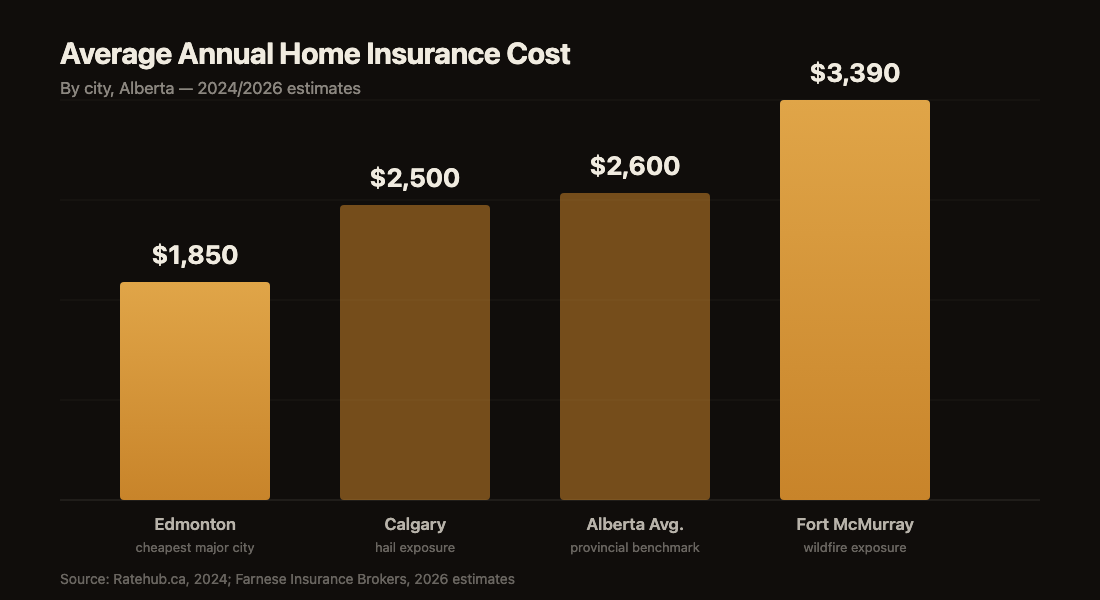
Edmonton's relatively low rate comes down to hail. Calgary sits in one of the most hail-prone corridors in the country, and Fort McMurray carries wildfire risk that Edmonton simply does not. That does not mean Edmonton is cheap in absolute terms, it means Edmonton is cheap relative to the rest of the province.
A newer, high-value home in a walkable Edmonton neighbourhood and an older infill with an aging roof will not get the same quote even on the same street. Age of home, roof condition, claims history, and proximity to a fire hall all move the number more than the city name does.
One thing I tell every relocating client from Ontario or BC: do not assume your old province's premium is a reasonable benchmark here. Get an actual Edmonton quote on the specific property before you budget for closing costs.
Why Are Alberta Premiums Rising So Fast?
Alberta premiums rose 55.8% between December 2020 and December 2025, far outpacing the 38.6% national average, according to Statistics Canada (2025). Only Manitoba, Nova Scotia, and Saskatchewan came close, and none matched Alberta's pace.
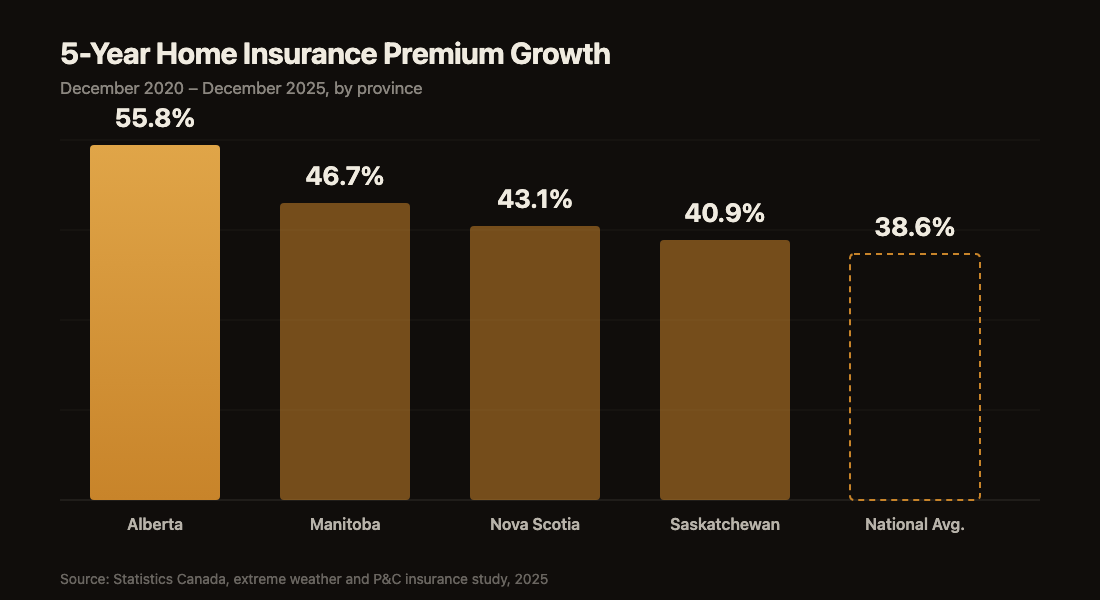
Statistics Canada economist Marisa McGillivray traced the increase to Alberta's exposure to hailstorms, wildfires, and convective storms. Insured catastrophic losses hit $8.6 billion nationally in 2024, breaking the previous record of $6.2 billion set in 2016. Alberta accounts for a disproportionate share of that total almost every year, which is exactly why premiums here move faster than in provinces without the same weather exposure.

Home insurance nationally rose 45% over the last six years, more than double the 23.9% increase on vehicle insurance over the same period (Statistics Canada, 2025). That gap tells you something specific: this is not general inflation. It is weather-driven, and Alberta sits closer to the center of it than almost anywhere else in Canada.
What Your Policy Actually Covers, and What It Doesn't
Standard Alberta home insurance does not include sewer backup or overland flood coverage. Both require a separate endorsement added to your policy, and neither is optional in practice if you own an older Edmonton home.
I have had more than one client skip the sewer backup endorsement to save a few dollars a month, then deal with a basement backup two winters later in a mature neighbourhood with older combined sewer lines. Newer builds in areas like Keswick or Glenridding run lower risk here than infill homes in Crestwood or Westmount, but I still recommend the endorsement on every property I sell, new or old.
Overland flood coverage protects against snowmelt or rainfall entering through a foundation crack or window well, which is a different mechanism than a sewer backing up. Sewer backup only covers non-storm backflow from the sewer or septic system itself. Ask your broker for both, not one or the other, because they cover different failure points in the same basement.
How to Lower Your Premium Without Cutting Real Coverage
Raising your deductible from $500 to $1,000 or $2,000 is the single biggest lever most homeowners can pull, and bundling your home and auto policies with one insurer typically saves another 5 to 15% (Farnese Insurance Brokers, 2026).

A claims-free history is worth protecting too. Some insurers reduce your deductible every year you go without a claim, sometimes called a disappearing deductible, and a clean claims record on its own usually earns a discount independent of that. Monitored alarm systems and updated smoke detectors can shave a bit more off, though the bundling and deductible decisions move the number the most.
Here is the part most cost-saving articles miss: your deductible choice interacts with your closing budget, not just your annual premium. If you are stretching to cover a $10,000 deposit and inspection costs during your condition period, a $2,000 deductible might look attractive on paper but leave you exposed right when your cash reserves are thinnest, in your first year of ownership.
When You Actually Need This Sorted During Your Purchase
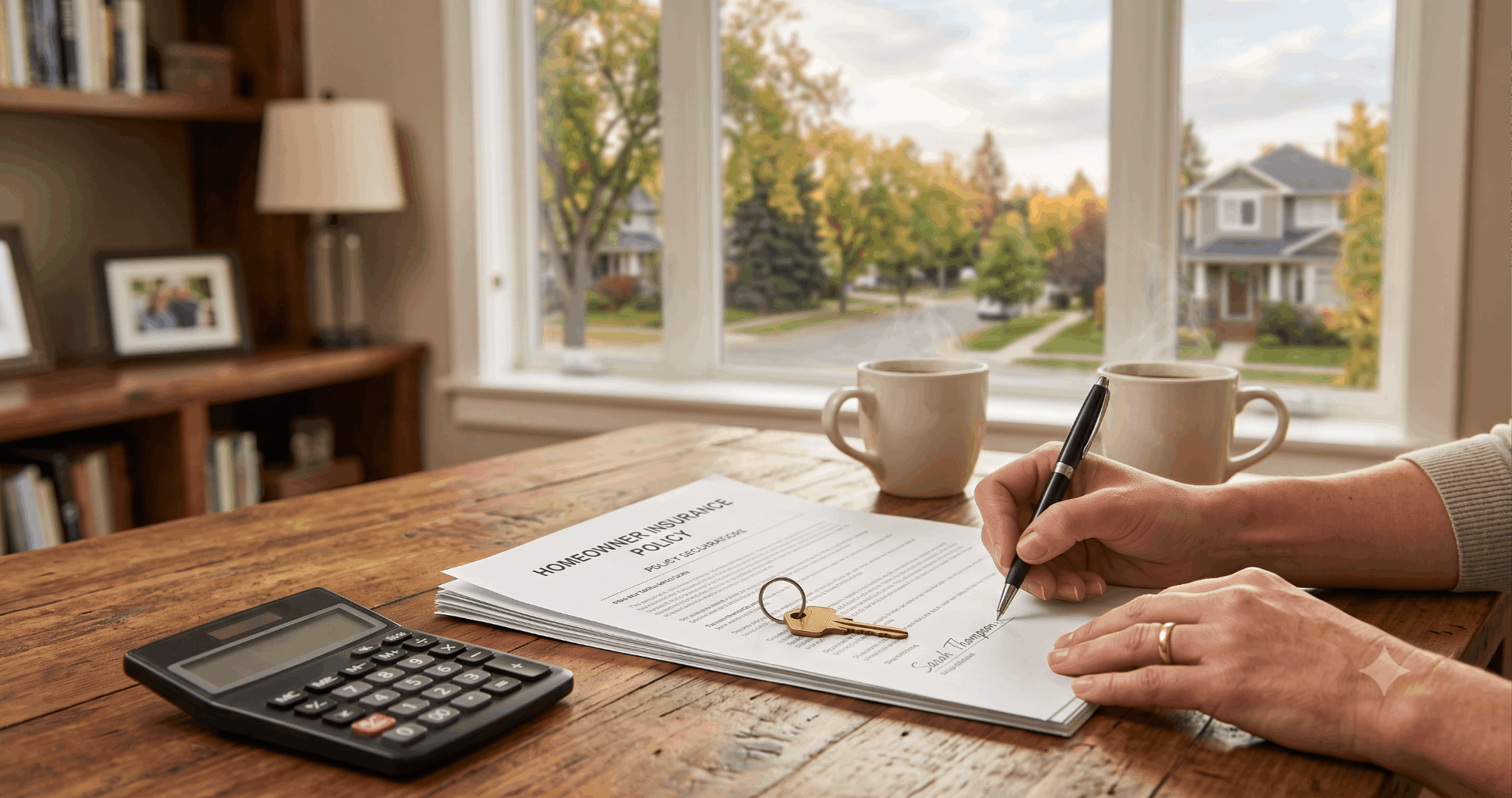
Your lender requires proof of home insurance before your mortgage funds, which in practice means it needs to be arranged before your financing condition is waived, not after. In Alberta, that condition period typically runs 7 to 10 business days from your accepted offer.
I tell clients to get an insurance quote on the specific property the same week the home inspection is booked, not after conditions are already waived. If a quote comes back higher than expected because of an older roof or a history of claims on the property, you still have room to negotiate or walk away while your financing condition is still open. Once you have waived conditions, that leverage is gone.
If you are selling your current Edmonton home to fund this purchase, get it priced and listed before your condition period starts, not after. Insurance is just one piece of a move-up timeline that has to line up on both sides.
Buying in Edmonton?
Get the Full Budget Picture Before You Offer
Insurance is one line item in a closing budget with several moving parts. The Edmonton Budget Buyer's Guide walks through all of them before you write an offer.
Get the Buyer's GuideFrequently Asked Questions
Is home insurance legally required in Alberta?
No provincial law requires it, but every mortgage lender does. If you are financing your purchase, which almost every buyer is, proof of insurance is required before your lender releases funds, making it mandatory in practice.
How much is home insurance in Edmonton on average?
Around $1,850 a year, the lowest of Alberta's major cities (Ratehub.ca, 2024; Farnese Insurance Brokers, 2026). Calgary averages closer to $2,500 and Fort McMurray runs about $3,390 due to wildfire risk.
Why has Alberta home insurance gone up so much?
Premiums rose 391.6% over the past 20 years, the largest increase of any province, driven by hail, wildfire, and severe storm losses (Statistics Canada, 2025). The last five years alone saw a 55.8% increase, well above the national rate.
Does standard home insurance cover sewer backup in Edmonton?
No. Sewer backup and overland flood coverage are both separate endorsements you have to add. Given how common basement backups are in Edmonton's older neighbourhoods, most brokers recommend adding both on any Edmonton property.
When during the buying process do I need to arrange home insurance?
Before you waive your financing condition, which typically falls within the 7 to 10 business day condition period after an accepted offer. Get a quote on the specific property as soon as your inspection is booked, not after conditions are already firm.
Categories
Recent Posts