How Much Income Do You Need to Buy a House in Edmonton in 2026?

Homes with Tristan: Buyer Finance
How Much Income Do You Need to Buy a House in Edmonton in 2026?
By Tristan Boire, REALTOR | Park Realty, Sherwood Park AB
Edmonton's average home sold for $475,079 in July 2026, down 1.8% from June and part of a market where sales are running 11% behind last year (Realtors Association of Edmonton, July 2026). If you're trying to figure out what income you'd need to buy at that price, or any price, the honest answer isn't the sticker price divided by a rule of thumb. It's whatever number the mortgage stress test says it is, and that number is almost always higher than people expect.
I walk buyers through this math every week, usually right after they've been pre-qualified for less than they thought they'd get. So here's the actual calculation, using this week's rates and Edmonton's current average price, not a number from a calculator built for the whole country.
Key Takeaways
- • The stress test qualifying rate is your contract rate plus 2%, or 5.25%, whichever is higher. At today's best insured 5-year fixed rate of 4.04%, that's 6.04% (Ratehub/WOWA, Aug 11, 2026).
- • On Edmonton's July 2026 average sale price of $475,079, a household needs roughly $106,600 in gross annual income to qualify with 5% down, before factoring in other debt.
- • Edmonton sales are down 11% year-over-year with inventory up 17.9% (RAE, July 2026), which means less competition for the exact buyers reading this.
- • Existing debt hits harder than most people assume: a $500/month car payment can push your required income up by well over $10,000 a year.
What Is the Mortgage Stress Test, and Why Does It Change Your Number?
Canada's mortgage stress test requires lenders to qualify you at a higher rate than the one you'll actually pay, specifically the greater of your contract rate plus 2%, or a federal floor of 5.25% (OSFI, confirmed unchanged as of January 2026). It exists so borrowers can absorb a rate increase without defaulting. In practice, it just means your approved mortgage amount is smaller than the math on your actual rate would suggest.

Right now, that gap is real and specific. The best insured 5-year fixed rate available in Canada sits at 4.04% as of August 11, 2026 (Ratehub.ca, WOWA.ca). Add the mandatory 2 points and you're qualifying at 6.04%, not 4.04%. That 2-point spread is the single biggest reason a buyer's "affordable" number and their "approved" number don't match.
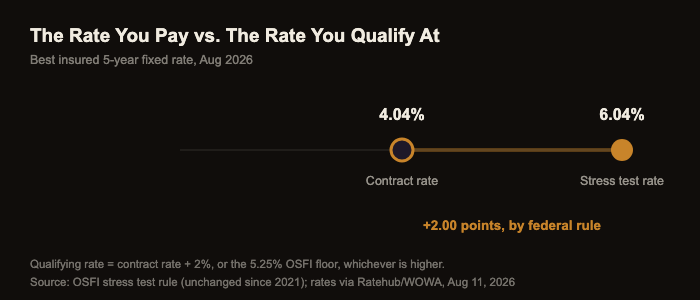
The mortgage stress test qualifies Canadian borrowers at their contract rate plus 2%, or 5.25%, whichever is higher (OSFI, unchanged since 2021). With the best insured 5-year fixed rate at 4.04% in August 2026, Edmonton buyers are being qualified at roughly 6.04%, not the rate they'll actually pay.
How Much Income Do You Actually Need at Today's Edmonton Prices?
Using this week's stress test rate of 6.04%, a 25-year amortization, minimum down payment, and standard lender assumptions for property tax and heating, here's what a single-income or combined household actually needs to qualify at four Edmonton price points, including the current market average.
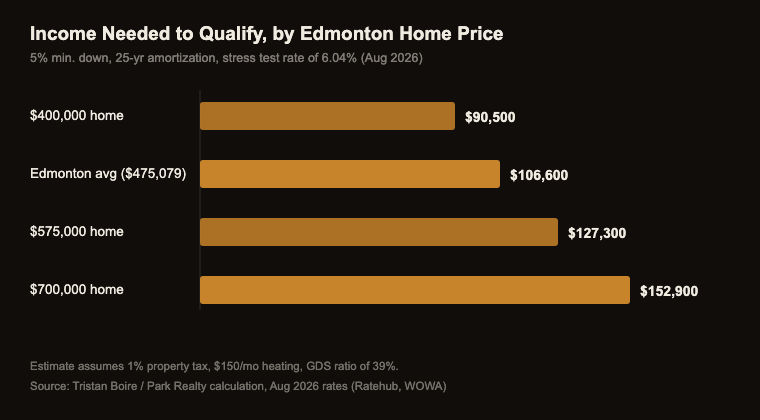
On a $400,000 purchase with 5% down, you're borrowing $380,000, and that works out to roughly $90,500 in gross household income to clear the GDS ratio. Move up to Edmonton's actual July 2026 average of $475,079, and the number climbs to about $106,600. At $575,000, closer to what a lot of infill and move-up buyers are shopping in, it's around $127,300. And at $700,000, solidly in Terwillegar or Sherwood Park detached territory, you're looking at roughly $152,900.
Those figures assume no other debt. If you're carrying a car payment or credit card balances, your number goes up from there, sometimes by a lot.
The Two Ratios Lenders Actually Use: GDS and TDS
Your Gross Debt Service (GDS) ratio can't exceed 39% of gross income, and it covers your mortgage payment, property tax, and heating. Your Total Debt Service (TDS) ratio can't exceed 44%, and it adds in everything else: car loans, credit cards, lines of credit, student loans. Most first-time buyers get tripped up on TDS, not GDS, because it's the ratio that punishes existing debt.
In my opinion, this is the part people underestimate the most. A $500 monthly car payment doesn't just cost you $500 a month, it reduces the mortgage a lender will approve by tens of thousands of dollars, because that $500 is now competing with your future mortgage payment for the same 44% ceiling. If you're planning to buy in the next 12 months, paying down a car loan or a credit card balance can move your approved amount more than waiting for rates to drop half a point.
Down Payment Rules You're Working Within
The minimum down payment in Canada, Alberta included, is 5% on the first $500,000 of purchase price and 10% on the portion above that, up to $1.5 million for first-time buyers and new construction (CMHC, effective December 2024). Above $1.5 million, you need 20% down and the mortgage becomes uninsured. If your down payment is under 20%, you'll also pay a mortgage default insurance premium, typically 2.8% to 4% of the loan, which usually gets rolled into the mortgage itself rather than paid up front.
| Home Price | Min. Down Payment | Mortgage Amount |
|---|---|---|
| $400,000 | $20,000 (5%) | $380,000 |
| $475,079 | $23,754 (5%) | $451,325 |
| $575,000 | $32,500 (5%/10% blend) | $542,500 |
| $700,000 | $45,000 (5%/10% blend) | $655,000 |
First-time buyers and new construction purchases with under 20% down also qualify for 30-year amortization instead of the standard 25 (CMHC, effective December 2024). Stretching your amortization lowers your monthly payment by roughly 8%, which can be the difference between qualifying and not, though you'll pay more interest over the life of the mortgage.
One cost people forget to budget for: if your down payment is under 20%, the default insurance premium gets added to your loan, not paid separately out of pocket. On the $380,000 mortgage from our $400,000 example, a premium in the 2.8% to 4% range works out to roughly $10,600 to $15,200 tacked onto the balance you're financing. It doesn't change the down payment you need up front, but it does mean your actual mortgage, and your actual payment, ends up a bit higher than the sale price minus your down payment would suggest.
Why This Might Be a Better Time Than It Feels Like

Edmonton's market cooled off noticeably in July. Sales fell 11% year-over-year, new listings jumped to 4,258, and total inventory is up 17.9% from a year ago (Realtors Association of Edmonton, July 2026). If you've watched this week's market update, you already know we're seeing every classic sign of a slowdown at once, softer prices, more supply, and longer days on market.
Here's the part I don't see anyone else connecting: a cooling market and a stable rate environment together often add up to more buying power than buyers assume, not less. The Bank of Canada has held its overnight rate at 2.25% since October 2025 (WOWA.ca, Aug 2026), and fixed rates have actually eased slightly this summer. Combine that with softer prices and less competition for the same listing, and a buyer who felt priced out in the spring may find their actual approved number goes further today. It doesn't feel that way scrolling headlines about a slowdown, but the math often says otherwise.
And if your number still doesn't reach $475,079, you're not out of options within a reasonable commute. Sherwood Park has detached homes starting in the $400s, and Keswick's average active listing sits closer to $750,000 with plenty of townhome and semi-detached inventory well under that. Widening your search radius by fifteen minutes can change your required income by tens of thousands of dollars a year, which matters more than most people expect when they start their search only inside city limits.
Five Ways to Actually Move Your Number

Every buyer I work with wants to know what actually moves the needle. From what I've seen sitting across the table from dozens of Edmonton buyers, these five levers matter more than waiting around for rates to drop:
- •Pay down consumer debt first. A $300/month credit card payment can cost you more approved mortgage than a full percentage point on your rate.
- •Stack your FHSA and RRSP Home Buyers' Plan. Combined, a couple can pull together up to $200,000 toward a down payment, which lowers your loan-to-income needs directly. See the full FHSA + RRSP HBP stacking strategy for the exact numbers.
- •Ask about the 30-year amortization. If you're a first-time buyer with under 20% down, it's an automatic option that lowers your monthly payment and your required income.
- •Get pre-approved before you shop, not after you find a house. A real pre-approval tells you your actual number, not a rough guess, and it's what lets you move fast in a market with more inventory to choose from.
- •Compare fixed and variable before you commit. The stress test applies to both, but which one saves you more depends on your timeline. Our variable vs. fixed rate breakdown covers both sides.
None of these levers are complicated. Most buyers just don't know which one to pull first, and that's usually the actual gap between "I can't afford Edmonton right now" and a pre-approval letter in hand.
Know Your Actual Number
Get the Edmonton Budget Buyer's Guide
A free breakdown of what your income, debt, and down payment actually get you in today's Edmonton market, plus the questions to ask before you get pre-approved.
Get the GuideFrequently Asked Questions
Does the stress test apply to variable-rate mortgages too?
Yes. Every federally regulated lender applies the stress test to both fixed and variable mortgages, qualifying you at your contract rate plus 2% or the 5.25% floor, whichever is higher (OSFI, 2026). Variable rates change your actual payment, not your qualifying math.
Can I avoid the stress test with a larger down payment?
No. The stress test applies to every federally regulated mortgage regardless of down payment size, including 20%+ uninsured mortgages. A bigger down payment lowers your loan amount, which helps your ratios, but it doesn't remove the stress test itself.
What counts toward my debt in the TDS ratio?
Car loans, credit card minimum payments, lines of credit, student loans, and any other reported monthly debt obligation. Your Total Debt Service ratio can't exceed 44% of gross income, and lenders pull a credit bureau report to verify every line (standard across federally regulated lenders, 2026).
Is Edmonton's cooling market actually good for buyers right now?
For qualified buyers, yes. Sales fell 11% year-over-year in July 2026 while inventory rose 17.9% (Realtors Association of Edmonton), which means less competition per listing and more room to negotiate than earlier in the year. It doesn't lower the income you need to qualify, but it can lower the price you actually pay.
Should I get pre-qualified or pre-approved?
Pre-approval is the one that matters. It involves a lender actually verifying your income, debt, and credit, and usually holds a rate for 90 to 120 days. Pre-qualification is a rough estimate based on what you tell them, not what they've confirmed, and it's not something a seller's agent will take seriously.
The stress test isn't going anywhere, and it isn't designed to be intuitive. But once you know your actual qualifying rate and run the real math against a real price, the guessing stops. Our full Edmonton home buying process guide walks through every step after that. If you want to know your specific number before you start house-hunting, that's exactly what a pre-approval conversation is for.
Categories
Recent Posts