Moving to Edmonton from Ontario in 2026: Your First 90-Day Checklist

Homes with Tristan: Edmonton Relocation Guide
Moving to Edmonton from Ontario in 2026: Your First 90 Days
By Tristan Boire, REALTOR | Park Realty, Sherwood Park AB | June 3, 2026
Moving from Ontario to Edmonton is one of the best financial decisions a lot of Canadians make right now. No provincial land transfer tax. No PST. Detached homes at half the price of Toronto. It makes sense on paper and it makes sense in person once you're here.
But there's a 90-day window from when you establish Alberta residency that has real legal deadlines in it. Miss the driver's licence exchange and you're technically driving illegally. Don't apply for AHCIP on day one and you risk a gap in health coverage. I've worked with dozens of Ontario buyers who got the house right and then scrambled on the admin side because nobody gave them a clear list.
Here it is.
Key Takeaways
- →You must exchange your Ontario driver's licence for an Alberta one within 90 days of establishing residency. No road test required, but the deadline is firm. (Alberta.ca / AMA)
- →Apply for AHCIP (Alberta health care) on day one. There's a 3-month waiting period, but OHIP covers you until the last day of the second full month after your move. Apply early to avoid any gap.
- →Your Ontario vehicle needs an out-of-province inspection before it can be registered in Alberta. Book this in the first few weeks so you're not scrambling at the 90-day mark.
Do These on Day One (or as Close to It as Possible)
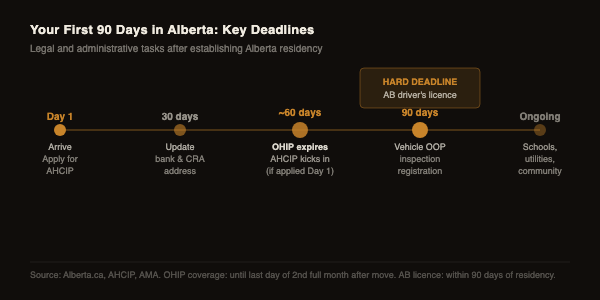
Alberta Health Care Insurance Plan (AHCIP) has a three-month waiting period from when you establish residency. That means the single most time-sensitive thing you can do on day one is apply. Go to alberta.ca/ahcip or call Service Alberta and get your application in. Your OHIP coverage protects you until the last day of the second full month after you moved, so the timing is tight but manageable if you apply immediately.
Example: if you move on June 1, OHIP covers you through July 31. Your AHCIP kicks in August 1, which is exactly three months from June 1. If you wait even a week to apply, you have a gap. Don't wait.
On the same day or within the first few days, update your address with the Canada Revenue Agency at canada.ca. This affects your tax returns, benefit payments (GST/HST credit, CCB, RRSP room calculations), and any provincial tax credits you're entitled to. Alberta tax rates are different from Ontario's and the CRA needs your current province of residence on file.
AHCIP requires a 3-month waiting period from the date Alberta residency is established. Ontario's OHIP covers a departing resident until the last day of the second full month after they leave. This creates a tight but workable overlap that only holds if the AHCIP application is filed on arrival day. Applying after the first week creates a gap in provincial health coverage. (Alberta.ca / OHIP.gov, 2026)
The First 30 Days: Admin, Finance, and Vehicle
Bank and financial accounts
Update your address at your bank and with any investment accounts you hold. If you have a TFSA, RRSP, FHSA, or LIRA, your financial institution tracks your province of residence for contribution limit and tax reporting purposes. This one takes 10 minutes online and most people forget it for months.
Out-of-province vehicle inspection
Your Ontario-registered vehicle needs an out-of-province vehicle inspection before you can register it in Alberta. This is a mechanical safety inspection performed by an Alberta-licensed inspection facility. It's not a pass/fail emissions test like Ontario has, it's a safety check. Book this in your first two weeks. Once it passes, you take the inspection certificate to a registry agent, pay the registration fee, and get Alberta plates. Budget $100 to $175 for the inspection itself.
One note: you can keep driving on your Ontario registration for a reasonable period while you complete this process. But don't leave it until week 10. Book it early, get it done, and you're registered before the 90-day window is anywhere near closing.
Utilities and address forwarding
Set up your Alberta utilities (ENMAX or your local provider for electricity, ATCO or direct gas for natural gas if applicable) and run address changes through Canada Post forwarding. Your mail from Ontario will take 3 to 6 weeks to fully redirect. Don't miss bills during that window. Put a calendar reminder to check your Ontario address with your bank statements online for the first two months.
The Hard Deadline: Your Alberta Driver's Licence (By Day 90)
This is the one with the hard deadline, and it's a real deadline, not a suggestion. You must exchange your Ontario driver's licence for an Alberta one within 90 days of establishing residency in Alberta. Even if you travel back to Ontario during that period, the 90-day clock keeps running from the date you established Alberta residency (AMA, 2026).
The good news: there's no road test. Ontario driving history transfers directly. Here's what to bring to a registry agent:
- →Your current Ontario driver's licence (you surrender it)
- →Proof of Alberta residency dated within the last 90 days (lease agreement, utility bill, bank statement with Alberta address)
- →Proof of Canadian residency (birth certificate or passport)
- →You'll take a vision test and have a new photo taken. Your new licence is mailed to your Alberta address.
Find your nearest registry agent through alberta.ca. They're in most communities and many shopping plazas. Don't go to a Service Alberta centre by accident, the registry agent is who does licences. Allow 30 minutes. Most appointments can be done as a walk-in, though some locations prefer bookings.
New Alberta residents must exchange their out-of-province driver's licence within 90 days of establishing residency, regardless of travel back to the original province during that period. Ontario driving history transfers without a road test. Required documents: current Ontario licence (surrendered), proof of Alberta residency dated within 90 days, and proof of Canadian residency. The new licence is mailed after a vision test and photo at any Alberta registry agent. (AMA / Alberta.ca, 2026)
After the 90-Day Window: What You Should Know

Once you're past the 90-day deadline sprint, a few things remain worth getting right. Children's school registration is the most time-sensitive if you're moving mid-year. Edmonton Public Schools and Edmonton Catholic Schools both have online registration portals. Call the school directly if you need placement mid-semester, they handle this regularly and there's a process.
One thing Ontario buyers underestimate: Alberta doesn't have a provincial sales tax. This shows up most clearly the first time you buy something significant, furniture for the new place, appliances, a vehicle. You pay 5% GST and that's it. After years of 13% HST in Ontario, that adjustment feels significant. Budget and spend accordingly.
On the other hand, Alberta does have provincial income tax, so don't make the mistake of thinking the province is tax-free. The provincial income tax rate is generally lower than Ontario's at most income levels, but it exists. If you're self-employed or have significant investment income, talk to an Alberta accountant in your first year to make sure your withholdings are set up correctly for the new province.
Neighbourhood orientation
Edmonton is bigger geographically than most Ontario cities and the neighbourhoods vary meaningfully. If you bought in southwest Edmonton (Windermere, Terwillegar, Glenridding) you're in a newer, family-oriented suburban zone with most amenities nearby. If you bought in Sherwood Park you've got one of the most livable small-city environments in Alberta. The west end (Spruce Grove, Stony Plain corridor) is more established suburban with a different pace.
Give yourself two or three weekends to just drive around. Edmonton spreads out in ways that take time to learn, and once you know the ring road system (Henday, Whitemud, Yellowhead), getting around becomes intuitive fast.
Planning a Move to Edmonton?
Start with the Edmonton Buyer's Guide
Free breakdown of the buying process, neighbourhood overviews, and the numbers Ontario buyers need before they start their search.
Get the Free GuideFrequently Asked Questions
How long does OHIP cover you after moving to Alberta?
OHIP covers you until the last day of the second full month after you establish Alberta residency. If you move June 1, OHIP covers you through July 31. Alberta's AHCIP kicks in after its 3-month waiting period, so applying on arrival day ensures the two timelines match with no gap.
Do I need a road test to exchange my Ontario licence in Alberta?
No. Ontario driving history transfers directly. You'll take a vision test and have a new photo taken at a registry agent. Bring your Ontario licence (you surrender it), proof of Alberta residency dated within 90 days, and proof of Canadian residency. The new Alberta licence is mailed to your address.
What is an out-of-province vehicle inspection in Alberta?
It's a mandatory safety inspection your Ontario-registered vehicle must pass before you can register it in Alberta. It's performed by an Alberta-licensed inspection facility and typically costs $100–$175. Once the vehicle passes, take the inspection certificate to a registry agent to complete registration and get Alberta plates.
Does Alberta have a land transfer tax?
No. Alberta has no provincial land transfer tax. Ontario buyers relocating to Edmonton save tens of thousands compared to buying in Toronto, which charges both provincial and municipal land transfer tax. On a $700,000 Edmonton purchase, that savings is approximately $20,000–$25,000 compared to a Toronto equivalent.
Does Alberta have provincial income tax?
Yes. Alberta has provincial income tax. What it doesn't have is a provincial sales tax (PST). Only 5% GST applies on purchases in Alberta. Never confuse the two. Alberta's income tax rates are generally lower than Ontario's at most income levels, but the province is not tax-free.
Keep Reading
Categories
Recent Posts