Edmonton Housing Market Cooldown: July 2026 Update
Homes with Tristan: Market Update
Edmonton's Housing Market Just Hit All Six Cooldown Signals
By Tristan Boire, REALTOR | Park Realty, Sherwood Park AB | August 15, 2026
There's a pattern housing markets follow right before they shift toward buyers, and it plays out in six stages, almost always in the same order: sales slow down, homes sit longer, inventory builds, the balance loosens, price growth stalls, and prices start to ease. As of July 2026, Edmonton has checked every one of those boxes, according to the REALTORS® Association of Edmonton's (RAE) July statistics package.
I'm Tristan, a REALTOR with Park Realty here in Edmonton, Alberta, and every month I break down what's actually happening in this market instead of repeating whatever headline gets the most clicks. Six-for-six sounds dramatic, and it is a real shift. But it doesn't mean the same thing in every price band and every part of this city, and that's the part most coverage skips.
Key Takeaways
- • GEA home sales fell to 2,535 in July, down 7.6% from June and 11% from July 2025 (REALTORS® Association of Edmonton).
- • Average residential price dropped to $475,079, down 1.8% month-over-month, while the composite benchmark price held at $429,100, essentially flat year-over-year.
- • Active listings climbed to 8,142, up almost 18% year-over-year, pushing months of supply to 3.7 in the City of Edmonton itself.
- • The $300K-$400K detached segment and homes above $650K are moving in opposite directions right now. This isn't a uniform cooldown.
The Six-Stage Pattern Behind Every Market Shift
Housing markets don't flip from a seller's market to a buyer's market overnight. Watching Edmonton's numbers month over month, the shift tends to show up in a specific order: sales slow first, then days on market rise, then inventory builds, then the balance shifts, then price growth slows, and finally prices ease. Edmonton hit all six in July.
I track this progression every month because it tells you where you are in the cycle before the average price number catches up and confirms it. By the time prices are visibly falling, the shift already happened months earlier in the sales and inventory data.
Every Box, Checked: What July's Numbers Actually Show
Edmonton's July numbers hit all six cooldown markers at once (REALTORS® Association of Edmonton, July 2026). GEA sales came in at 2,535, down 7.6% from June and down 11% from July 2025. The average sale took 39 days, up three days from June and six days from a year ago.
| Stage | July 2026 | Change |
|---|---|---|
| 1. Sales slow | 2,535 GEA sales | -7.6% MoM, -11% YoY |
| 2. Days on market rise | 39 days | +3 days MoM, +6 days YoY |
| 3. Inventory builds | 8,142 active listings | +17.8% YoY |
| 4. Balance loosens | 3.2 mo. supply GEA / 3.7 mo. City of Edmonton | Toward balanced |
| 5. Price growth slows | $475,079 average price | -1.8% MoM |
| 6. Prices ease | $429,100 composite benchmark | Flat YoY, down slightly MoM |
Darlene Reid, this year's board chair with the REALTORS® Association of Edmonton, points to the usual seasonal pattern behind the July numbers: the spring rush fading into a quieter summer, with activity unlikely to return to spring-level pace for the rest of the year (REALTORS® Association of Edmonton, July 2026).
In my opinion, the 3.7 months-of-supply number for the City of Edmonton itself matters more than the 3.2 GEA figure. It isn't diluted by Sherwood Park, St. Albert, or the acreage market outside city limits, so it's the cleanest read on where Edmonton proper actually sits right now.
Six stages, six boxes checked. I don't think it's that simple, and the rest of this breakdown is why.

The Real Story Is by Property Type, Not the Average
The average price number hides more than it shows. Detached homes averaged $585,726 in July, still up 1.2% year-over-year, while apartment condos fell into a much rougher stretch with sales down more than 21% year-over-year (REALTORS® Association of Edmonton, July 2026).
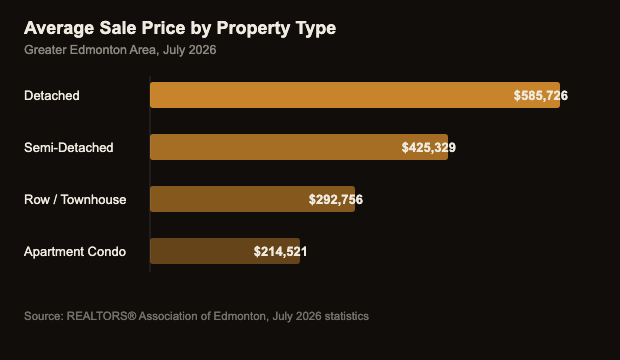
Detached is cooling from a position of real strength. It's down 1.3% from June, but that's a pullback from a genuinely hot spring, not a collapse. Semi-detached homes averaged $425,329, down 2.1% month-over-month and about 1% below last July. Row and townhouse product averaged $292,756, down 3.5% on the month, and it posted the steepest year-over-year drop in units sold of any category, close to 17%.
Apartment condos are the outlier. The average price is actually up roughly 2.4% year-over-year to $214,521, but sales volume fell more than 21% year-over-year, and the segment is sitting 55 to 56 days on market on average, up from 46 to 47 days a year ago.
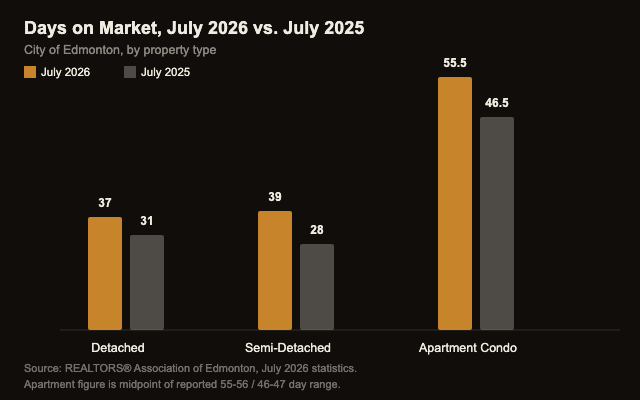
Detached homes in the City of Edmonton took 37 days to sell in July, up from 30 to 31 days last year. Semi-detached homes took 39 days, up from 28. The condo and townhouse segments are dragging the citywide averages down on volume even where price is holding up. Detached is cooling from a much stronger starting point than the headline number suggests.
Apartment condos moved toward buyer's-market conditions faster than any other property type in Edmonton this summer, driven by new-construction inventory finishing at the same time demand from BC and Ontario relocators softened (REALTORS® Association of Edmonton, July 2026).
Is This Actually a Buyer's Market? Not Everywhere.
Not yet, and not evenly. One Edmonton outlet put it well this month: Edmonton isn't into a buyer's market yet, it's slowly transitioning there. I agree, and the transition looks completely different depending on price point.
Detached homes in the $300K to $400K range are still moving fast enough that I'd call that band a seller's market on its own. I'm saving the full breakdown on exactly how fast for my next update on August 28, because that number deserves its own explanation rather than a one-line mention here. Above roughly $650K, the shift has genuinely gone the other way. Buyers in that range have real negotiating room they didn't have back in the spring.
This is the piece that gets lost when a market update gets boiled down to one headline. Edmonton in July 2026 isn't one market. It's at least three: an entry-level segment that's still competitive, a broad middle that's genuinely cooling, and a luxury tier where buyers finally have the upper hand.
What's Actually Dragging Days on Market Up
Part of the jump in days on market this summer isn't about demand at all. It's about water. Edmonton and the wider GEA saw record rainfall this summer, and I've watched it show up directly in showings.
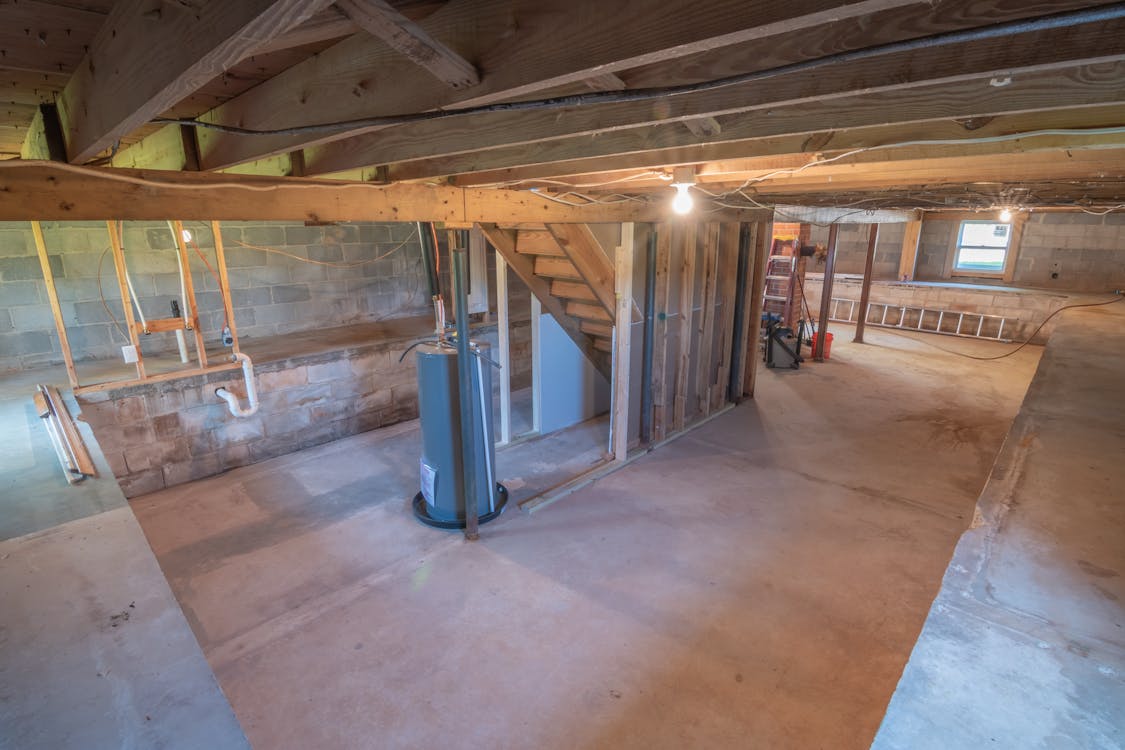
In the past month alone, I've walked into two showings with visible mold that never showed up in the listing photos. I've had three showings cancelled outright because the seller disclosed moisture issues before we even got in the door. And I've smelled that unmistakable musty basement odor in two more listings that were otherwise perfectly staged.
Move-in-ready homes with dry basements are still moving at a normal pace in this market. It's the "as-is" inventory with real or suspected moisture damage that's sitting for weeks and dragging the citywide days-on-market average up. If you're touring homes right now, ask directly about basement moisture history. Don't rely on the listing photos to tell you.
The Buyer Confidence Problem No One's Talking About
Some of the slowdown showing up in the data isn't softening demand. It's buyers getting cold feet after the offer is already accepted. I've seen it happen twice in the past few months, once on my own deal.
One of my clients ended up securing a half duplex because the original accepted buyers never actually submitted their deposit. They never made it to the due diligence period. They got cold feet and walked away before the condition period even started. A colleague of mine had nearly the identical thing happen on a different deal around the same time.
In my opinion, this is happening at a bigger scale than the official numbers reflect, and it's part of why days on market and re-listings are climbing separately from any real softening in demand. A property that gets re-listed after a buyer walks looks like a slow-moving listing in the data, even though genuine buyer interest was there the whole time.
Here's another pattern worth understanding: average prices are often still positive year-over-year while median prices are down, and that gap usually means more activity is happening at the higher end, pulling the average up, while typical middle-of-market transactions are the ones actually softening.
In my own listings this summer, mostly in the lower and middle price bands, prices have been flat to slightly softer year-over-year. But they're still moving quickly when a home is priced right and shown well. Pricing strategy matters more in a market like this than it did a year ago.
What's Happening in Edmonton's Rental Market
Edmonton's rental market moved in two different directions in July. Active rental listings jumped over 46% month-over-month and almost 29% year-over-year, but one-bedroom and two-bedroom units told completely different stories on price.

One-bedroom units averaged $1,392 in July, up almost 33% from June and well above the long-term average of $1,207. Two-bedroom units actually came down to $1,614, about 8% below June and below the long-term average of $1,725.
My take: there's intense demand right now for smaller, more affordable rentals, largely from people priced out of buying or choosing to wait out the cooldown before committing to a purchase. Bigger units are getting some relief as that demand concentrates on the smaller end of the market.
This ties directly into the buy-versus-rent conversation I have with clients constantly. At today's prices, ownership can still be the more predictable long-term option once you actually run the numbers, especially with rent on smaller units climbing this fast. It's worth doing that math before assuming renting is the safer move.
Free Download
Get the Edmonton Market Cooldown Checklist
A short, practical checklist covering what to check before you buy or list in a shifting market, from basement moisture questions to reading days-on-market by price band.
Download the ChecklistFrequently Asked Questions
Is Edmonton in a buyer's market as of August 2026?
Not fully. GEA months of supply sat at 3.2 in July, with the City of Edmonton at 3.7 (REALTORS® Association of Edmonton, July 2026). That's a real shift toward balance, but the $300K-$400K detached segment is still moving fast enough to favor sellers, while homes above $650K have genuinely tipped toward buyers.
Why did Edmonton home sales drop in July 2026?
GEA sales fell to 2,535 in July, down 7.6% from June and 11% from July 2025 (REALTORS® Association of Edmonton, July 2026). Part of it is normal seasonal cooling after spring, and part of it is buyers walking away after an accepted offer instead of following through to possession.
Are Edmonton home prices actually falling?
The average residential price dropped 1.8% month-over-month to $475,079 in July, while the composite benchmark price held roughly flat year-over-year at $429,100 (REALTORS® Association of Edmonton, July 2026). Detached prices are still up 1.2% year-over-year; apartment condos are the softest segment on volume.
Why is basement moisture causing Edmonton homes to sit unsold?
Record rainfall across Greater Edmonton this summer has made basement moisture a bigger factor in days on market than usual. Move-in-ready, dry-basement homes are still selling at a normal pace, while listings with disclosed or suspected moisture issues are sitting significantly longer.
Is it a good time to sell in Edmonton right now?
It depends heavily on price band and property type. Detached homes under $400K are still moving quickly, while listings above $650K face more buyer negotiating room. Pricing accurately for your specific segment matters more in August 2026 than it did during the spring market.
This is a real shift, not an overreaction to one slow month. But it's not a uniform, market-wide cooldown either, and treating it like one is the fastest way to misprice a listing or miss a good deal as a buyer. The market rewards whoever actually understands which part of it they're standing in. In two weeks, on August 28, I'll walk through exactly what I'd buy in Edmonton right now, segment by segment, including the full $300K-$400K numbers I held back here.
Categories
Recent Posts